
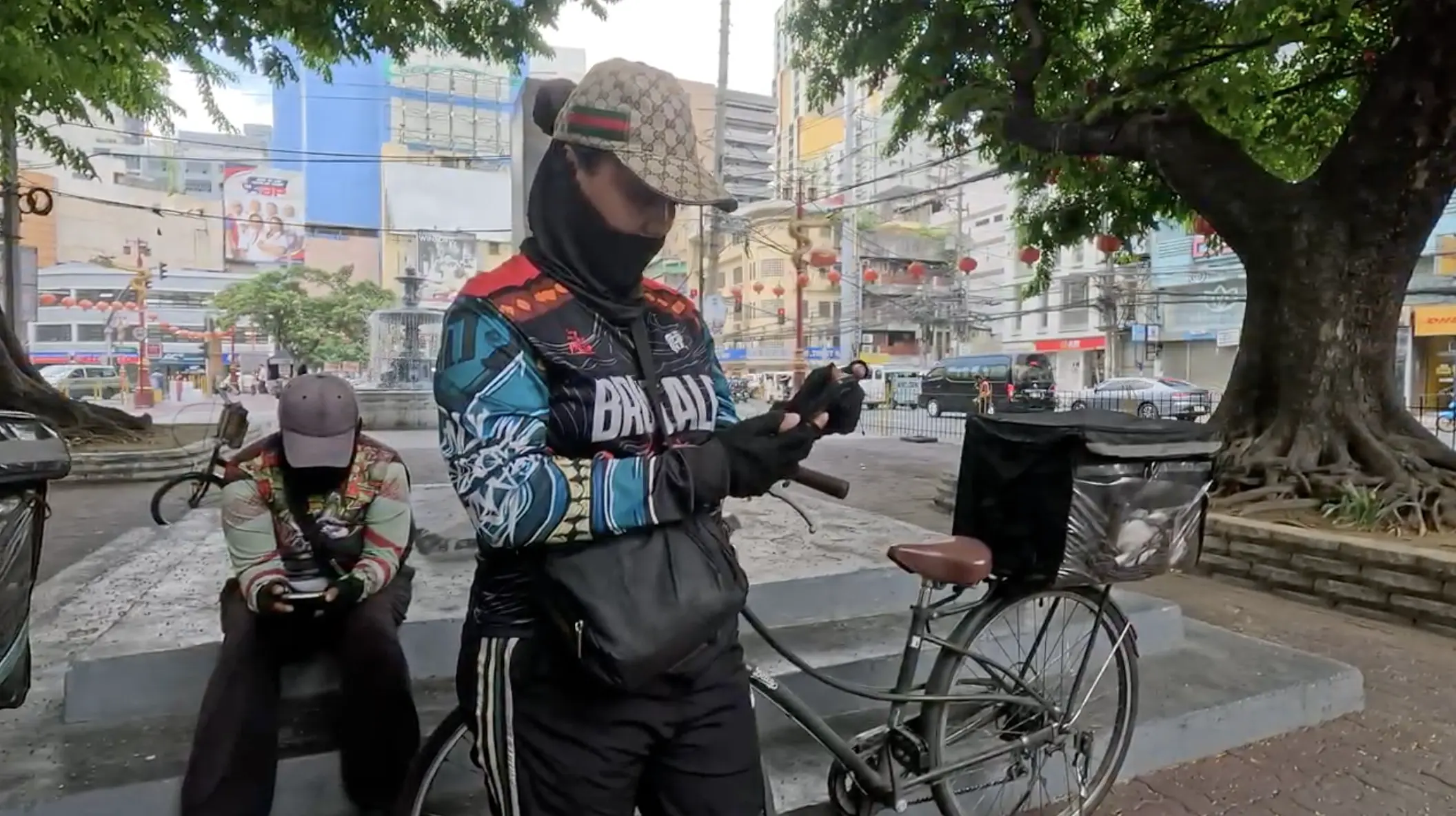

Even in February, when Genevieve started making vlogs to document her life as a mother and a rider, and when the last of the rains of the amihan season fell, she complained of the intense heat starting early in the morning.
According to the state weather bureau PAGASA, summer started on March 21. Yet, the agency has been alerting about dangerous heat index levels, from 41°C, as early as the first week of March.
For Genevieve and other riders of food, parcel delivery, or ride-hailing platforms, letting the intense heat pass can take a few minutes up to four hours.
“Even in the shade, the heat is painful. The steam from the helmet is hot. It is difficult to work because it is so hot,” shared Yen, 33, a food delivery rider from Valenzuela City.
Despite spending 10 hours outdoors, Yen shared that she had to stop for two to three hours to let the heat pass. Due to the extreme heat, she lost P200 to P300 for pausing work.
Jocelyn, 33, a food delivery rider from Parañaque, said she is forced to stop working at lunch hours due to the intense heat.
“When it’s too hot, we rest, we wait a few hours to beat the heat, but our income will be reduced. My rest is from 12-2 pm, when the heat is sweltering,” she said.
Lalyn, 37, a motorcycle rider from Quezon City, shared that she stops taking bookings from 11 am to 3 pm when it’s too hot. This usually occurs in the summer months, specifically April and May.
“It’s so hot at 11 am. My body can’t handle it, and my nose is bleeding from the heat. Even if I wash my face or drink water, I can’t handle it. What more if I’m driving with a passenger?” said Lalyn.
Besides the heat effects on the rider, food deliveries also suffer from traveling under hot conditions.
“I had a booking to deliver a cake from Taguig to Novaliches. That’s a 30-km drive. It was summer. The cake melted,” shared Marivic Jacinto, 41, now a motorcycle taxi rider.
She wasn’t asked to pay for the cake and could only offer the receiver a photo of its original appearance for consolation.
All the women partner-riders Manila Today interviewed agreed that weather conditions–heat or rain–impact their livelihood.
Drive for flexibility leads to vulnerability to heat-related illnesses
“I still work even when it’s hot, as long as the booking is good,” said Anna, 35, a motorcycle driver from Quezon City.
A good booking to the riders is one that offers a just fare over a reasonable distance without heavy traffic and long waiting time (or allows for fast completion).
University of the Philippines Resilience Institute Executive Director Dr. Mahar Lagmay said platform riders are vulnerable to climate change effects and heat-related illnesses because the nature of their work is that they are under the sun.
“That’s what we mean by vulnerability. You can’t do anything because that’s who you are, you can’t change your job, so you’re vulnerable to that condition,” said Dr. Lagmay.
Anna, a full-time platform rider, thought she might not last long in the job due to platform-imposed lower fare rates over time and her body giving in to fatigue. One time, her menstruation did not stop for a month and she had to shoulder all her medical expenses. She has developed body pains from prolonged exposure to heat and rain that makes it difficult for her to work.
The women platform riders Manila Today interviewed also shared experiencing some of these symptoms while working during intense heat: shortness of breath, eye irritation, nosebleeds, headaches, sunburn, melasma, dizziness, exhaustion or feeling weak, and dehydration.
While none of them have experienced collapsing due to the heat, they have heard that it often happens with many platform riders, especially during summer.
Meanwhile, the riders have varying personal practices for mitigating the effects of intense heat.
A common practice is to bring water, drink lots of water, and wear a head cover.
They also cover their arms and legs to prevent sunburn. Though being all covered up restricts ventilation, most riders think it’s a better option than being sunburnt and feeling the heat and fast, hot wind blowing against the skin, especially the face.
Sometimes, the only remedy to the heat is to go home and cease working for the day.
During summer, Lalyn experienced dizziness twice a week and a nosebleed at least once a month.
“I often feel dizzy from the heat. I won’t work anymore. I’ll go home and rest,” she said.
This is the same for Genevieve. When her headache from the extreme heat does not subside, Genevieve decides to go home and end her work day. This gives her more time for childcare and house chores.
Promise of flexibility
Genevieve used to work as a security guard but had to stop when she had her third child. Her husband’s earnings could barely tide them over, so now that her youngest daughter is six, she looked for work again. She applied to the food delivery platform when there was a call for lady riders on bikes in October 2024. Thanks to flexible work hours, she thought she could care for her three children while working on the platform. Their savings could only afford her a bicycle then, so everything fell into place.
She fetches her youngest child from preschool at noon, eats lunch with her, and sends her home before resuming work. She then fetches her second child at 4 pm, then eats snacks with her two daughters. That is when her work day usually ends. She does not have time to take more food delivery bookings before she needs to pick up her eldest child at around 6 pm. Then they all go home together, and Genevieve prepares their dinner.
Like Genevieve, Lalyn could only work jobs that would still allow her to care for her children. When her kids were younger, she worked two to three days a week as an office liaison before becoming a motorcycle taxi rider. Lalyn is a single parent to three now-teenagers.
Lalyn said, “I can earn P1,000 from 5 am to 3 pm. I still have quality time with my children. I can attend their school programs.”
Anna said she cannot find another work that will allow her to juggle child care duties.
“If I were to find another work, it would be one where I can still control my time,” said the mother of two.
Marivic said working for a platform or mobile application means they also have control over not working during the hottest hours.
Marivic works from 11 pm to 5 am to avoid the heat and traffic in Metro Manila, which are now reaching extremes. If bookings are slow, she would extend her hours until 6 am or 7 am to reach her daily target of P1,000.

As the president of her platform riders’ group in Taguig, she advises her members to continue working as long as there are bookings, even when it’s hot. She shared that bookings are slow in many situations, such as specific areas in the metro, certain times of day, days with no classes, or holidays.
No ride, no money,” she stressed.
In contrast, the holiday season in December is the peak month for motorcycle taxi riders. She said they could earn double, or P2,000, in 10 hours or less.
“It’s not always Christmas, you’ll have lots of slow days,” she nudged.
Edna Belga, 44, a motorcycle taxi driver from Mandaluyong, works from 1 pm onwards due to her health.
She recently underwent surgery to remove stones from her gall bladder. From time to time, she has stomach pain in the morning. Due to this, she settled to work from 1 pm onwards, covering some of the hottest hours of the day.
“Even though it’s hot, I take bookings because I have a target income,” she said.
Her target income is P2,000 per day in nine hours of work. In reality, she could only earn P900 to P1,000 in said duration. To earn more, she continues to work beyond nine hours until she feels sleepy, and has to go home.
Edna worked as a lending collector for 20 years. However, as a single parent to three, her daily wage of P300 was insufficient.
A platform rider for six years now, Edna said the toughest parts of the job are the extreme heat, fatigue, thirst, and traffic. However, she is not looking to switch jobs soon and plans to work as a platform rider until she retires.
“I prefer this job, I control my own time,” she said.
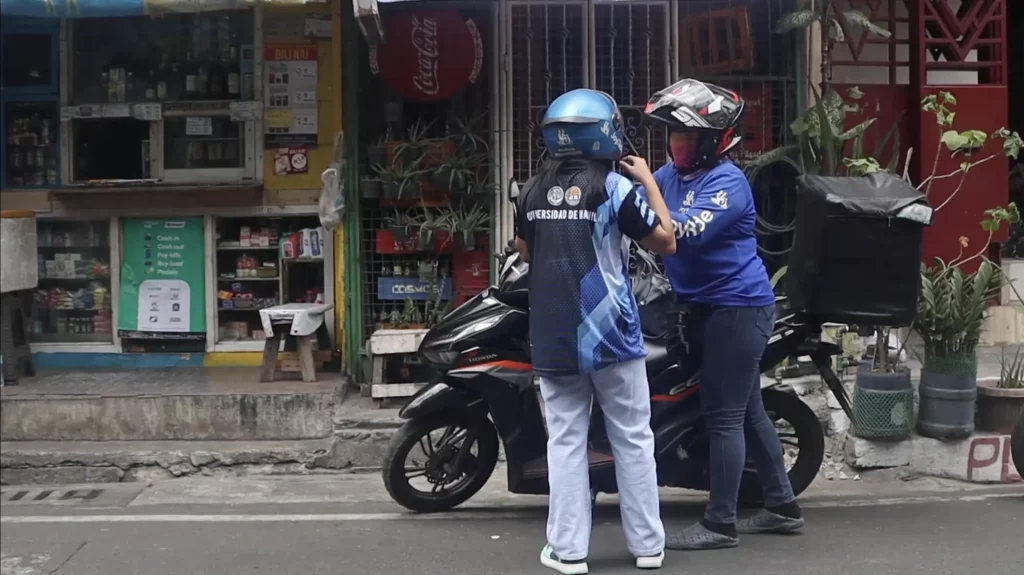
Maricar Puno, 32, a motorcycle taxi rider, lives in North Caloocan but works as an elementary public school teacher in Pasay. She hopped on a motorcycle because her 36 km daily commute cost P200. She became a platform rider to earn extra money on the long way to work or home.
She likes that the platform doesn’t dictate where or when she needs to work. She takes around five short ride bookings from 9 a.m. to 11 a.m. on her way to school, where she has to be by noon.
However, the Fairwork Philippines Ratings 2022 study challenges the notion that riders or drivers control their time in gig work.
“There is no flexibility if the rider or driver is forced to work during peak hours for incentives, spend up to 16 hours on the road, and follow a batching system and variable kilometer rates to earn enough,” said Fairwork Philippines in its pamphlet.
Only four of the nine platforms surveyed earned a positive score. GrabCar and GrabFood/GrabExpress ranked highest, getting three out of 10 possible points. Angkas and Lalamove each got two, while Foodpanda, Joyride, and four others did not get any. The point system assigns two points each for standards of fair pay, conditions, contracts, management, and representation.
Despite flexible work hours, the riders have to work longer than the regular eight-hour workday to match or surpass the earnings of minimum wage workers.

Potential to earn above minimum wage
The potential to earn above the minimum wage or a set monthly wage or salary is another appeal of working in the platform economy.
“It’s up to you how much you will earn,” Jocelyn raved.
Working for 10 hours, she could earn up to P1,500. Her net income is around P1,100, including the tips she got.
Yen accepts food delivery bookings from 12 pm until 10 pm. In 10 hours of work, she could make approximately 20 deliveries and earn around PHP 1,200. After deducting gas and food expenses, her take-home income would amount to P800 to P900.
Lalyn said her usual work hours are from 5 am to 9 pm, translating to 16 hours of driving on the road to complete 25 rides. Her net income working for that long is usually P1,000.
“Now, it’s hard to earn P1,000 in 12 to 15 hours,” said Anna.
She started as a delivery courier rider in 2017 and switched to motorcycle taxi in 2022. She shared she used to earn P2,000 to P3,000 working for 12 hours. Now, she works from 1pm to 1am and regularly earns P1,000, sometimes up to P1,300. Deducting the 20% app commission rate and P200 for a full tank gas would leave her with P600.
The minimum wage for non-agricultural workers in the National Capital Region (NCR) is P645 per day, effective July 17, 2024.
Fairwork Philippines could not find evidence to determine whether the nine platforms they surveyed could ensure workers earn at least the daily minimum wage after accounting for work-related costs.
“Since the rider or driver is responsible for the operating costs, such as app commission, gas, load and data, and even vehicle insurance, this must be included in the computation of the driver’s income. Will the net income amount to more than the minimum wage?” asked Fairwork Philippines.
Most platform riders interviewed deduct only gas and food expenses from their daily earnings to derive their net income. Deducting load, data, and a portion of the cost of acquiring their vehicle and maintenance costs could drive their bottom line below the daily minimum wage.
Research think tank Ibon furthered that the mandated minimum wage falls way below the P1,222 per day a family of five needs to live decently (as of March 2025), or the family living wage.
If the riders barely meet the minimum wage, they fall short of the family living wage by a significant margin, despite working 10 hours or more.
Rains and floods displace heat woes during wet season
“Rain or shine, you need to work when you want to earn money,” said Lalyn.
Food delivery and ride-hailing riders have their pros and cons when it comes to working in the rain.
Jocelyn shares her earnings double when it’s rainy. In eight hours, she can earn P1,200 in 17 to 18 deliveries.
“I still work when it’s raining because there are more food delivery bookings. More people can’t go out,” shared Jocelyn.
“When it’s raining, it’s also raining tips,” enthused Yen.
Despite more tips, she still prefers to work when the sun is out, when it’s less risky to traverse the roads.
Another downside is that rains make it difficult for riders to handle food deliveries packed in paper in cities where plastic bans are in effect. She would provide her packaging to keep food orders from getting wet.
Marivic shifts to her food delivery roots when it’s raining.
“I switch to [food delivery] when it rains so that my passenger and I don’t have to wear raincoats because it’s a hassle to put on and take off every trip,” shared Marivic.
However, she said it’s best not to risk submerging the motorcycle in the flood, as repairs will cost the rider more than their projected income loss due to the rains and floods.
Bike riders like Genevieve stop working altogether when it’s raining.
“When it rains, I stop driving because the roads are slippery. I can’t see the road very well. When I enter the mall wet, I feel cold and could get sick. That’s why I will just let the rain pass,” she said.
Meanwhile, intense rains, floods, or typhoons during the wet season could render platform riders unable to work for days, sometimes a whole week.