
(CONTENT WARNING: This report contains images and footage of violence, police brutality, and blood)
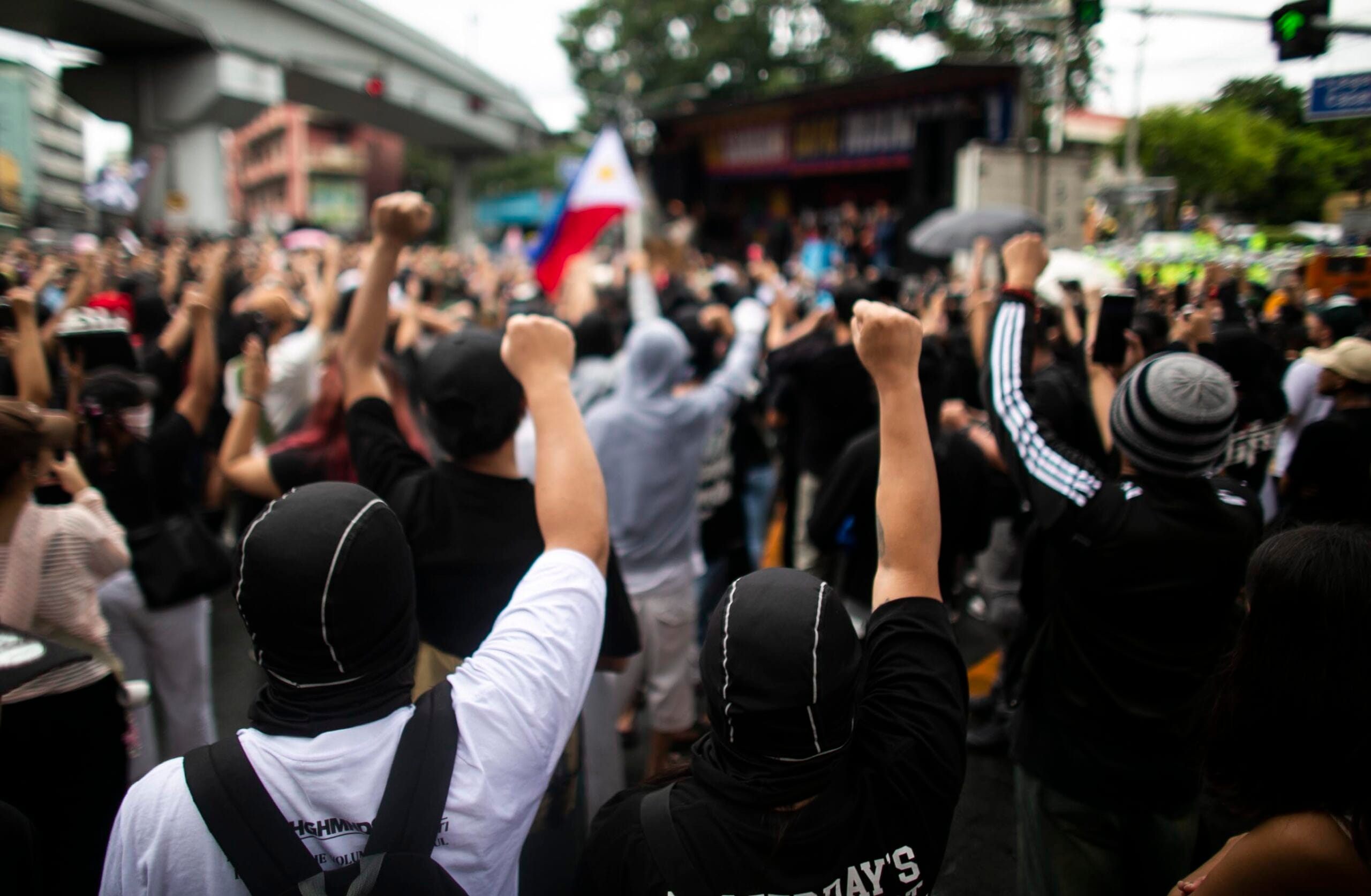
In many ways, the day began in historic fashion. In Luneta, by 10 in the morning, emcees announced that the crowd was approaching 80,000, gathered mostly along Bonifacio Drive/Roxas Boulevard, that long stretch of concrete that cuts through the national park and is considered the country’s “Kilometer Zero.”
The Jose Rizal monument stood on look-out at the crowd along Kilometer Zero, but also in the many shades and spaces that may be occupied by people. It was a diverse crowd that included groups of youths in black shirts and ski masks. At around 10 AM, I chanced upon youths like them along Kalaw Avenue, selling black ski masks. Among the sea of people at Kilometer Zero, the kids were great blotches of black in the crowd, intently listening to speakers, unfurling banners and “One Piece” streamers and flags, with one youth protester or two carrying black flags with the anarchist “A” symbol.
At around 10:30 AM, navigating my way toward the front of the stage, I chanced upon another group of youths in similar garb negotiating their way inside the cordoned area behind, in front, and on the side of the stage, claiming they were part of the program—or part of the party of hip-hop performers. They were quiet and respectful, and did not insist when asked to leave.
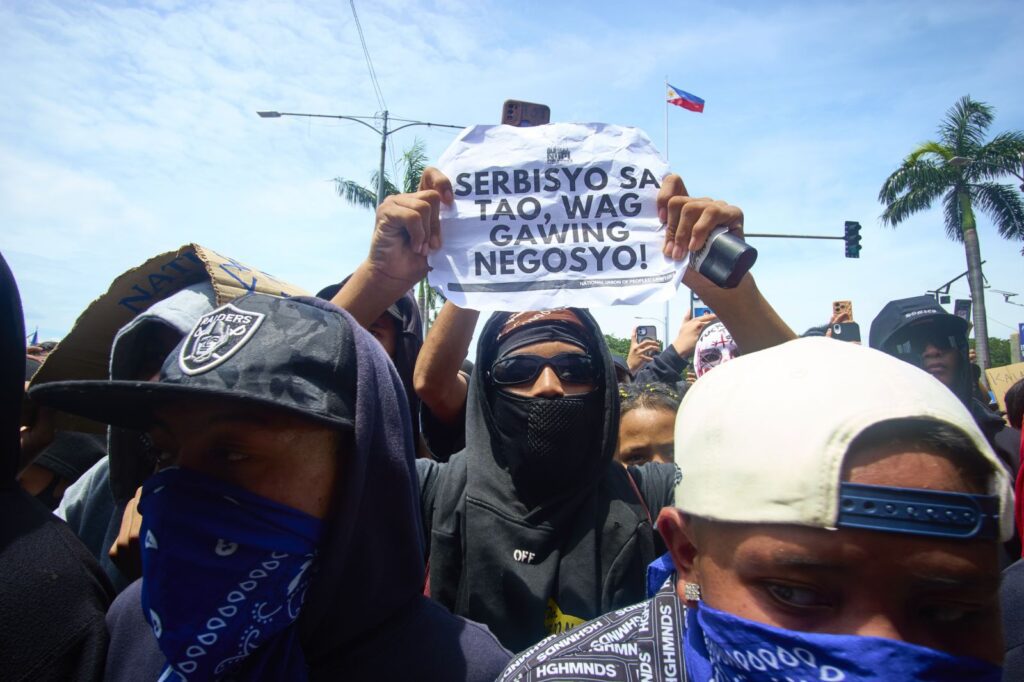
By 1:00 PM, it was possible that despite the sweltering heat of the sun and the threatening winds the crowd had already swelled to 100,000. By that time, the program had wrapped up and marchers—not all of the 100,000, but a sizable amount nevertheless—began formation to march to Mendiola. The mood, for sure, was celebratory.
To organizers, especially the Bagong Alyansang Makabayan (Bayan, New Patriotic Alliance), only a march to the gates of presidential power in Malacañang could top the day’s success. It was to be a peaceful march. A militant assertion of people’s power, a symbolic occupation of that long-contested space that is the Don Chino Roces Bridge (formerly Mendiola Bridge).
It was still a huge crowd of different persuasions that marched through Kalaw, then Taft, until it reached the corner of Taft and United Nations Avenue. By then, a bunch of youths in those black ski masks broke from the main march to advance to Mendiola via a different route. From there, at about 1:40 PM, the story took a turn.
Sharp turn
What follows is a narrative based on interviews with witnesses as well as hundreds of citizen videos, photos and posts published on TikTok, Instagram, Facebook, YouTube, and X. We triangulated the videos, cross-checked some with journalists’ documentation and some of Altermidya’s coverage, and stitched these together to present a clearer picture than what has so far been presented by authorities and media.
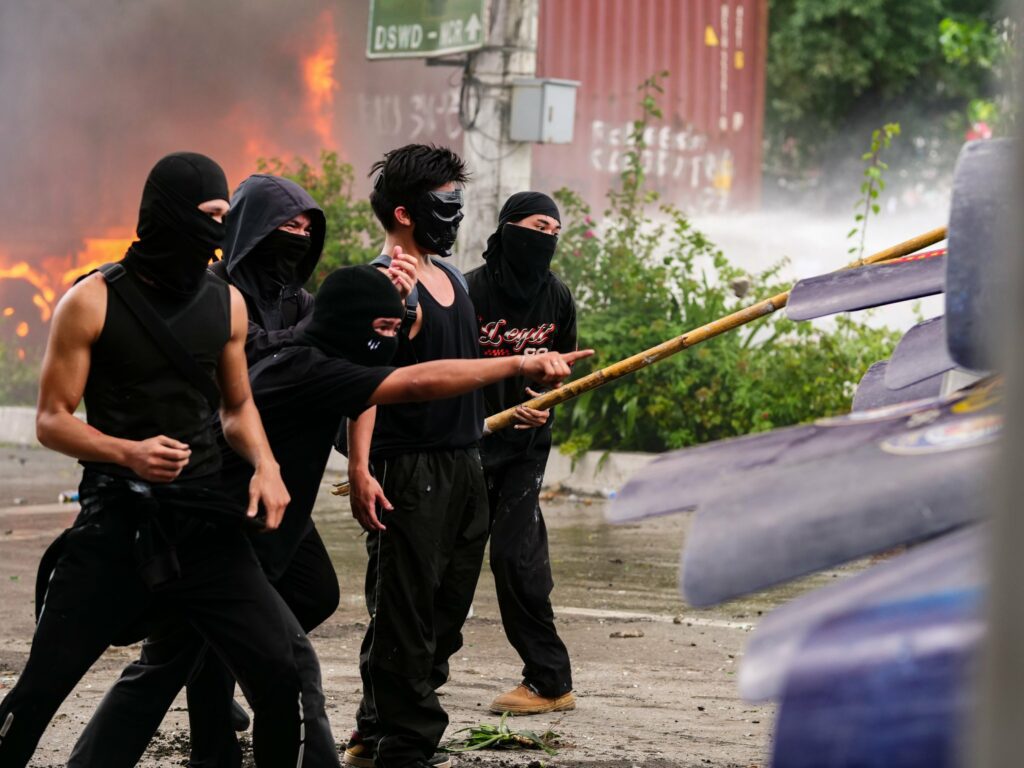
It was reported in broadcast news that the youth protesters were prevented by cops from passing through by a long ten-wheeler barricading UN before Ayala Bridge. It was also reported that these protesters went on to throw rocks at the police, and Molotov cocktails at the wheels of the truck, igniting it and causing a large fire.
Police promptly broke up the protest, arresting some of them, roughing them up and manhandling them, as evidenced by citizen and journalist footage. Those who managed to break free from the police cordon found themselves, eventually, at Recto and Mendiola.
Mendiola, historically a much-contested political space—its concrete road a mute witness to countless skirmishes between militants and cops—was now a site of construction. It had a backhoe, a huge gaping hole in the middle, and layers of concrete barriers, steel railings, and barbed wire. Behind those was a phalanx of riot police, in neon-green traffic jackets over their traditional blue uniforms. Beside the backhoe were water cannons mounted on Bureau of Fire Protection (BFP) fire trucks. Behind them stood the Peace Arch, the outer gate, and another phalanx of cops.
Meanwhile, the main bulk of protesters under Bayan arrived at Mendiola at 3:00 PM, their chants of “Ayan na ang sambayanan!” (“Here come the people!”) signaling an intention, partly to scare, partly to warn would-be dispersers. The short program ended at 3:25 PM, with emcees officially announcing an organized dispersal and directing the crowd to march back to Morayta.
It was almost on cue, after the truck that served as a stage started to maneuver back to Recto and the main crowd began walking back to Morayta, that the group of youth protesters—in garb similar to those at Ayala Bridge—approached the steel railings and promptly began tossing plastic bottles and rocks over the barriers and into the ranks of police, now with their shields raised.
One of those thrown was apparently a projectile that caused a small fire in front of the cops’ shields. The fire was met almost instantly by water cannons from the fire trucks. Smoke came with the water, tear gas apparently being lobbed by police. Some Bayan marshals pleaded for order, but their calls were drowned out by the crowd’s primal roar and by youth protesters darting to evade the blasts of pressurized, putrid water.
Brutal dance
Between 3:40 and 3:50 PM, video footage from journalists showed a brutal dance of push and pull.
On the left side near the Legarda LRT Station, police charged, then retreated under a hail of rocks and bottles. With the center contested between water cannons and protesters, one group focused on charging the left flank, at one time commandeering a tricycle and attempting to ram it into police shields. They managed to surge forward on the left side of the Peace Arch, celebrating the small victory as police were forced to fall back. One man, his face hidden by a mask, stood atop the backhoe, flashing a placard, silhouetted in an almost heroic image against a cloud of smoke and water.
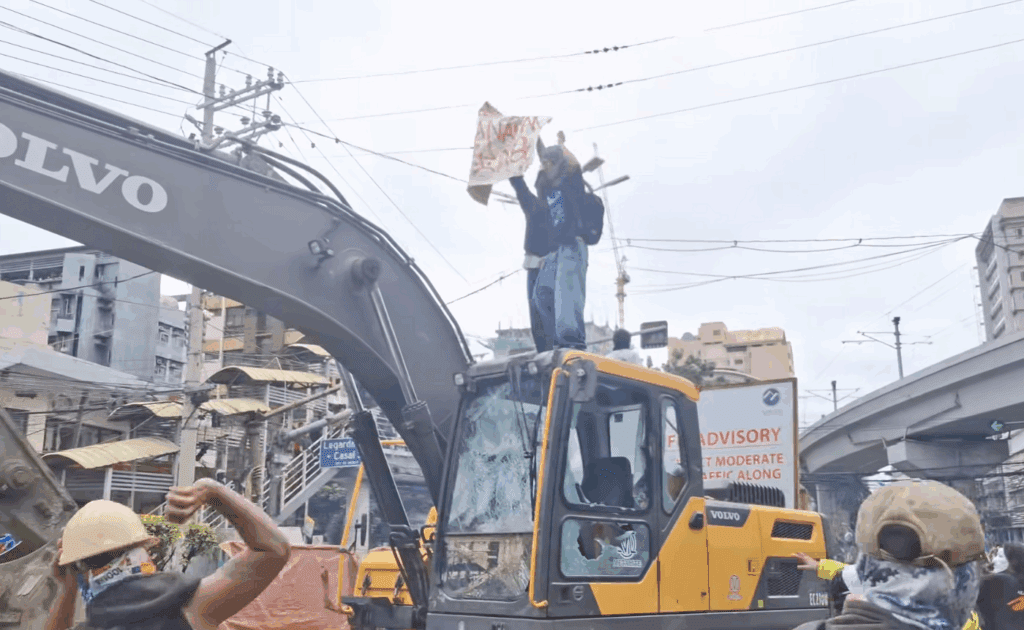
Meanwhile, it was 3:50 in the afternoon, and on the left side—where a Jollibee used to operate—police were also engaged in their own battle against youth protesters. Eventually, a group of cops was unable to retreat with their shields as protesters surrounded them on the corner of Mendiola and Casal Street.
At this point, some protesters stood between both camps and called for a stop to the attacks. “Huwag ninyo idamay ang kapulisan!” (“Don’t attack the police!”) one protester shouted. In what was surely a surprise to the cops, the protesters relented and allowed them to retreat behind the Mendiola gate.
By 3:55 PM, the piercing, high-frequency wail of a Long-Range Acoustic Device (LRAD) cut through the air, but was met only with jeers. But more tear gas followed, and the crowd finally began to break, allowing the police to regain ground. From there, the pursuit began. The mopping-up operation became a hunt. Along Casal Street, photojournalists—including Zedrich Xylak Madrid and Lisa Marie David—captured scenes of police pouncing on protesters, only to be harassed themselves. SWAT teams moved in.
Meanwhile, past 4:00 PM, it was still touch-and-go for both sides. Some protesters fled, while others stood their ground, continuing to hurl objects at police as they retreated toward Recto, Casal, and Legarda. Citizen videos from Recto establishments, including Uncle John’s, showed horrified bystanders as cops charged into crowds of retreating protesters and other bystanders.
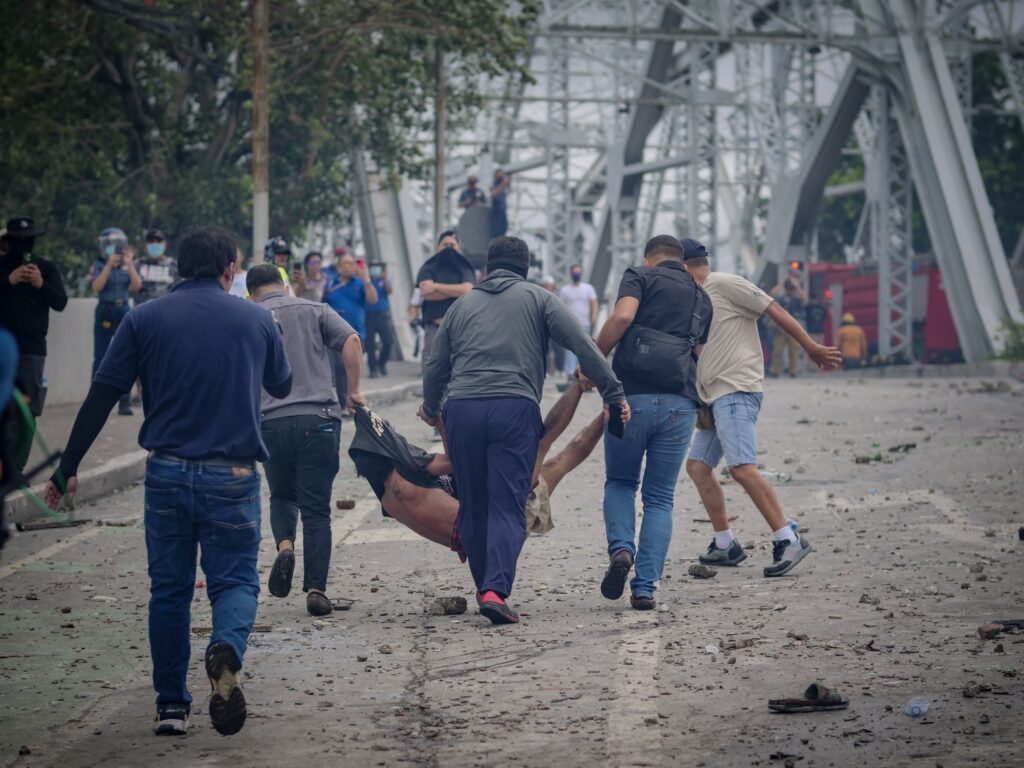
Some unlucky enough to get separated from companions were accosted and promptly beaten. There were reports, too, of random bystanders assaulted.
A separation
Altermidya did a field inspection of Recto Avenue on September 23, two days after the protest, and interviewed vendors and employees along the street.
Invoking anonymity, they recounted how, between 6:30 and 7:00 PM, some retreating protesters managed to seize an NCRPO-marked motorcycle, along with another motorcycle (some witnesses said there were three motorcycles) and set them ablaze in the middle of the street. It was an apparent attempt to create a barrier between themselves and the advancing police. SWAT, by then charging beyond Morayta and nearing Quezon Boulevard, openly brandished long firearms, scaring away vendors and passersby.
One protester, apparently a minor, attempted to seize another NCRPO motorcycle. He may have intended to burn it like the others already set ablaze. In a citizen video, a burly man in a yellow shirt is seen catching up with the youth and stabbing him.
The Facebook page named Police-Big Brother, which reports on police operations in Manila, later posted the video and cut to an interview with Police Lieutenant Colonel Arwen Nacional, commander of the Barbosa Police Station (Station 14 of the Manila Police District). Nacional, who identified himself as the “ground commander” of the Mendiola operation that day, said that night they received a call from the security guard of Jose Reyes Memorial Hospital. A person—a minor—had been rushed there with a stab wound and died.
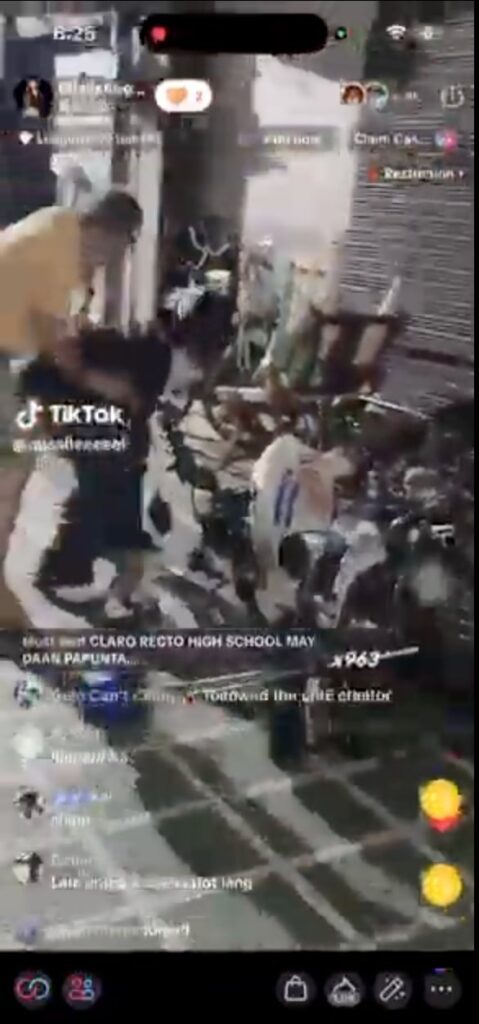
“The next day, we saw the video of the actual stabbing,” Nacional said in Filipino. “Our cops recognized the assailant because he frequented that place, in Access (Computer Center, a building beside SOGO), at the corner of Recto and Roxas Boulevard. We contacted his relatives and he voluntarily surrendered.” The same video claimed the assailant was a small businessman in the area.
Jose Reyes Memorial Hospital, a Department of Health facility, confirmed the next day that a patient with a stab wound had indeed died there on the night of September 21. In all, 48 people were brought to the hospital with various injuries from the Mendiola clashes.
Friends of the slain minor—whom we confirmed hailed from Taguig City—posted anguished tributes on Facebook that night and the following day. One shared a black-and-white photo of the lifeless protester, his face cropped out, with what appeared to be a Jose Reyes medical report placed on his stomach.
As this story was about to be published, Manila Mayor Domagoso held a press conference, past 11:00 AM of September 24. He presented to the media Richard Francisco, 52, a watch technician. Domagoso said that Francisco was only “protecting his property and business” when he used a “case knife” (used for opening watches, the mayor said) to stab the minor. He affirmed Nacional’s statement that after the video was sent to the MPD, the suspect was properly identified and later formally surrendered to the police.

Facebook story of a Taguig resident who was friends with the victim, September 21, 2025
Meanwhile, back at SOGO that same night, September 21, the chaos escalated further. Citizen videos showed at least two men in civilian clothes, believed to be police operatives, brandishing firearms as they rushed into the hotel. Another video showed a SWAT officer holding a civilian—unclear whether protester or bystander—in front of him during an assault, an apparent case of using a human shield. Other footage captured protesters chasing after police, shattering the hotel’s glass walls, and storming into the lobby. Molotov cocktails were reportedly hurled inside. DILG Secretary Remulla, in media interviews later that night, claimed that protesters took money from SOGO.
The police, wielding superior armed force, eventually secured the hotel, arresting and beating protesters in the process.
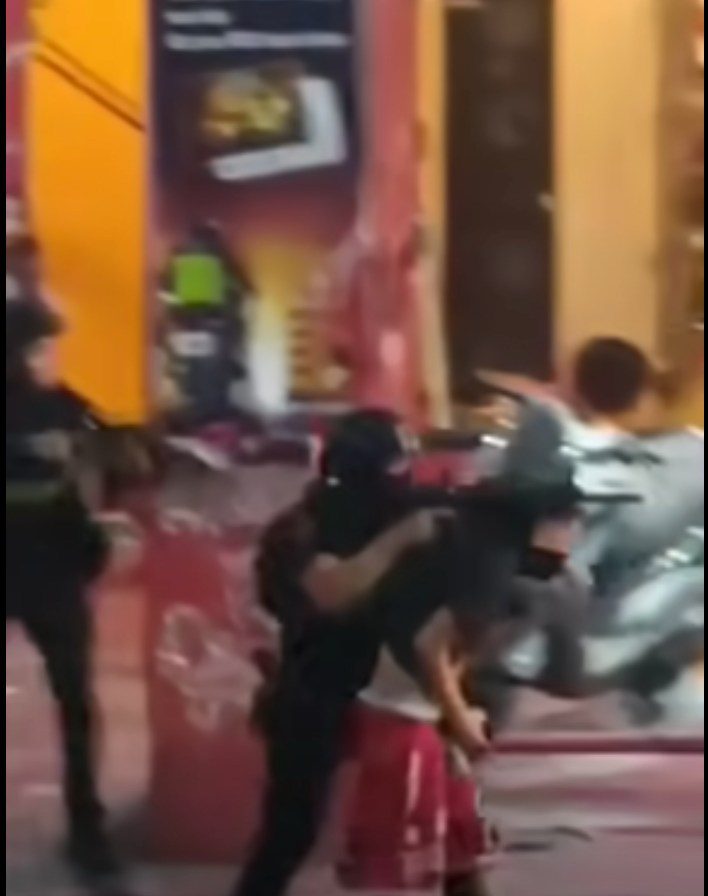
During Altermidya’s field inspection, we spoke to an employee of a food establishment nearby SOGO Hotel. He refused to give his name or that of his workplace for security reasons, but swore to what he saw. “It looked like war,” he said. SWAT officers with long rifles were stationed in front of SOGO, aiming across the street. Recto, of course, is divided by an island, a narrow, elevated plot with plants. He saw the armed men fire in the opposite direction. He saw someone shot in the neck. “It was a stray bullet,” he claimed.
Citizen videos soon circulated, showing a middle-aged man with a mustache, in a red shirt, walking across Recto in front of SOGO Hotel before suddenly collapsing to the ground. Protesters and bystanders rushed to him, carrying him to the sidewalk. In some videos, he was visibly bleeding from a neck wound. Other clips showed blots of blood on the concrete and the roadside island. A day later, Manila Mayor Domagoso ordered Recto repainted and cleaned, covering the bullet hole. Altermidya confirmed the bullet hole’s existence during its inspection.
During the press conference presenting the stabbing suspect Francisco on September 24, Domagoso replied to a question from media regarding reports of mauling of an arrested protester by police and SOGO employees and supposed deaths during the “riot”. He did not receive any reports, he said.
“The first thing we do when we receive such reports is we look at our morgues, and even our hospitals. There were no reports,” the mayor added.
Insiders from Jose Reyes Memorial Hospital, however, told Altermidya that the hospital treated a victim from a gunshot wound in the neck that night. Altermidya also found Facebook posts about the same victim, aged 35, apparently a resident of Paracale, Camarines Norte, who was shot during the protests in Mendiola on September 21. A Facebook post said, in Filipino, that the victim “was admitted at Jose Reyes Memorial Hospital in NCR (National Capital Region)… he was one of the casualties during the rally last September 21, 2025. No relatives visited to take care of him. Only hospital staff cared for him.”
Another protester, apparently another minor, was seen in a citizen video being accosted by a cop and taken upstairs inside SOGO. There, at least two male hotel employees proceeded to beat him as he cried out, “Ayoko na po!” (“Please, enough!”) Moments later, the cop dragged him back downstairs. The video ended there. This was the video that Domagoso was asked about in the September 24 press conference that the mayor said he did not hear about. “I would advise the parents to file a complaint,” Domagoso said.
On September 23, the DILG announced that a total of 216 people, including 103 minors, had been arrested two days earlier in Mendiola. They insisted no tear gas had been used. No shots had been fired (despite multiple citizen videos with several shots being heard near SOGO). Malacañang called the youth protesters “thugs” and batang hamog (street urchins). Mayor Domagoso suggested they may have been funded by a “Filipino-Chinese ex-politician and a lawyer” but offered no evidence as of this writing.
In a press briefing at the Presidential Communications Office the next day, DILG Sec. Remulla was in wholesale denial mode.
“I would like to commend the PNP for their performance…They acted according to law. They acted according to instructions. I would like to debunk the rumors going around that someone died, that there was a death. There were zero casualties. I repeat, there were zero casualties. What is spreading around in social media is fake news. There were, however, people who got hurt. None of the protesters were seriously hurt. I repeat, none…There was no tear gas used by the PNP,” Remulla said.
His denials—from the use of tear gas, to police brutality against arrested protesters, to the very existence of casualties—stand in stark contrast to evidence. Citizen videos, widely circulated online, and eyewitness testimonies show otherwise. Even Jose Reyes Memorial Hospital, a government facility, confirmed that a minor protester from Taguig died after being rushed there with a stab wound. Sources from the said hospital also said one protester died there from a gunshot wound.
This instance of citizen fact-checking amid an abundance of available information speaks of the ubiquity of social media and cellphone cameras—wielded by bystanders and participants alike. This proved crucial in providing information in spaces where supposedly professional coverage was absent or restricted.
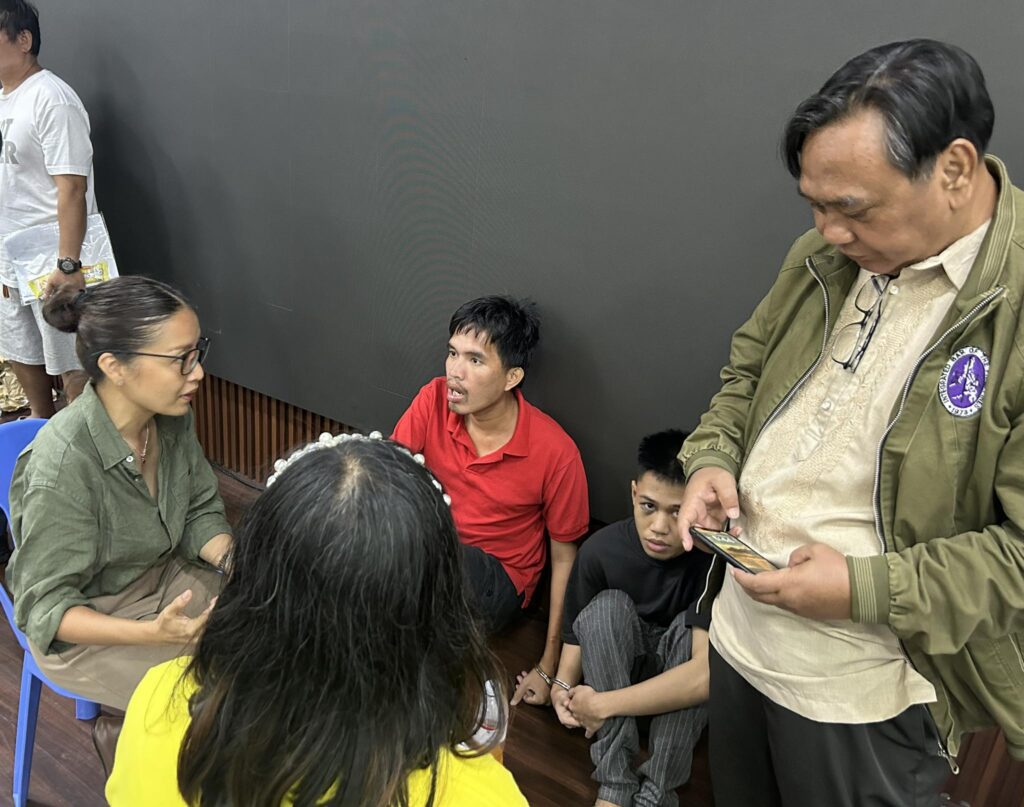
Meanwhile, in the two days following the melee, volunteer lawyers and relatives camped outside the Manila Police District headquarters, waiting anxiously for news of the arrested. They endured Typhoon Nando’s pounding rains and howling winds, hoping to even catch a glimpse of their loved ones. By the second day, they were informed through a social worker with a megaphone: protesters under the age of 15 would be turned over to Municipal Social Welfare and Development social workers, while those 15 and older would face charges.
September 21, 2025 was a historic day, indeed, for the sheer numbers that poured into the streets to protest systemic corruption. But also for the way the State once again wielded its coercive force against its own youth, leaving Mendiola’s concrete yet again tainted with Filipino blood.
With reports from Neil Ambion, Avon Ang, Jaja Necosia, Adrian Puse, and Chantal Eco