Cheaper than LNG
For the last two decades, natural gas has contributed 22,364kwh (kilowatt per hour) or more than 20% of power to the Luzon grid. But by early 2023, data from the Department of Energy indicated that natural gas’s share shrank to 14%. As early as 2022, the country’s energy self-sufficiency dropped to 49%, the lowest in 10 years.
It was no surprise that the decrease in the country’s natural gas reserves coincided with the spike in electricity rates. Like coal, another imported fossil fuel that the Philippines depends on for its energy supply, LNG is vulnerable to global market price fluctuations. When gas prices surge—whether because of geopolitical tensions, rising demand in Asia and Europe, or supply disruptions—the higher costs are passed on to Filipino consumers through increased generation charges.
De la Paz said electricity bills began to increase when the government allowed LNG imports to augment Malampaya’s thinning reserves.
Before 2023, electricity prices in the Philippines were already among Asia’s highest. With LNG in the mix, the country had grown more dependent on imported fossil fuels, causing electricity prices to spike.
In January last year, President Ferdinand Marcos Jr. signed Republic Act 12120 or the Philippine Natural Gas Industry Development Act, which prioritizes indigenous natural gas and provides a blueprint for its development.
Like Malampaya, lawmakers are banking on more indigenous natural gas facilities to enter the grid, which is expected to bring down electricity prices. Indigenous gas prices remain steady, they say, while imported fuels continue to peak.
The government also extended Malampaya’s exploration contract and billionaire Enrique Razon Jr.’s Prime Energy had been drilling for new wells in the Malampaya fields since July. There had been no news of any discovery yet.
“We will continue [exploring Malampaya’s new wells],” energy secretary Sharon Garin told reporters in a June briefing in Malacañang. She added that if new reserves are found in a year’s time, the reserves can contribute to the grid in three years.
“Ayokong isipin na wala—we have one year to explore the area. We will need to recalibrate our target this year kung medyo konti lang siya,” Garin explained. (I don’t want to think we’ll find nothing—we have one year to explore the area. We will need to recalibrate our target this year if the resources are small.)
While the government banks on Malampaya’s new wells, what happened to SC72?
The service contract was under revolving moratoriums to “placate China,” de la Paz said. A moratorium was placed first in 2014, lifted in 2020, and reimposed in 2022.
It was “unofficially” lifted in 2023 to allow Forum Energy to “enter into a contract to get the ship, the people (to do the surveys),” retired Supreme Court Associate Justice Antonio Carpio told PCIJ.
“But nothing happened,” Carpio said. “It looks like nagdalawang isip ang gobyerno. They are not interested anymore,” he said. (It seems the government changed its mind. They are not interested anymore.)
Philippine presidents
Every Philippine president since the Malampaya project went online had a plan to harness the gas reserves at Reed Bank.
When China lodged diplomatic protests against Service Contract 72 in 2002, claiming the area lies within its nine-dash-line territory, then President Gloria Macapagal-Arroyo shifted strategies.
In 2004, Arroyo approved a bilateral agreement with China which became a trilateral agreement to include Vietnam when the three-year exploration agreement rolled out in 2005.
The Philippine National Oil Company signed a tripartite Joint Marine Seismic Undertaking with China National Offshore Oil Corporation and Vietnam Oil and Gas Corporation.
The agreement would be controversial, however, because 80% of the explored area was inside the Philippines’ Exclusive Economic Zone. It expired in 2008 and was not renewed.
The Supreme Court later declared the agreement “unconstitutional and void” and said, “the exploration, development, and utilization of natural resources shall be under the full control and supervision of the State.”
In 2010, the election of a new president signaled a new approach. Forum Energy, which had acquired Sterling Energy’s interests, saw its exploration agreement for Recto (Reed) Bank renewed that year.
A year later, in 2011, one of the first major confrontations between Philippine and Chinese vessels occurred at Recto Bank, foreshadowing the Scarborough Shoal standoff that would erupt the following year.
In 2013, President Aquino filed a case against China in The Hague—and won. The arbitral award, a landmark in international law, is being studied in universities across the world and serves as the anchor of Philippine claims over the Sampaguita gas fields.
The ruling made it clear that China’s nine-dash-line claim, an imaginary line that covers almost 80% of the South China Sea, is “not valid” under international law; therefore there is no legal basis for China’s claims.
The succeeding government under President Rodrigo, amid its open-arms policy on China, came closest to sealing a deal with the regional power. The Duterte administration attempted to make China a service contractor through a joint exploration deal in 2018.
Those deals, Carpio said at the time, “expressly recognize that the area falls within Philippine sovereignty or sovereign rights.”
China backed out on the deal, though.
Strategies
As the Malampaya gas field nears depletion, attention has increasingly turned to Recto Bank as it was “identified as an alternative source,” according to Rommel Jude Ong, retired Philippine Navy Rear Admiral and professor of praxis at the Ateneo de Manila University.
In direct contrast to Duterte who forged closer ties with Beijing, Marcos Jr.’s strategy tends to be more focused on Washington, a long-time security treaty ally.
The Department of Energy did not respond to PCIJ’s request for comments, but Carpio said the Marcos administration has been “seeking” round-the-clock assistance from the U.S. to support Philippine-commissioned survey vessels.
Ong told PCIJ that this was likely based on Malaysia’s experience in 2020.
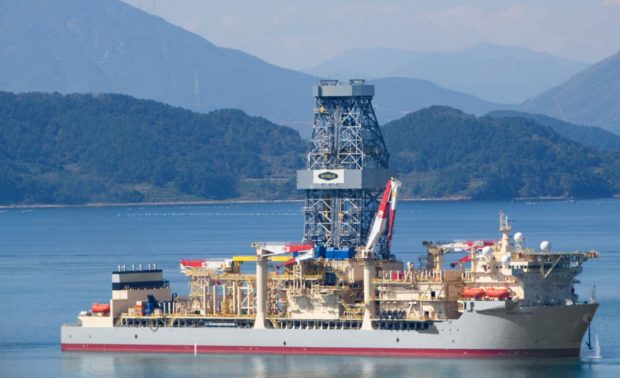
Back then, tension flared up between Kuala Lumpur and Beijing after Malaysia’s state-owned Petronas sent out the West Capella drillship to explore the Arapaima-1 and Lala-1 blocks off the coast of Sarawak and it was harassed by Chinese vessels.
Malaysia sent its Navy and the situation escalated into a standoff in April. The tension prompted the U.S. and Australia to send out warships. While the US Navy’s presence there was meant to keep watch should tensions escalate, experts consider it a show of U.S. support for Malaysia.
“That (US supporting the Philippine survey ships) was already mentioned several times. That was implied because they did it for the Malaysians, they did it for the Indonesians… of course, we are treaty partners. We have a mutual defense treaty,” Carpio said.
But attempts to engage Washington’s support while Filipino-commissioned survey ships explore Sampaguita gas fields have not materialized as the government wants “full protection” from the U.S. Navy, which is not possible, Carpio said.
“Hindi naman pwedeng the U.S. Navy is there 365 days a year,” he reiterated. “They can accompany us, but the American ships cannot be there the whole time,” Carpio added. (The U.S. Navy cannot be there 365 days a year.)
Indonesia, on the other hand, has opted to engage with American firms to explore oil blocks in Natuna.
Carpio said the government could look at Malaysia and Indonesia’s examples to harness the long-contested gas in Recto Bank since efforts by the government to engage with Beijing had failed numerous times in the past.
Since the revival of Philippine-U.S. military relations under Marcos Jr., the country signed security agreements with Australia and Japan, and conducted hundreds of annual joint exercises, joint sails and flights, and activities with the U.S. and allies—all of these could provide cover for Philippine resource exploration operations, experts say.
“There are many strategies,” Ong said. “It would be good for the country if Reed Bank can start supplying energy,” he reiterated.