
The World Bank has officially reclassified the Philippines as an “upper middle-income country” (UMIC), prompting celebration from government officials and many commentators. It’s played up as an important milestone, and as recognition of the country’s economic progress. But what does the reclassification actually mean? More importantly, what does it not mean? The answers are much less impressive than the official narrative suggests.
Unfortunately, the World Bank’s bumping the Philippines into its UMIC classification isn’t really a big deal. Before anything else, what does the classification mean even on its own terms? The Philippines’ US$4,850 gross national income (GNI) per capita squeaks us into the lower end of the Bank’s UMIC category. (See chart) Development isn’t a competition. But for those a little bit fixated on country comparisons, the Philippines ranks 130th out of 201 countries—putting us among the poorest one-third of countries in the world.
CHART. GNI per capita, 2025 or latest available year (Atlas method, current US$)
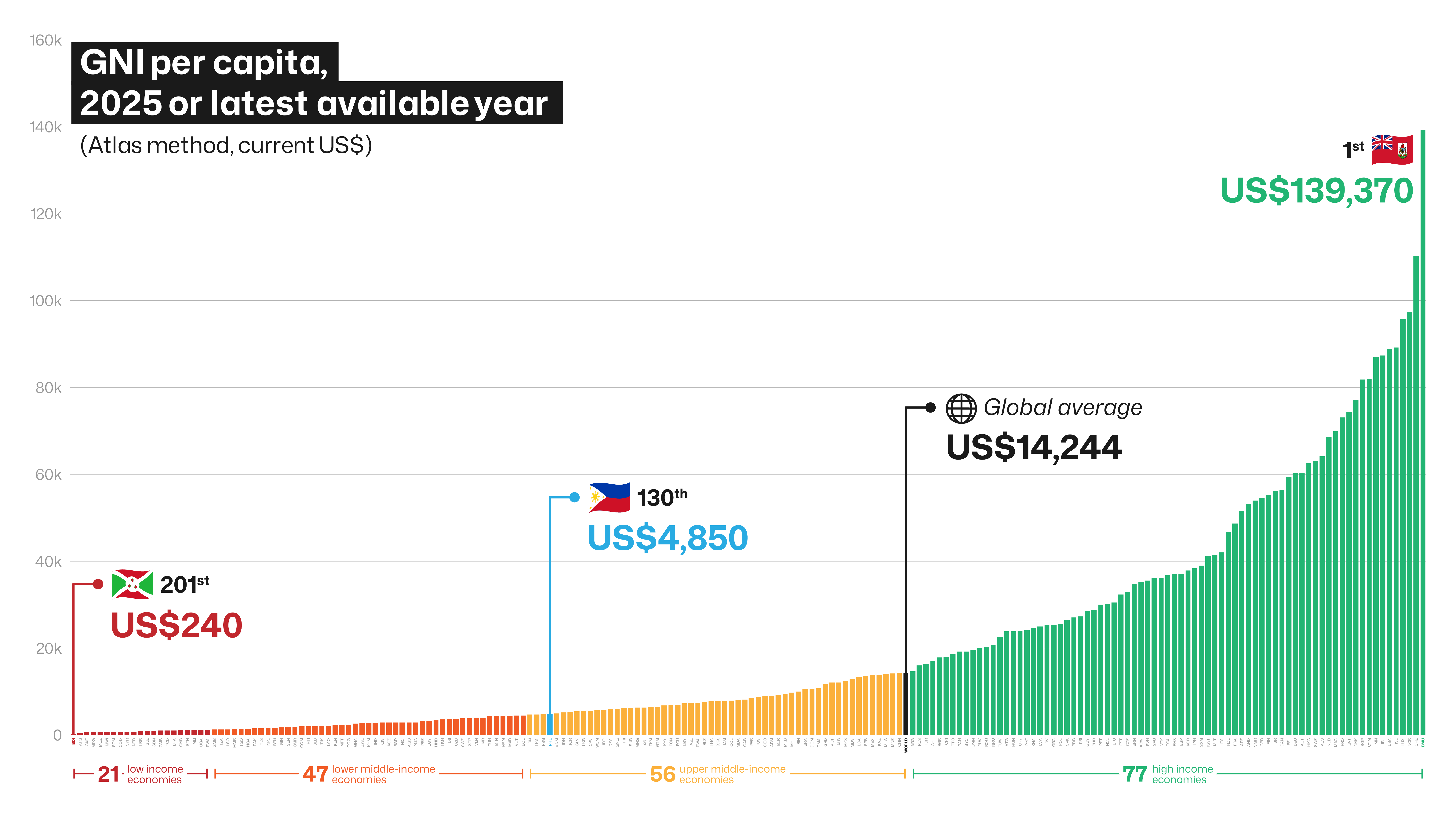
The Philippines’ GNI per capita is 20 times that of lowest-ranked Burundi at US$240, but it’s also just one-thirtieth of top-ranked Bermuda’s US$139,370—confirming that we’re much closer to the lowest end of country income levels than the highest.
The Philippines is literally below average—our GNI per capita is just one-third of the global average (US$14,244).
None of this is to disparage the Philippines—but all of it is to puncture the exaggerated narrative around the UMIC status. President Ferdinand Marcos Jr, his executive secretary, and his finance and planning secretaries have presented the reclassification as validation of their economic policies. The World Bank, meanwhile, has likewise framed it as a positive milestone despite longstanding criticisms of its policy advice and lending conditionalities that contributed to weakening the country’s productive sectors.
The official storyline is that the statistical reclassification is evidence that government policy is working, that the economy is fundamentally strong, and that ordinary Filipinos are poised to benefit.
This is a highly imbalanced presentation. The underlying rhetorical move exaggerates GNI per capita as evidence about the overall state of the economy and of people’s living conditions. But so many have justifiably already contested this on the basis of their daily lived experiences.
The overwhelmingly celebratory narrative gives comparatively little attention to severe economic problems of poverty and inequality. It even spins things as, basically, “we’ve grown the pie and now it’s time to distribute it.” This trickle-down idea is long-discredited and obsolete. It’s more accurate to say that “the pie’s growing slowly because our recipe sucks, and we still won’t share the small pie more equally.”
There have been disagreements about how IBON Foundation calls out UMIC as not a measure of progress, while agreeing that GNI per capita is a narrow metric of development.
But the World Bank’s country classifications really aren’t meant to measure progress. From the beginning, they were designed as a simple standardized way to classify countries for the Bank’s operational purposes. Particularly, this is for determining eligibility for concessional lending and its other development finance tools.
Nonetheless, can the arithmetical result still be used as a measure of progress? Maybe, if it didn’t conceal more than it revealed.
In the Philippines’ case it does conceal a lot. And it’s not just about averages hiding inequality, of which much has already been said.
It’s how GNI per capita hides economic growth coming from wage repression, irregular low-paying informal work, and scrimping on environmental protections. Or from corruption-driven infrastructure spending. Or from other government spending that is increasingly debt-driven because taxes are cut on large companies and wealthy families, while more tax revenues are squeezed from the poor and middle class.
And how GNI per capita trends hide manufacturing falling to its smallest share of the economy in nearly 80 years—especially since the World Bank’s US$200 million “industrial development” structural adjustment program in 1980±and agriculture to its smallest in the country’s history. As well as how the resulting job scarcity drives millions of Filipinos abroad for work, boosting GNI with their earnings overseas.
Does a Top 1,000 company’s soaring profits reflect its employees’ wages, working conditions, and welfare? Maybe sometimes in a good way, but much more often likely in a bad way.
This episode of UMIC overhype shows how the government’s presentation of the economy gives disproportionate emphasis to a favorable statistical reclassification while giving comparatively little attention to the country’s persistent structural weaknesses. It also underscores why independent analysis remains important—not to dismiss positive developments, but to place them in their proper context and contribute to a more balanced public discussion.