

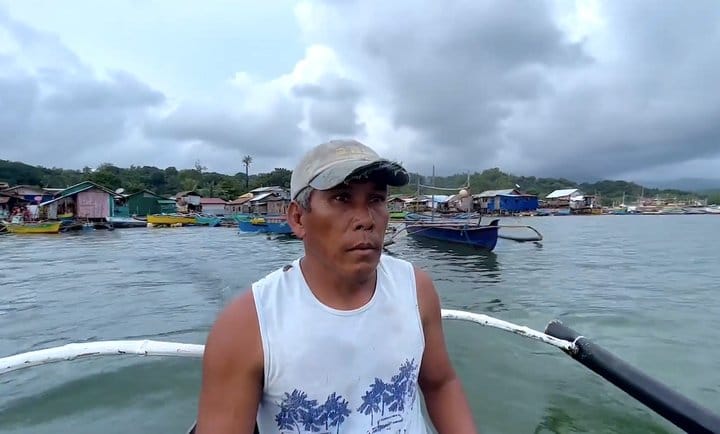
Fifty-two year-old Rolando Fuentes had been a fisher all his life. Born and raised in a coastal village in Masinloc town, Zambales province, all he knew was to eke out a living from the sea.
But it had been more than five years since their last trip to traditional fishing ground called Scarborough Shoal 220 kilometers off their village. In that last trip, they were chased by Chinese naval militia with water cannons until they were forced to turn back with no fish in their boat’s holds.
“I suffer severe trauma since then,” Rolando said. “We also lost US$4,000 worth of fuel and supply that day and returned with nothing,” he added.
Rolando had since been laid off by their boat’s owner and now subsists on small-time fishing close to his village. “Before the Chinese barricade of Scarborough, we used to give away fish to our neighbors every time we return. Now, I am personally neck-deep in debt,” he bewails.
Chinese 9-dash line
Scarborough Shoal is well within the 370-kilometer exclusive economic zone (EEZ) of the Philippines from mainland Luzon Island. The shoal’s many underwater geological features and coral gardens are ideal spawning grounds for all types of marine life. Rolando recalled no one returns from Scarborough Shoal with an empty boat.
Scarborough Shoal is 875 kilometers from mainland China, the superpower who sends warships, coast guard vessels and hundreds of supposedly civilian fishing boats to the area to prevent local fishermen from practicing their trade of hundreds of years.
China is claiming nearly 90% of the entire South China Sea through its nine-dash line demarcation, encroaching on boundaries and EEZ of not only the Philippines but also of other Southeast Asian countries such as Vietnam, Malaysia, Brunei and Indonesia.
China justifies its nine-dash line by claiming so-called historic rights to the waters, islands, and resources within the South China Sea. Beijing argues its sovereignty in the area predates modern treaties, pointing to centuries of Chinese presence in the maritime zone.
David versus Goliath
But since the Philippines has one of the weakest navies in the region, it is in its territorial waters that Chinese vessels are most present. The regional giant even built artificial islands in the territory that serve as forward military bases to assert its claims. Meanwhile, fisherfolk like Rolando are chased, even hurt, and prevented from fishing. In Zambales province alone, 15,000 families have been driven to poverty by Chinese aggression.
Ten years ago, however, the Philippines scored a legal victory that affirmed its sovereign rights and maritime entitlements within its EEZ under the United Nations Convention on the Law of the Sea (UNCLOS). The international maritime tribunal based in The Hague in The Netherlands clarified that China’s expansive claim has no legal basis under international law.
Professor Roland Simbulan of the Center for People Empowerment in Governance (CENPEG) stressed that China must respect the arbitral award and refrain from actions that violate Philippine sovereign rights. He however cautioned against interventions by rival powers in the region, such as increased US military presence in the Philippines that may draw the country into a costly conflict between the superpowers.
“The arbitral ruling belongs to the Filipino people. It is neither a diplomatic trophy to be appropriated by Washington nor an excuse for Beijing to ignore international law,” said Prof. Roland G. Simbulan. “The Philippines must reject any attempt by external powers to use our legitimate maritime dispute as a pretext for expanding their military footprint or advancing their geopolitical agenda,” he added.
While the Philippine and various other governments point to the ruling as a rule-based basis in resolving conflicting claims to the sea and its riches. It has the effect of water on a duck’s back, as far as Beijing is concerned.
Marcos wasting victory
The Communist Party of the Philippines (CPP), meanwhile said it is fitting for the Filipino people to commemorate the arbitral victory that debunks China’s claims of ownership under its so-called nine-dash line.
“The Filipino people stand on strong grounds to assert their rights under the arbitral ruling. The country must continue to engage China in vigorous diplomacy to explore and pursue all possible mutually acceptable terms of cooperation consistent with the arbitral ruling,” the revolutionary Party said in a statement.
The CPP however condemned the Ferdinand Marcos Jr. government for wasting the arbitral ruling’s potential for peaceful dialogue and practical agreements, by being subservient to US interests and dictates. “Instead of pursuing diplomacy, it is deepening tensions by allowing the country to be used as springboard for US war preparations and provocations,” CPP chief information officer Marco Valbuena said.
Valbuena pointed out that instead of serving the peaceful resolution of maritime disputes, the arbitral ruling is now being made to serve the US strategy of containing China. On US urging, Japan and other US allies have expressed “support” for the arbitral ruling, to justify sending its own military forces, heightening tensions and making peaceful resolution of disputes more difficult, he said.
“All these dangerous moves form part of the malign strategy of US imperialism. The Filipino people must reject US claims of being a friend and ally, when it serves only its imperialist interests of imposing its hegemony and provoking war to assert its supremacy.
‘Scarbrough is for our children’
Rolando said he fears for the future of his children while the Philippines remains seemingly powerless to assert its rights. “I wish for my children to be able to fish in Scarborough even when I am already gone,” he said.
He also called on China to stop its claims on traditional Filipino fishing grounds.
Simbulan, meanwhile, called on the Philippine government to strengthen its economy so that it can build its own credible external defense capability like its ASEAN neighbors. “[This is] so that we are not held hostage by other big powers which will only compromise our national security as its pawn and forward base,” the expert said.
“As we commemorate this landmark victory, let us remember that genuine sovereignty means not only defending our seas but also preserving our freedom to determine our own destiny,” Prof. Simbulan concluded. “The Philippines should be a bridge for peace in the region—not a launching pad for conflict,” he ended. # (Raymund B. Villanueva)