

By Aaron Ernest Cruz and Anne Marxze D. Umil

MANILA – It has been months since both charges of Anti-Terrorism Act and attempted murder against United Methodist Church clergy, Pastor Glofie Baluntong were dismissed. Yet she has found little relief fearing that the State, which filed these cases against her, could bring similar charges against her again.
“I felt fear because this (dismissal of charges) might infuriate the state forces,” Baluntong said in an interview with Bulatlat.“The military will do all means to demoralize people [like me].”
In fact, on March 7 of this year, Baluntong was red-tagged again when state forces used her profile picture in a powerpoint presentation labeling her as a recruiter of the New People’s Army.
Monitoring by human rights group Karapatan showed that 256 individuals were charged with ATA and Terrorism Financing Prevention and Suppression Act or TFPSA.
Of this number, there are 138 (53.90%) individuals whose cases were dismissed by the courts.
For Karapatan, the dismissal of these cases by the courts is “proof of the arbitrariness of the terrorism-related charges filed against activists, as evidenced by the numerous cases that have been already dismissed by courts and prosecutors.”
“For years, the ATA and the TFPSA have served as legal weapons for unjust arrests, prolonged detention, bank account freezes and other forms of political repression, threatening the people’s fundamental rights and freedoms,” said Karapatan Secretary General Cristina Palabay.
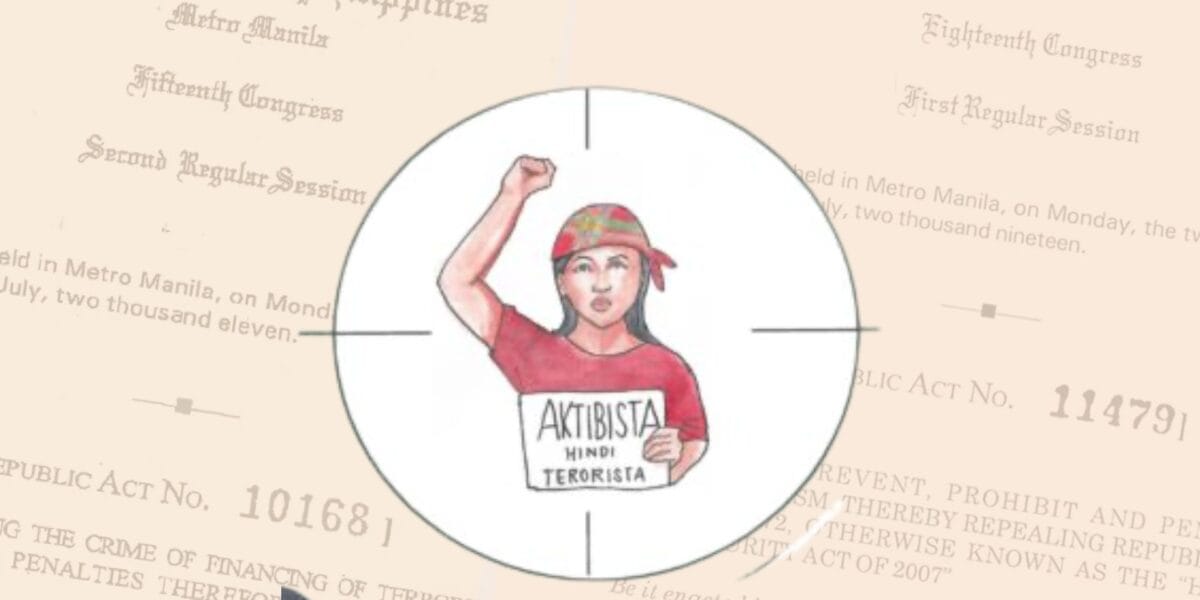
The misapplication of twin ‘terror laws’
There are 25 individuals who are currently detained including community journalist Frenchie Mae Cumpio and church worker Marielle Domequil. Rights groups and press freedom advocates assert that they are wrongfully convicted for supposed violation of TFPSA after the Court of Appeals voided the civil forfeiture case against them in 2025. This decision was upheld again by the CA on April 13, 2026.
Read: CA declares no legal basis for civil forfeiture case vs red-tagged journalist, lay worker
Read: CA upholds ruling: No proof money seized from Cumpio, Domequil linked to terrorism
Karapatan also recorded 37 individuals who were arbitrarily designated as terrorists by the Anti-Terrorim Council (ATC). Among them is Windel Bolinget, Chairperson of Cordillera People’s Alliance (CPA). He and three others were arbitrarily designated by the ATC as “terrorists” in 2023. But Bolinget has kept a positive mind saying that the truth shall always prevail despite the legal harassment against him.
“We did nothing but to protect our ancestral land and safeguard the rights of the Indigenous People in the Cordillera,” Bolinget told Bulatlat.
Before ATC’s designation, Bolinget was red-tagged and faced murder charges over an incident that occurred in Tagum, Davao del Norte in 2018. Former Police Regional Officer-Cordillera Chief General R’win Pagkalinawan also issued a shoot-to-kill order against him. Later on, the murder charges were dismissed. The court also decided in favor of Bolinget after filing a civil suit against Pagkalinawan and other officers in Benguet.
Read: Red-tagged Cordillera leader faces murder raps
Read: Court victory for Cordillera activist affirms dangers of red-tagging – advocates
“[What happened] forced me to seek protective custody from the National Bureau of Investigation in Cordillera and I was technically detained for two months,” Bolinget said.
Bolinget said that life has been difficult as he dealt with many trumped-up charges just by doing his duty as an Indigenous People’s rights advocate by fighting for their ancestral lands and their rights to determination.
The red-tagging against Bolinget extended to his family which he said is unjust. “It was a hard time for my family. My mother and my father pleaded to me to leave CPA, to the point that they knelt in front of me because of fear and worry.”
In his 39 years of being an IP activist, he said this phase of his activist life is the one of the worst. It drained him, he said, physically and mentally.
“Just imagine, they’ll label you a terrorist. Even your family will be affected. Your children will hear things that their father is … a terrorist,” he said, adding that terror laws “demonizes” individuals who are critical of the government and cause a chilling effect to the general public.
A look into the data of Karapatan would also show that out of the 37 individuals who were designated as terrorists, eight have been killed.
In the ATC Resolution No. 17 (2021), many of the listed so-called terrorists were peace consultants and leaders of the revolutionary groups including, Jorge “Ka Oris” Madlos who was killed in October 29, 2021, Wilma Austria-Tiamson and Benito Tiamzon killed in August 2022, Ma. Concepcion Araneta-Bocala, NPA North Central Mindanao Regional Committee Dionesio Micabalo killed in July 2023, Myrna Sularte, member of the Communist Party of the Philippines Central Committee and Political Bureau killed in 2025, peace consultant Perdo Codaste killed in 2022, and CPP leader Menardo Villanueva killed in 2022.
This is why Karapatan and other progressive groups continue to question the powers of the ATC to designate individuals as terrorists. They asserted that the ATC “exercises unilateral power without judicial oversight, denying the accused due process by failing to provide them with evidence or an opportunity to contest the accusations.”
This is also the reason why it has caused alarm to people who are arbitrarily designated as terrorists, such as Bolinget. The chilling effect was not only felt by the people who are designated, he said, but the people they are helping.
Bolinget and Baluntong both lamented that it took only one military asset for them to be designated as “terrorist” or charged with ATA, they on the other hand had to prove in the courts and present all evidence that they are not.
Meanwhile, two of the 37 individuals namely, Norman Ortiz and Lee Sudario are victims of enforced disappearance.
Unjust freezing of assets
The designation by the ATC triggers the freezing of assets by the Anti-Money Laundering Council (AMLC). Rights groups decried how the freezing of assets greatly affected the lives of those who were arbitrarily designated as well as those who had transactions with them. This is challenging for those who were arbitrarily designated, especially the freeze orders can take along until the designation is lifted.
Read: A year into terror law, ‘meager’ assets of rights defenders frozen
Read: AMLC freezes peace consultant’s compensation as martial law victim
For one, the designation of Bolinget and other CPA leaders Stephen Tauli, Jennifer Awingan and Sarah Alikes, led to the freezing of the CPA’s bank account. This has become a challenge to operate and fulfill their duty to the IP sector.
“I think last year there was severe flooding in Cagayan Valley, and they asked for support from the CPA because we used to do that. But I said we can’t give anything anymore because the bank accounts are frozen,” Bolinget shared.
But freezing of assets is not only caused by the terrorist designation. Rights groups observed that the Terrorism Financing Prevention and Suppression Act (TFPSA) has also been used against them.
National Union of Peoples’ Lawyers (NUPL) President Ephraim Cortez also said that civil society organizations have become vulnerable to laws aimed at combating money laundering and terrorism financing.
Cortez said that the vague provisions of the TFPSA, freeze orders have been extended to the bank deposits of officers, staff, and even their family members once they were implicated in terrorism-related cases.
He added that the lack of transparency in the law’s implementation further compounds the problem. Because the freeze orders may be issued ex parte (or one party only), the freezing of assets were executed without prior knowledge of the targeted individual or groups or when the order has been already enforced.
Cortez further explained, there are two types of reports that financial institutions are required to submit in relation to TFPSA. One is the covert transaction report (CTR) where it automatically reports to the AMLC the transactions that will exceed the P500,000 ($8107.65) threshold within one banking day. The second is the suspicious transaction reports (STR) where a customer’s activity indicates potential money laundering or terrorism financing.
“So all of that is justified because it is intended to curb financial terrorism. But the implementation shows otherwise. What is being targeted are legal mass organizations, activists, and critics,” Cortez said.
Citing the AMLC’s report covering the period 2017 to 2020 second period, Cortez said that only 3.5 percent STR were related to alleged terrorism financing activities. Meanwhile, only 0.95 percent of all STRs involved non-government organizations (NGOs).
Despite relatively low figures, Cortez said the implementation of the law has disproportionately affected legal organizations. Aside from the CPA, Cortez also cited the freezing of assets belonging to peasant women’s group Amihan and 17 other NGOs across the country monitored by Karapatan.
“If we notice, there are more cases of financial terrorism than ATA because financial terrorism is more lethal in terms of consequences,” Cortez said.
How Philippine terror laws emerge
Cortez said the country’s anti-terrorism laws should not be viewed solely through the lens of domestic counterterrorism efforts. He argued that it is also influenced by global counterterrorism policies promoted by international bodies such as the United Nations Security Council (INSC) and the United Nations Office of Counter-Terrorism.
However, Cortez said that it is the Financial Action Task Force (FATF) that pressures countries into implementing the recommendation in combatting money laundering and international crimes.
The FATF was created by G7, an informal intergovernmental political and economic forum composed of Canada, France, Germany, Italy, Japan, United States, United Kingdom, and the European Union as a non-enumerated member.
Cortez said that FTAF’s recommendations cannot be forced as law and has no legal effect on the country since it is not a treaty-based international body.
“In reality, it is still considered as an imposition because if a state fails to comply with the recommendations, they may face financial and economic sanctions,” he said.
“But if you are able to comply with these recommendations, a state will benefit on many privileges, financial and economic, as these countries have large capitals to award you,” Cortez added.
The FATF has issued 40 recommendations to combat terrorism financing and money laundering. Due to the September 11, 2001 attacks in the US, FATF added nine special recommendations focusing on financing terrorism. Cortez said similar policies have also been implemented across many developing countries, including the Philippines.
“These counter-terrorism measures are not truly meant to address its goal of ending their so-called ‘terrorist’ or ‘extremist’ but they’re used to target legal mass movement or civil society groups that only assert the rights of their countrymen,” shared Cortez.
Cortez also recalled how the ATA was “railroaded” through Congress. Instead of completing the normal legislative process, including separate deliberations and amendments, the House of Representatives adopted the Senate version of the bill, effectively abandoning proposed amendments to RA 9372 or the Human Security Act of 2007..
Cortez also criticized the participation of Philippine judges, prosecutors and politicians who attended anti-terror seminars and capacity building workshops, saying that these would only enhance the weaponization of terror laws toward activists and human rights defenders.
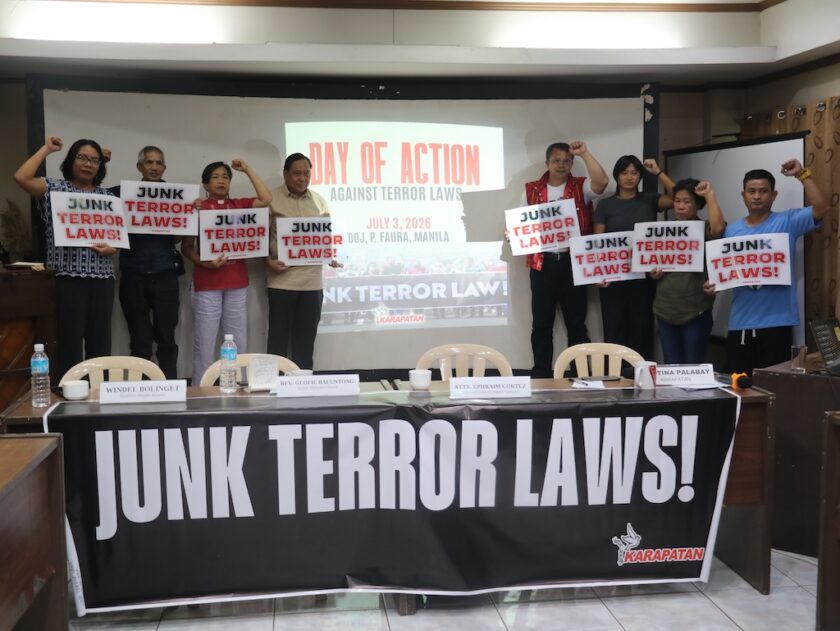
Rights groups demand that terror laws should be repealed. They added that they and those who were charged with such cases will continue to amplify their stories through their testimonies and expose state repression against people who are only working for the welfare of their countrymen.
“We likewise demand accountability for all officials responsible for the political persecution and human rights violations committed under the guise of counterterrorism. The Filipino people’s struggle for justice, accountability, and genuine democracy will not be silenced by terror laws,” Palabay concluded. (RVO)
 Save as PDF