
By Cong B. Corrales
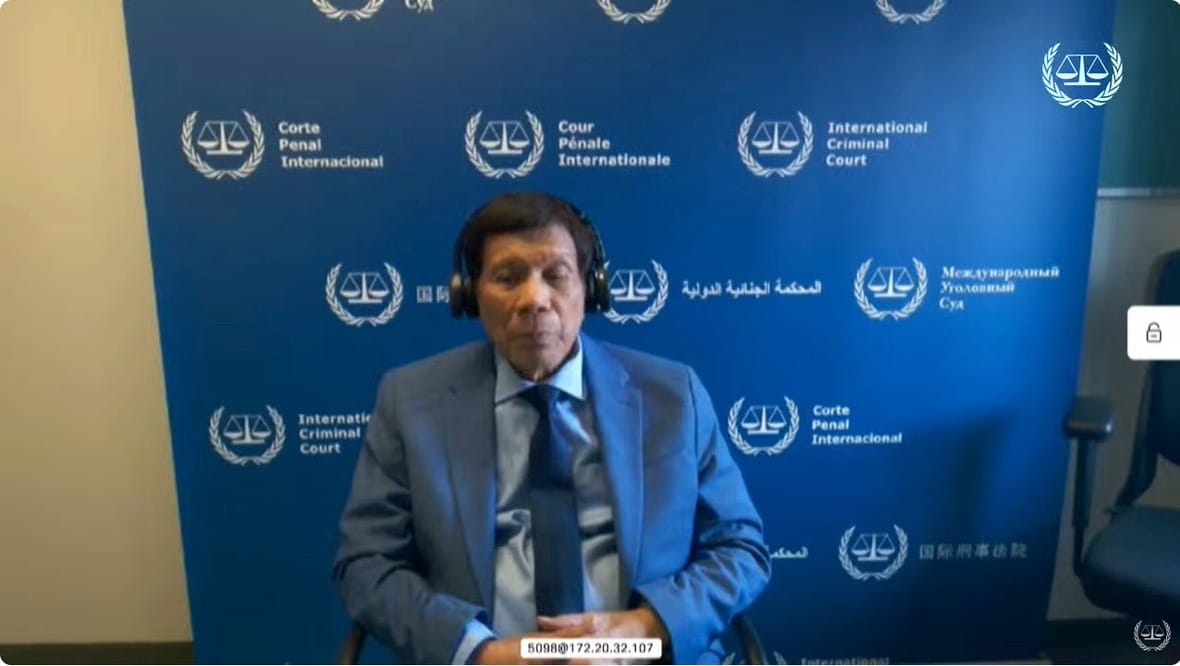
CAGAYAN DE ORO — The first day of the confirmation of charges hearings against former President Rodrigo Duterte at the International Criminal Court (ICC) opened with a stark clash of strategies: a methodical presentation of evidence by the prosecution and a highly rhetorical, politically charged opening from the defense.
For observers in Mindanao — the geopolitical heartland of the former president — the proceedings laid bare the deep scars left by the drug war and ignited fierce local debate over accountability, impunity, and the pursuit of justice.
The Hague clash: evidence vs. rhetoric
At The Hague, ICC Deputy Prosecutor Mame Mandiaye Niang anchored the prosecution’s opening statement on a foundational principle: “Those in power are not above the law.” Niang argued that Duterte wielded “ultimate influence and authority” over a systematic campaign of killings, characterizing the documented cases as “merely a fraction of the overall criminality” of the drug war.
Victims’ counsel Atty. Joel Butuyan delivered a poignant plea, calling the ICC proceedings “the last boat that the victims can board to go on a journey in search of justice for their loved ones.” Butuyan warned that failing to confirm the charges would allow Duterte to return to the Philippines as a “conquering hero” who continues “gospeling impunity.”
Conversely, Duterte’s lead defense counsel, Nicolas Kaufman, dismissed the former president’s public kill orders as mere “hyperbole, bluster, and rhetoric.” Kaufman painted Duterte as a frugal leader who grew up in an impoverished household and subsisted on “dried fish and boiled rice,” asserting that his harsh language was a protective measure for the poorest citizens, not a literal command to murder.
That characterization was quickly dismantled by observers back home. Right Rev. Felixberto Bert Calang, Iglesia Filipina Independiente Bishop and Co-Convenor of Sow the Seeds of Peace in Mindanao, scoffed at the portrayal of the former president—whose father was a provincial governor—as poor. “Is there an impoverished governor in the country?” Calang asked. “I know of none.”
Similarly, Butuyan swiftly countered the defense’s premise on Duterte’s rhetoric: “If he were merely being pompous and flippant, the people who were killed should be alive and laughing today at his supposed pranks.”
Mindanao reacts: “rabble-rousing” and disappointment
Back here, local legal practitioners and human rights advocates expressed overwhelming disappointment in Kaufman’s strategy.
Antonio J. Montalván II , a Kagay-anon pundit currently in self-exile due to online harassment from DDS trolls, called the defense’s approach the most unexpected point of contention.
“Nicolas Kaufman [didn’t have] anything to say about evidence but instead resorted to gaslighting and rage-baiting,” Montalvan said.
Observing from the gallery, he added: “Kaufman wasn’t talking in a courtroom. It was like he was rabble-rousing a DDS rally in Duterte Street.”
Antonio La Viña , Chairman of the Movement Against Disinformation and Law Dean, praised the prosecution while mocking the defense’s performance.
“Kaufman sounded like Harry Roque without a wig or Salvador Panelo minus the velvet pants,”
La Viña said adding: “The Dutertes would have saved millions of pesos if they stuck with Roque and Panelo.”
Charlito Kaloy Manlupig, a Cagayan de Oro-based humanitarian worker, criticized the defense’s strategy.
“The defense counsel’s performance was, frankly, a disappointment,” Manlupig said. “Given the substantial fees reportedly received—especially considering the source of those funds—the advocacy displayed fell short of what the public is entitled to expect in proceedings of this magnitude.”
Human rights lawyer A Dexter M Lopoz, whose brother Atty. Rex Jasper Lopoz was murdered during the drug war, condemned the defense’s arguments as “troll-level” scripts that offered “nothing new.”
Lopoz emphasized that the ICC was created specifically to run after impunity, adding that the intense trolling surrounding the case only proves that a fair trial in domestic courts remains impossible.
Weighing the law and the evidence
While emotions ran high, local legal practitioners focused on the structural process of the hearings.
Former Cagayan de Oro city councilor and practicing lawyer James Judith pointed out that the first day went exactly as expected for a confirmation hearing, focusing on opening statements rather than deep evidentiary dives.
However, Judith acknowledged the weight of the Rome Statute’s principles: “It is obvious that the systematic approach to EJK could only be made by the higher-ups… and all this points to Malacañang.”
Pat Pangantihon , a climate justice advocate in Northern Mindanao, said he was impressed by the “dispassionate and unambiguous method” of the prosecution.
“The playing of the video clips where Duterte openly admits to have a hand in the extrajudicial killings… blatantly shows a person who sees himself above and beyond the law,” he said.
Mid-level government employee Dondale Dumagat agreed, criticizing Kaufman as “the epitome of a substance user with no substance in his argument,” while expressing sorrow over the systematic targeting of the poor.
Meanwhile, Honey Pie Pisos, president of the Cagayan de Oro Press Club, urged caution.
“My position is anchored on respect for due process and the rule of law,” she said. “It is not our role to pre-judge its outcome. What matters most is that proceedings are conducted fairly, transparently, and in accordance with international legal standards.”
Similarly, Philippine News Agency Regional Bureau Chief Nef Luczon opted to wait for the Chamber’s actual decision rather than getting caught in the initial fray: “For now, I’m letting all the noise play out… then sift them after.”
Divided voices on the ground
Despite the heavy criticism of the defense, some locals viewed the proceedings through a different lens.
Patrick Tee, a local radio reporter, admitted he did not pay attention to the prosecution, noting his main takeaway was Kaufman’s assertion that Duterte had “no intention to really kill but to take out the poison in society.”
Practicing lawyer Tiburcio M. Tibs Palasan, Jr., a former Duterte supporter and campaigner in Cagayan de Oro, simply dismissed the defense’s efforts entirely: “I know Digong’s lawyer will also be trolling to please the DDS. Digong will be convicted.”
When asked what had changed his mind about the former president, Palasan replied: “When billions of pesos worth of shabu passed by our ports but Customs Commissioners (Nicanor) Faeldon and (Isidro) Lapeña were treated with kid gloves, I knew the drug war was for show.”
For others, the high-level international court feels detached from daily struggles. Lourderico Leorderico Pedimonte, a local motorela driver, expressed apathy: “Even if I take an interest in the ICC hearings, it still won’t help our situation. Away kana sa mga agalon.”
A broader context of impunity
For many in Mindanao, the ICC hearings represent more than just the drug war; they symbolize a reckoning for broader human rights abuses.
Jessiemer Loi JL Algarme, Station Manager at Juander Radyo-Cagayan de Oro, highlighted that the climate of fear extended to advocates of truth and human rights who fell victim to red-tagging.
“I will be happier if this is confirmed after the pre-trial and proceeds to a full trial so that justice is fully served,” Algarme said.
This sentiment was forcefully underscored by Fr. Raymond Ambray, Convenor of the Save Our Schools Network who tied the start of the hearings to the fourth anniversary of the killing of the “New Bataan 5″—a group of volunteer teachers and community workers slain in Davao de Oro.
“For Indigenous peoples, the ICC proceedings signify that state power is not beyond accountability—and they strengthen our demand for justice for communities harmed by Duterte’s militarist policies,” Ambray said. “Accountability for Duterte strengthens the call for justice in Mindanao. The struggle against impunity continues.” #