
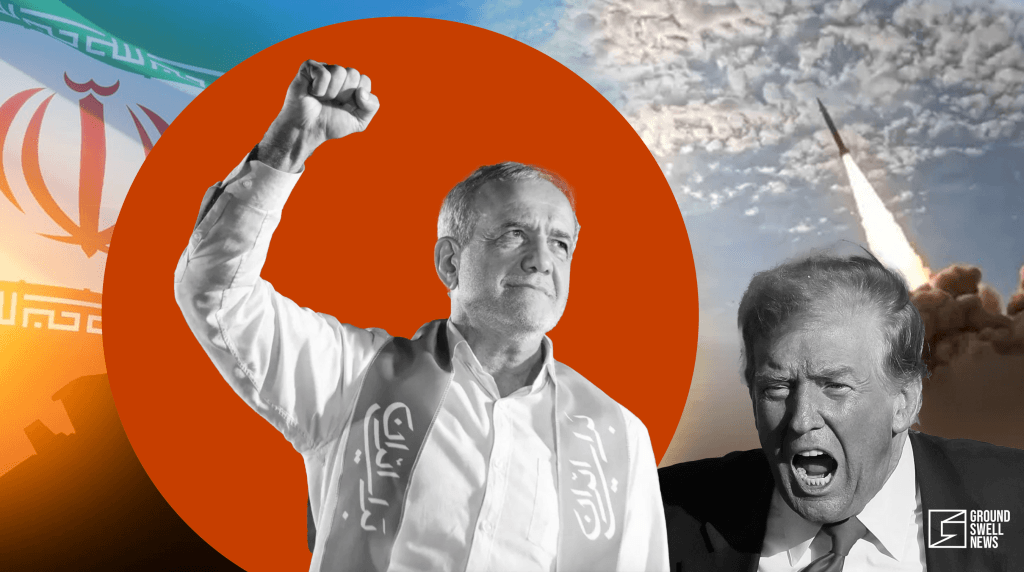
Iran has condemned remarks by Donald Trump threatening to bomb the country “back to the Stone Age,” with President Masoud Pezeshkian calling the statement an admission of intent to commit a “massive war crime.”
Pezeshkian said the remarks reflected the gravity of the escalating conflict and raised concerns about international silence. “History is full of those who paid a heavy price for their silence in the face of criminals,” he said, adding that he had raised the issue with Alexander Stubb, Finland’s president.
Does threatening to send an entire nation back to the Stone Age mean anything other than a massive war crime? This was the question I asked my Finnish counterpart, who is a jurist. History is full of those who paid a heavy price for their silence in the face of criminals.
— Masoud Pezeshkian (@drpezeshkian) April 3, 2026
The comments come as US-‘Israeli’ attacks continue across Iran, with growing reports of strikes hitting civilian infrastructure which are violations of international humanitarian law tantamount to war crimes.
In southern Iran’s Bushehr Province on April 3, a drone strike hit a warehouse storing humanitarian aid and emergency vehicles, according to the International Federation of Red Cross and Red Crescent Societies (IFRC). The attack destroyed containers, buses, and several emergency response vehicles.
The IFRC, which operates with a large network of responders across Iran, said three of its staff have been killed since the war began on February 28. Officials warned that medical needs are rising rapidly as supplies become increasingly scarce.
The escalation has also affected neighboring Lebanon, where ‘Israeli’ strikes have damaged critical water infrastructure in the south. The South Lebanon Water Establishment reported that facilities in areas including Ibl al-Saqi and al-Maysat were hit, along with solar-powered systems supporting water supply stations.
The agency condemned the attacks, saying they constituted a violation of international norms protecting civilian infrastructure. “The targeting of vital facilities… especially water facilities… is a clear and explicit violation of all international conventions,” it said.
Under international humanitarian law, including the Geneva Conventions and their Additional Protocols, objects indispensable to the survival of civilians such as water installations, food supplies, and medical facilities are explicitly protected during armed conflict. Deliberate or indiscriminate attacks on such infrastructure are prohibited because they can deprive entire populations of access to drinking water, sanitation, and basic hygiene, leading to disease, displacement, and death. Legal experts say that when water systems are targeted without clear military necessity, or when the harm to civilians is disproportionate, such actions may constitute war crimes.
The latest incidents add to earlier documented attacks on civilian sites, including a widely condemned strike on a girls’ school in the southern Iranian city of Minab at the start of the war. On February 28, a US-linked missile strike destroyed the Shajareh Tayyebeh elementary school, killing at least 168 to 175 people, most of them children aged between 7 and 12, and injuring dozens more. The attack, which involved multiple strikes that collapsed the school building while classes were in session, has been described by human rights groups and UN experts as a potential war crime and a “grave assault on children.” Investigations by international media and legal experts have indicated that the United States was likely responsible for the strike, making it one of the deadliest single incidents of civilian casualties in the conflict.
Post Views: 93