

Migrante Middle East
Press release
January 24, 2025
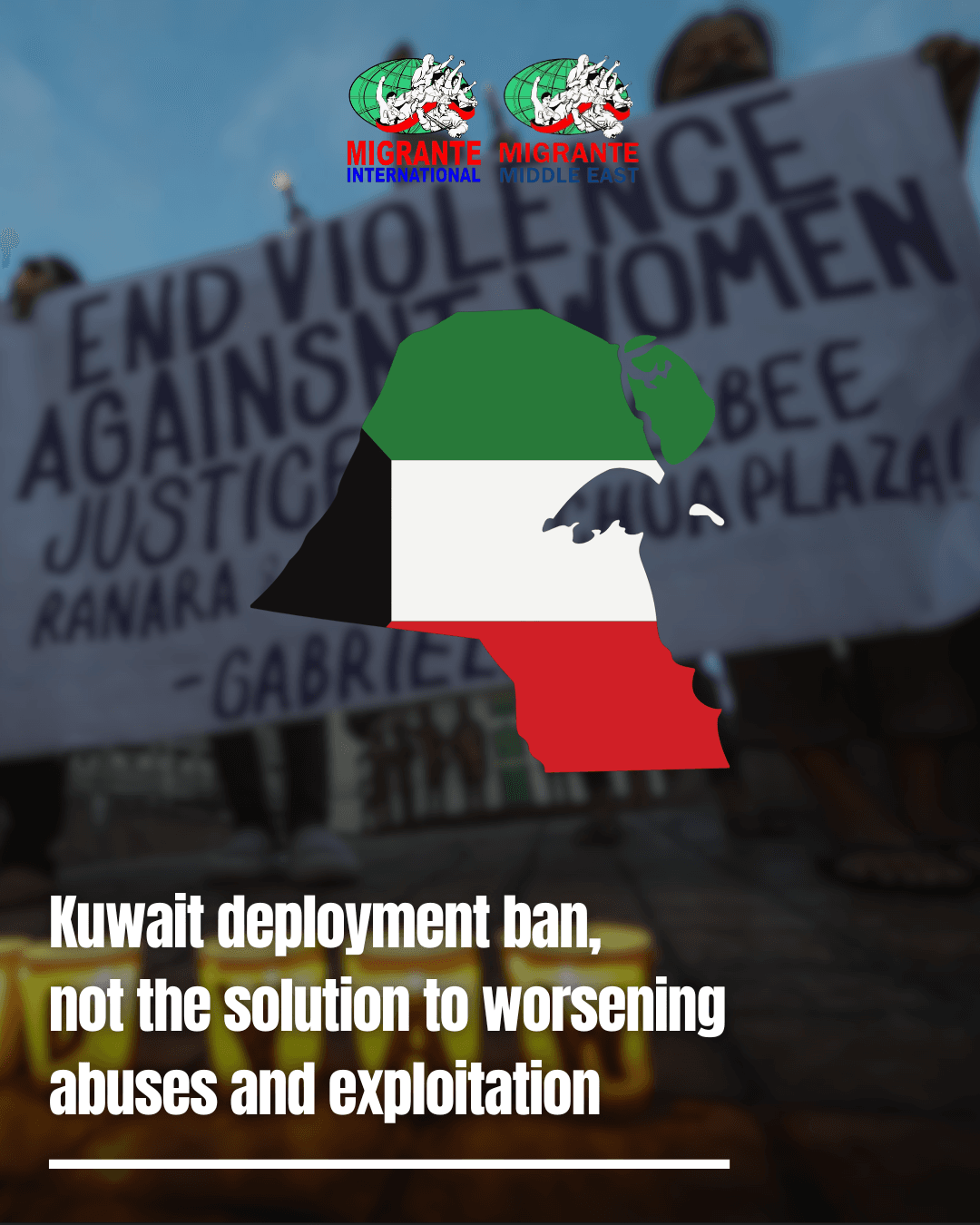
Migrante Middle East on Friday criticized the proposed deployment ban for OFWs bound to Kuwait as a superficial measure to address the worsening cases of abuse and exploitation of OFWs in the Gulf country.
The proposed measure is under consideration by the Department of Migrant Workers (DMW) after a Senate committee hearing last Tuesday Tulfo sought to investigate the recent deaths of two Filipino OFWs, prompting Senate Committee on Migrant Workers Chairperson Raffy Tulfo to call for a total deployment ban on newly hired OFWs.
Deployment bans have been employed many times by the Philippine government during high profile cases of OFW deaths, but these bans have not addressed the root causes of the problem. The organization of OFWs in the Middle East argued that deployment bans have not stopped cases of OFW deaths, grave cases of maltreatment and exploitation, and even cases of human trafficking and illegal recruitment.
Even with past deployment bans, many OFWs were still trafficked to countries such as Syria, Lebanon and Kuwait. In Lebanon, thousands of undocumented OFWs were seen in the country over the years despite a deployment ban implemented by the PH government in 2006.
“The cycle of OFWs experiencing various forms of rights violations in the Middle East due to war and conflict, economic and political crises, discrimination and violence are only heightening; yet the PH government has neglected to protect many of them each year,” said Migrante Middle East.
Without seriously providing an alternative to its decades-long labor export program, such as addressing rising unemployment and the lack of a living wage in the Philippines, the group claimed that the Philippine government is only putting the lives and livelihood of our migrant workers and millions of Filipinos at even more risk.
Migrante Middle East demanded that the Marcos government begin focusing away from deployment bans and instead study and implement proposals to implement genuine agrarian reform and develop national industries in order to provide long-term jobs to millions of Filipinos.
“The genuine solution to problems such as the exploitation and abuse of our OFWs abroad lies not in intensifying export of Filipino labor but in generating decent jobs at home,” said Migrante Middle East.