
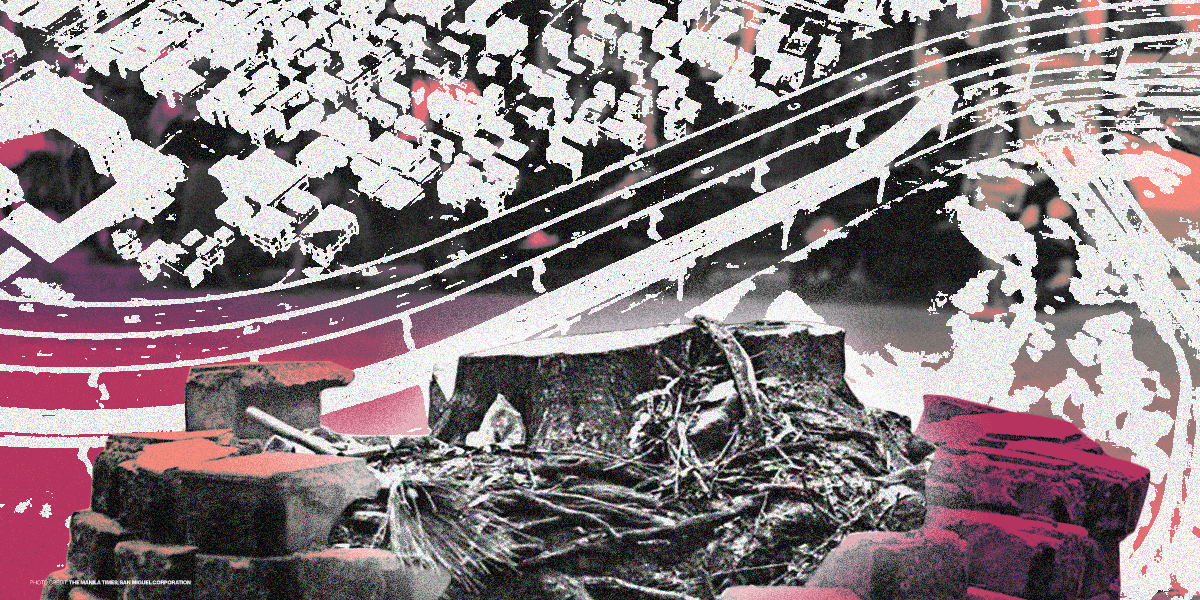
The Department of Environment and Natural Resources (DENR) cut trees; it was bad. In fact, it’s terrible for the environment, and we got mad.
But it’s not just trees that the government passively allows to be damaged. Our seas, land, air, and other natural landscapes are also deteriorating at the cost of so-called development that the government allows to flourish.
Trees have been cut for highways, the waters are reclaimed for fake beaches, and mountains are flattened for private mining or energy projects. Then, the government says this is for our own good.
Water and air are not spared
Take the Manila Bay Reclamation for example, carried out with the premise of livelihood and job creation, beautification of Metro Manila, and other bright future assumptions. The project covers almost 10,000 hectares of land and water area, featuring 25 dump and fill projects. These include San Miguel Corporation’s New Manila International Airport, SM Prime Holdings Pasay 265 Projects with the construction of new business district areas and other mixed-use commercial and residential projects, and Horizon Manila, an inter-island community, residential plan spearheaded by JBros Construction Group, currently negotiating with European contractors.
None of the bright future promises is taking place. What is happening is coastal erosion, dwindling biodiversity, and ginormous levels of water toxicity. The sea is contaminated with fecal matter, which the DENR blames on informal settlers, but the toxicity is primarily caused by wastewater discharge from nearby establishments.
Land subsidence is a threat. Based on a 2014 study, Metro Manila’s coastal areas were found to be sinking by nine centimeters every year. The liquefaction of land will eventually act like quicksand, while storms and earthquake-induced ground shaking will become more prevalent. Reclamation projects also destroyed mangroves—99% of the mangroves had been uprooted between 1890 and 2016. Mangroves absorb carbon dioxide and act as natural barriers to flooding and tidal waves.
Fisherfolk working in the bay reported that the waters have gone from transparent to muddy, reddish, and murky, while there are fewer fish to catch . Despite categorizing it as an ‘integral biodiversity area’, the DENR has no plans of protecting Manila Bay, and there are still no set guidelines for approving reclamation projects.
Another case in point is the Smokey Mountain waste-to-energy facility.
Smokey Mountain is a former dumpsite, now housing an estimated 55,000 residents across multiple barangays in Manila. Earlier this year, the residents expressed fears of losing their homes and livelihoods due to a Php26 billion peso waste-to-energy (WTE) project, first announced in 2025.
The project is said to process about 3,000 tons of municipal waste daily and convert it into electricity. But environmental groups and the residents vehemently oppose it, as the identified key company in the project is Philippine Ecology Systems Corp (PhilEco), which has a dirty record of environmental compliance issues. The company has had 10 notices of violation related to the Clean Water Act, Clean Air Act, Ecological Solid Waste Management Act, and its own Environmental Compliance Certificate. PhilEco was also suspended in 2017 over the disposal of untreated leachate into Manila Bay.
Public health will also be put at stake, since waste incineration has documented risks, including respiratory infections, adverse birth outcomes, impacts on brain and lung function, obesity, asthma, otitis media, cancers, and increased mortality.
The WTE will have emissions, including ultrafine particles that cause these health risks, say several environmental science and engineering experts. The WTE incinerator also produces toxic ash, wastewater, pollutants, and other fine particulate matter. These cause acid rain, harm fish and wildlife, cause cancers in animals, stunt plant growth, halt animal access to oxygen, contaminate bodies of water, and destroy ecosystems.
Plunder by policy
President Marcos Jr increased the climate change fund seemingly in solidarity with the world to address the climate crisis. But we see the exact opposite of improving the environment—the environment is shouldering the cost to make way for profit-driven developments.
Private projects are the #1 cause of environmental harm, destruction, public health risk, human displacement, among others—a striking contrast against the government’s faux campaign on climate change adaptation.
The government promises to recover from the cut trees, damaged waters, and polluted air. Unfortunately, the replacements of trees and replanting will take a long time to take effect, and will not be as valuable as the original trees that were there before. Also, the administration has not proposed any new programs and policies for the rehabilitation of Manila Bay. It has not actively responded to the community’s struggle against the WTE incinerator in Manila.
The Marcos Jr administration is showing indifference to environmental ruin because it is the enabler of the profit-driven projects. It benefits from the support of oligarchs who are implementing the likes of Pasay 265 Projects and New Manila International Airport, while the local oligarchs in partnership with foreign companies gain gargantuan profits from plundering the environment, with government protection. Lastly, bureaucrats gain commissions from this plunder. We’ve seen under the administration how the country’s highest officials amass great fortunes from anomalous flood control projects in the name of environmental sustainability, putting the people in greater peril.
We should get really mad.