
Yes, unless you are doing a study on the lifestyle of the rich in BGC!
Seriously, yes. If we are to understand the social conditions that keep this nation poor despite its natural wealth, researchers, as a matter of duty, should go beyond the screens of their computers and immerse themselves in the social phenomenon. As a researcher, you should go deeper into the radiks, the roots of the problem in order to find solutions—you are inevitably called to be a part of a change movement. For what is the point of research, then, when it does not engage?
Unforgettable respondents
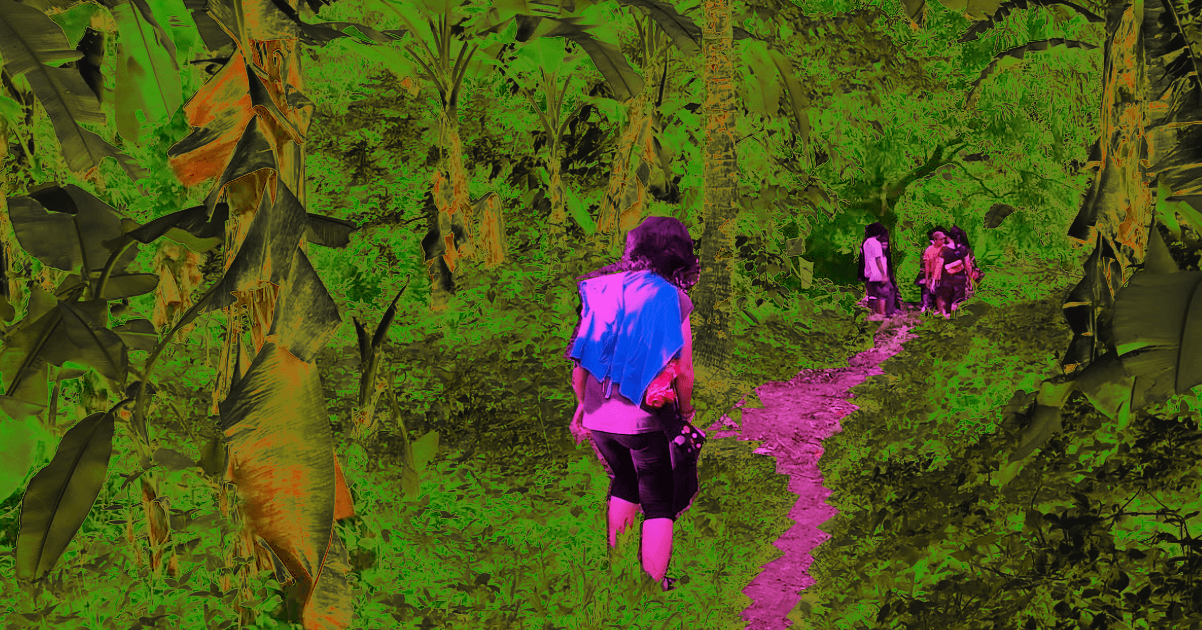
Five years ago, one of my first assignments as a researcher at IBON was to document the Bungkalan, or the collective land cultivation practice of several farming communities, during the pandemic. Inspired by the practice of Negros farmers during tiempo muerto or dead season, several Bungkalan communities around the country persevered in their collective farming, urgently for food security but also strategically to assert their right to till the land.
Many of our respondents were farmer leaders who had long been targets of harassment by state agents and armed forces. Our team had to take different routes going out of the community to avoid being seen by the military and armed goons. I also remember when, in the middle of our focused group discussion or FGD, one farmer had to step out to receive a call from a local government employee. He was told to give up the collective farm—the caller insisted that the land was owned by the local government.
Another unforgettable field experience was an FGD with farmers who had been jailed and forced off their land. They were in a dispute with a private real estate company that claimed ownership, but the farmers stood their ground and refused to leave. The area was barricaded. Their electricity was cut. Their homes were demolished, and they were violently dispersed. One story that stood out was that of an elderly woman who was arrested and jailed for theft after allegedly taking one sack of banana plantains from the barricaded area—an absurd accusation, yet it was upheld in court. But the most harrowing story from this community was the killing of one of their leaders—his body was found cemented inside a drum and dumped several kilometers away from their community.
Confronting dilemmas
The protocol in our field research is simple: we make courtesy calls to local government officials, bringing letters addressed to them, and, if the research has a small grant, provide SEC forms for barangay officials to fill out. Otherwise, you may be accused of “financing terrorism”.
I was naïve then, following the protocol to the letter. Local organizers, however, deemed it unsafe, knowing that the local government is in collusion with some private, vested interests. After hearing their stories, I realized the dilemma. Should I follow the protocol at the expense of my respondents? How can the farmers trust me with their stories if following the protocol puts them at risk?
Another dilemma I was confronted with as a young researcher was the endless debate on methodology. The validity of research is not constrained by the methods imposed by the academe. Research is an iterative process, where social conditions are the subjects of investigation from which theories are derived and brought back to social practice. Research is a process of knowing that is open to all, where the communities, which are the subject, can also be the object of research through participatory methods. Research is not merely reserved for “intellectuals” with formal degrees—it is a people’s process of knowing their own conditions so they can come up with solutions.
The goal of our research is not to build our resumes or add another publication under our names. It’s not even my story. The objective of the study is to document the farmers’ stories, expose their working conditions, and how they are being treated unjustly by the state.
I matured as a researcher in the process, not just asking questions and recording responses, but also joining some of the community’s farming and household tasks to understand and experience for myself their hard life. I recall going to the farm one day, wearing only strapped sandals, when one woman farmer lent me her boots. She is dead now—her heart gave out at the height of relentless harassment by state agents against her and her husband. (I’ve already told this story in another article.)
Picking it up forward
The Toboso 19 massacre has made me reflect on my journey as a researcher, amid debates and black propaganda that question why researchers, journalists, and peasant advocates like Alyssa, RJ, Errol, Maureen, Lyle, and Kai were even there in the boondocks. Some academic researchers have even circled back to the debate on protocols and methodologies.
Immersing in the community and experiencing their daily condition is a valid research methodology called ethnography. It is an in-depth study of a community to form a deeper analysis of their daily life, patterns, and relationships to bigger contexts. Even other methods, such as participant observation, process documentation, life story, fact-finding mission, and the like, require a modicum of community integration.
We have a running joke in the office that your research design should be simple and clear, so when you die before finishing the research, whoever picks up the design can easily finish the research. But more than research designs, the deaths of the Toboso 19 have left me with a more valuable lesson: the truth reveals itself when you are out there in the field, asking the right questions and putting your life on the line in service of the people, who should be the subject and object of your research. More than being iterative, research is a liberating process.