
As the country marks its 128th year of independence, we are once again reminded of how our forefathers fought for freedom from Spain, only for that victory to be seized by the Americans. Philippine flags are hoisted once more along major roads and in government offices, but for what celebration?
The 128 years include more than four decades of direct American colonial occupation and more than eight decades of neocolonial relations that continue to shape the Philippine economy, politics, and culture.
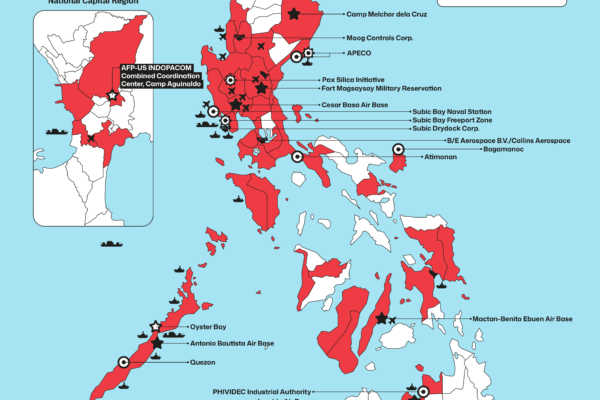
Probably the starkest contradiction on Independence Day is the growing US military presence, which has become more pronounced and brazen than at any point since the removal of the US bases in 1991. With Trump 2.0’s pursuit of American economic security, the Marcos Jr government has not skipped a beat in offering both military and civilian facilities for US geopolitical interests. It has committed to be part of the US-led initiative, Pax Silica, to secure global supply chains for semiconductors, in particular, initially offering 1,600 hectares for this hub as part of the Luzon Economic Corridor.
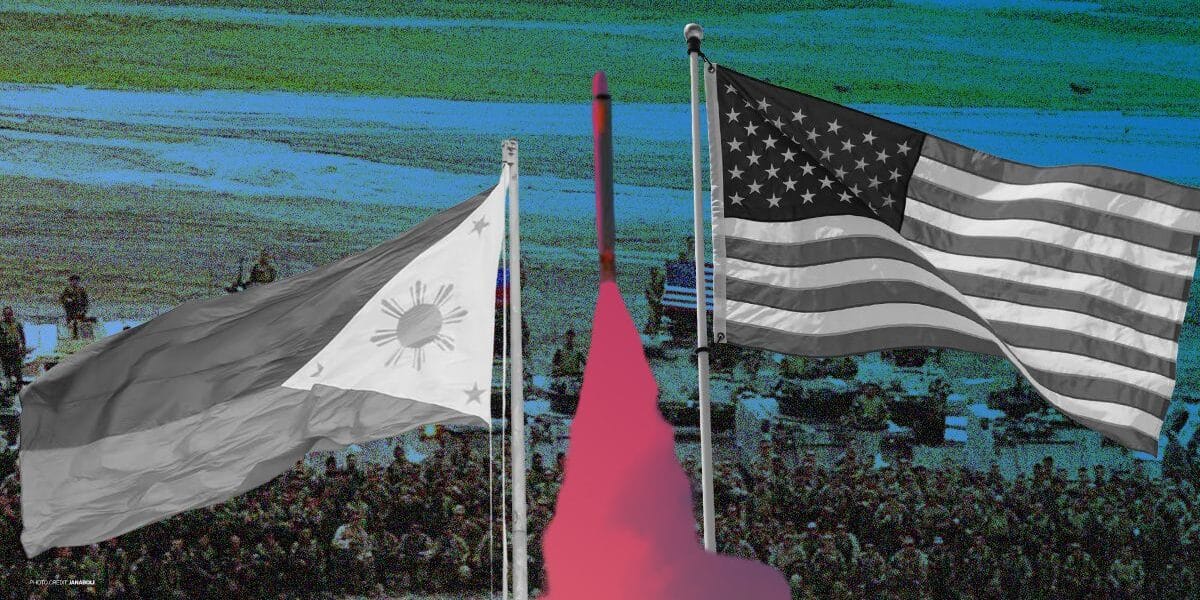
The test firing of a Tomahawk cruise missile using the land-based Typhon system from Tacloban, Leyte, to its target in Fort Magsaysay in Laur, Nueva Ecija was a striking sight in the backdrop of the largest Balikatan exercises so far, the legal basis for which, the colonial US-PH Mutual Defense Treaty, turns 75.
Asia’s oldest republic is America’s most reliable lapdog in the Pacific. Beneath the flag-waving and ceremonial display of Pinoy pride, there also appears to be a contradiction of a miseducated citizenry whose trust in its former colonizer has never wavered—82% of Filipinos to be exact, according to Pulse Asia’s December 2025 survey.
Whenever Chinese ships bombard PH fishing vessels, or whenever Chinese espionage is raised in Senate hearings, the notion of ‘sovereignty’ is invoked. The US has 750 military bases and facilities in at least 80 countries, including the Philippines; China has only one in Djibouti. The US is the single largest defense spender in the world, still 150% bigger than the spending of the next four countries (China, Russia, Germany, India) combined. While Chinese vessels are out there in disputed territorial waters, US troops are right here on Philippine soil in a permanent rotational basing.
There was once a president who pursued an “independent foreign policy”—he was perceived to be anti-US and pro-China. This patriarch of a political dynasty is hounded now by his upcoming trial in the International Criminal Court (ICC) for crime against humanity, and his daughter, groomed to be the next leader in line, is about to undergo her own trial for impeachment. They continue to wield influence among their bailiwicks—their allied senators have declared themselves as the “independent majority” and the “true Senate of the Philippines”. Have they presented an “independent foreign policy” amid all this political drama as against the Marcos Jr administration’s visible allegiance to US hegemonic geopolitical interests? No. Has anybody mentioned the fact that it was the Duterte administration that granted the first four Enhanced Defense Cooperation Agreement (EDCA) military installations to the US, while the Marcos Jr administration granted the rest, including non-EDCA facilities and neocolonial bilateral security guidelines?
US neocolonial control of the country is the bedrock of the rotten political system and the oligarch-dominated economy. The Philippines acts as a reliable pawn for such neocolonial control, ever facilitated by a neocolonial state. The collateral is paid by the Filipino majority who remain impoverished, and disenfranchised, who are battered by crisis after crisis, and chronically exploited by the country’s elite and foreign masters.
Can the Filipino still manage to smile towards resilience—forgiving and forgetting the various ills that afflict the nation? Or is this one of those lies that our colonial education wants us to imbibe?
We carry a history of struggle and resistance, of vibrant social movements that had held power to account, of revolutions, which despite being snatched and vowed to be crushed, remain aflame. The Filipino people have deposed tyrannical and corrupt presidents, and have produced generations after generations of activists, critics, and concerned citizenry.
As we sing the national anthem and admire the Philippine flag on June 12th, may we be reminded that our nation, in all its beauty, is still mired in crisis and war. Injustice rages on, and genuine freedom remains elusive for many. But hope shall always spring forth from a people never wavering from a dream of a better Philippines.