

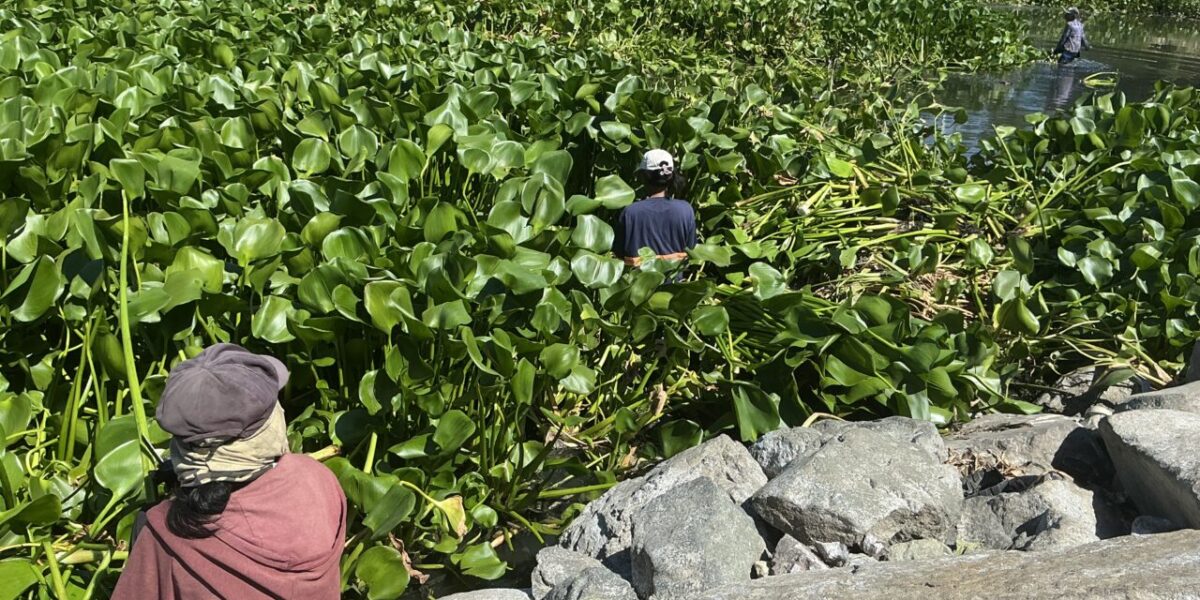
The month of June has arrived, and so have the rains. Soon, even Erlinda Coyos and Purok Sais women’s other main source of income on Laguna Lake—gathering and drying water hyacinths—will be overtaken by the wet season.
“When the clams disappeared, the water lilies became our alternative. At least we still have a source of income, even if it’s just loose change,” said Erlinda.
Water hyacinths—or water lilies, as locals often call them—have swarmed the women’s usual clam-diving areas. This may also be one of the reasons the clams disappeared. The women have since turned their full attention to water hyacinths.
Like clam gathering, this livelihood thrives during the dry season from December to May. Previously, they could begin harvesting water hyacinths in November. In recent years, erratic weather patterns have pushed harvesting well into the dry season.
“We were able to start gathering water lilies in February this year when the rains stopped, and the lake water level went down,” Erlinda shared.
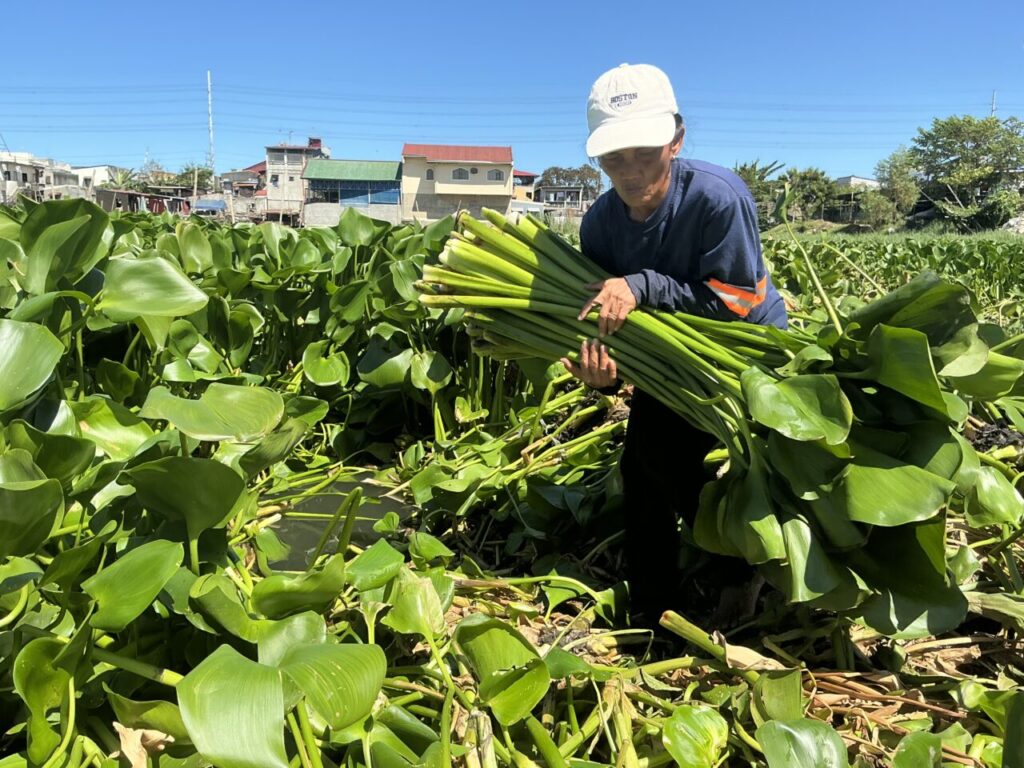
In 2022, a livelihood program from the Muntinlupa City local government’s Gender and Development Office allowed the women to sell dried water hyacinth stalks for P500 (US$8.27) per bundle. One bundle contains 1,000 stalks, with each stalk valued at P0.50. Each stalk must measure at least 35 inches; shorter ones are rejected, though the women keep them for weaving bags at home after the harvest season.
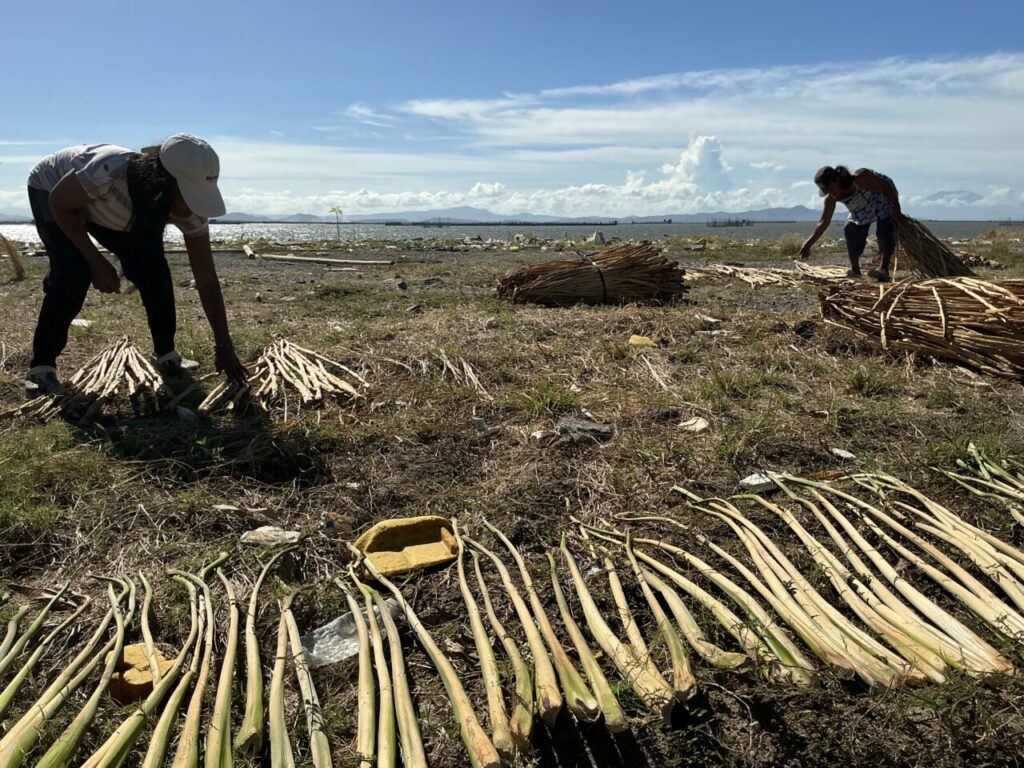
“We pick water lilies every day. We clean them, save the stalks, and dry them. It takes three days for the surface to turn brown. We lay them out in the sun until they are completely dry. When we have at least one bundle, we can sell them. Usually, we deliver to the office once a month, sometimes twice,” said Erlinda.
The work takes the whole day, and the first trickle of income comes after nearly a month.
This is because the stalks take about three weeks to fully dry. While waiting, the women continue gathering water hyacinths. The drying process requires them to check the stalks several times a day, turn them over, protect them from unexpected rain, and bundle them properly so they can be laid out easily again the next day.
In the past, they had to go farther from shore to reach the plants. They built makeshift bamboo bridges to reach them. Falling into the water was commonplace.
“I nearly drowned several times. I almost died. But that did not stop me because we would have no income. My husband is sick. How can we survive if I can’t make a living?” said Erlinda.
They also face the task of hauling stalks from the water to their makeshift storeroom—a shed where they rest, eat, and take shelter from heat and rain.
For the women, even if the work is strenuous and tedious, it guarantees some income.
“It’s really hard work. But we won’t earn anything if we just sleep or stay idle at home. It’s hard to rely on others or on a single source of income,” said Erlinda.
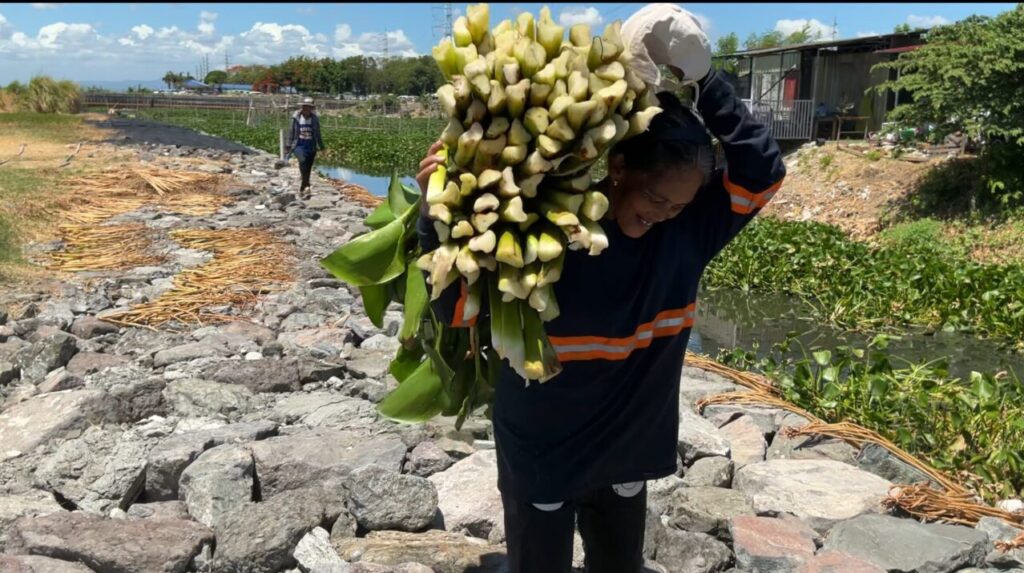
The free-floating aquatic plants have drifted and gathered between the lakeshore and a long strip of reclaimed land built around 2018, where a small cove formed as an unintended result of soil dumping. This is where the women used to dive for clams, but the clams have since disappeared. The empty stretch of land is now where they dry water hyacinths, making their work somewhat easier.
“Fishers consider the water lily a pest. Fortunately, they drifted here so they would not hinder boat movements as much,” Erlinda said.
Because it spreads quickly, the plant often chokes waterways, snags fishing nets, and endangers marine life by blocking sunlight and reducing oxygen levels in the water.
Poor water circulation and high levels of pollution have been identified as drivers of water hyacinth infestation.
The fisherfolk group Pamalakaya has also blamed the Napindan Hydraulic Control Structure for the proliferation of invasive species, including water hyacinths, janitor fish, clown knifefish, and tinfoil barb. The group has called on the government to permanently open the structure to allow Manila Bay and Laguna Lake waters to mix, to help rehabilitate the lake and restore its natural abundance.
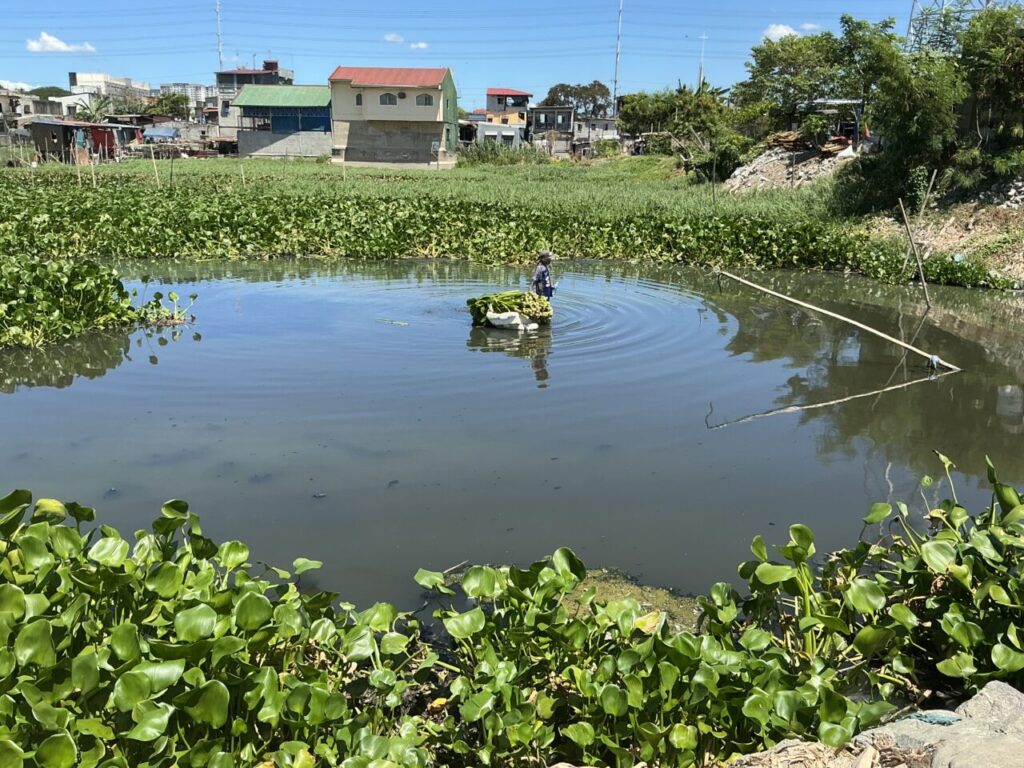
In four months of producing dried water hyacinth stalks, Erlinda’s earnings totaled about P10,000 (US$165.40). She was not dissatisfied or disheartened by this.
“If you don’t have too many distractions, you can earn more. One of my fellow harvesters earned P8,000 in one delivery. You just have to harvest a lot. Even if it takes long to dry, as long as you gather enough, you won’t lose out,” said Erlinda.
As for Erlinda, she still has to look after her home, her grandchildren, and her ailing husband.
The rainy season has begun, but as long as it is not raining, the women try to make the most of every sunny day left.
“Even when the days were very hot, we collected as many water lilies as we could. But now, even if we want to, if we cannot fully dry them under the sun, mold will form in the bags we weave,” Erlinda said, lamenting the end of this year’s harvesting season.
Bag weaving provides the women with alternative income when they can no longer harvest water hyacinths during the rainy season. The local government also engages them to weave bags using the stalks they have sold.
The women are paid around P70 (US$1.15) for each bag they weave, following specific designs required by the livelihood program. The rejected stalks they keep also allow them to take orders from the program using their own stock, for which they are paid P100 (US$1.65) per bag. Bag weaving can be done year-round.
“That P500 sale for dried water hyacinth stalks becomes over P1,000 if we can make 10 bags from one bundle,” Erlinda said.
The women can shift quickly from one livelihood to another as the seasons change and new needs arise.
Yet their ability to adapt may soon be constrained by an expressway project that could force them from the lakeshore and cut them off from the livelihoods they have long depended on.
Erlinda has long believed that the land where they dry the stalks would have been connected to the C-6 Road or the planned lakeshore expressway if their homes had not stood in the way.
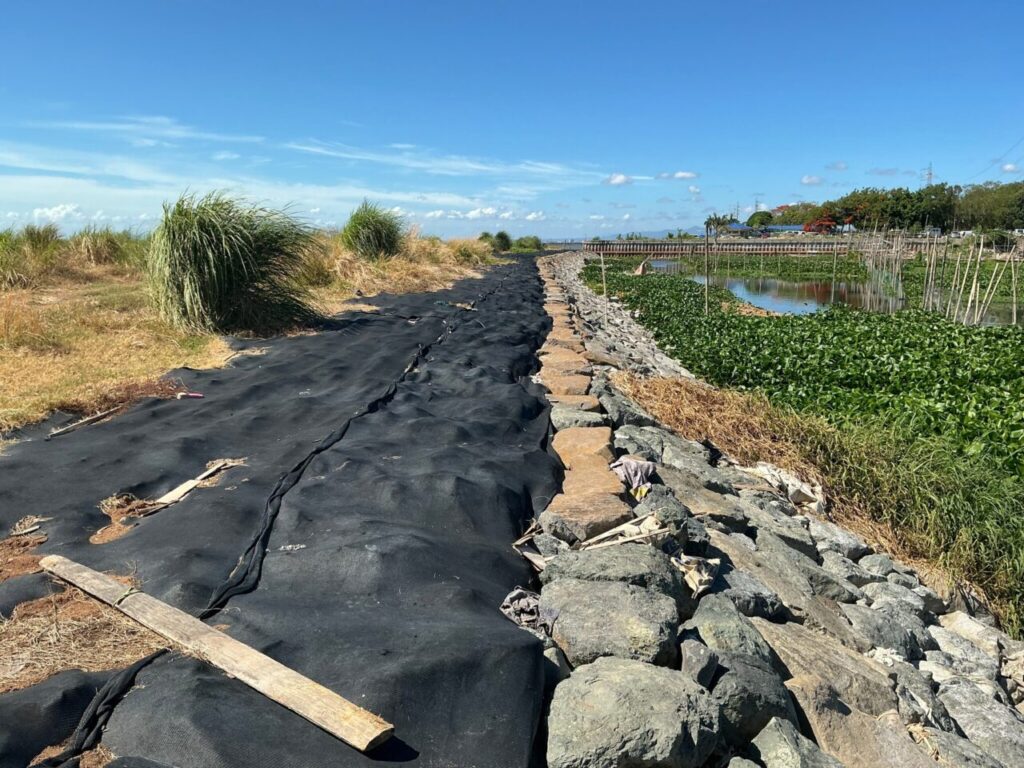
“If we are kicked out of here, where will we go? How will we live? We will no longer be able to catch clams. We will no longer be able to gather water hyacinths,” Erlinda said.
The threat of demolition has loomed over them for more than a decade. However, it has been less immediate than the more serious threats of typhoons and severe flooding they have endured over the decades.
“We have lost our home not less than four times due to strong typhoons and floods. High typhoon signals would wash out homes in our community. We rebuild each time. Lower signals could immediately trigger evacuation. We return after a few days,” Erlinda shared.
But the current proposed solution to flooding would not benefit them, as it would require demolishing their homes.
The Laguna Lakeshore Road Network (LLRN) would cut through their communities, or itself contribute to flooding in low-lying settlements like theirs.
“Even if it’s hard, even if it’s hot, even in storms, I won’t give up as long as I can find a means of living here,” said Erlinda.
Save Laguna Lake Network, an alliance opposing reclamation in the lake and the displacement of communities, has warned that the LLRN may worsen the challenges facing Laguna Lake and the small communities that depend on it.
“Ironically, to address significant climate risks, more structural measures were recommended on top of the massive infrastructure that created these risks in the first place,” the group said.
Only time—and the quality of life in lakeshore communities—will show whether the trade-offs are worth it, or whether the benefits outweigh the damages.
“Once civil works for the project begin, lives will be displaced or disrupted,” the group added.
The lake’s multiple and conflicting uses, combined with changing seasons, allow it to both provide and take away. Because of the lake, many people live and earn a livelihood, and communities have thrived. But population growth, rapid industrialization, and unregulated aquaculture have led to pollution that continues to affect the lake’s life-giving capacity.
In the end, those who contribute the least to these pressures and take the least from the lake stand to lose the most.
—
With additional reports from Agatha Rabino, Czyrene Farrales, Rafael Mendoza, and Roy Barbosa
This story was produced with support from the Asia Pacific Forum on Women, Law and Development (APWLD) Feminist Media Fund for Alumni.

