
International election observers from the European Union refuted allegations its mission aimed to interfere in Monday’s elections, complaining it was the Commission on Elections (Comelec) that did not honor agreements to allow them full access to the entire electoral process.
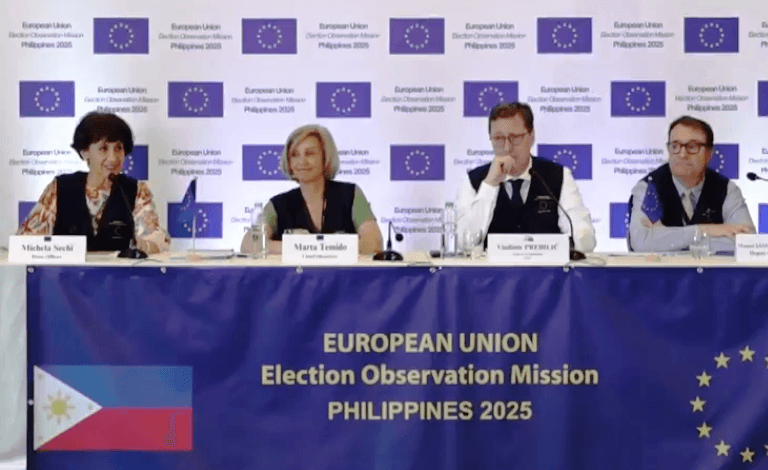
In its exit statement presented on Wednesday, the European Union Election Observers’ Mission (Eu OEM) said Comelec disregarded prior commitments, undermining their ability to observe voting procedures.
“As a result, the EU EOM could no longer ensure meaningful observation of the voting phase in all polling stations during the voting hours. Consequently, the Mission did not deploy its full team of observers as originally planned,” Chief Observer Marta Temido said in a press conference.
Vladimir Prebilič, head of the of the six-member delegation of European Parliament members, expressed disappointment at the Comelec snub as they were formally invited by the Philippine Government and the Comelec.
Prebilič said they were equally shocked when Comelec informed them four days before election day that they could not observe the voting process inside precincts.
He repeatedly pointed out that EU and Manila signed an Administrative Arrangement setting the basis for the mission, granting the EU EOM and its members “freedom of access, at any time, to all polling stations and counting/tabulation centers.”
He added that they tried as late as Sunday to seek an audience with Comelec chairperson George Erwin Garcia to try to find solutions to their predicament, “but not a single one met them.”
Prebilič said that the Comelec cited that local laws do not allow international observers inside polling precincts, adding however the poll body knew of such laws when the agreement was signed last March.
As a result, the EU OEM said it is not in a position to assess the voting process in line with its methodology and mandate to “to observe all aspects of the electoral process.”
Corrupted process
Despite having 226 observers from EU member states, Canada, Norway and Switzerland, the mission decided to field only 82 teams in 92 polling precincts across the country.
In eight of them they were denied access.
From what it was able together, the mission observed that the elections took place against the backdrop of a continued dominance of few political families in the lists of candidates, detracting from overall competitiveness.
The process was also marred by election-related violence, including on election day,” the chief observer Temido added.
EU observers said they witnessed several credible indications and received reports of vote-buying through cash and goods, as well as partisan distribution of welfare payouts.
Violent incidents marred the election process in some parts of the country, including through at least 30 killings of candidates and election officials” Temido noted.
While violence was more prevalent in local rather than national elections, “it influenced the overall atmosphere, resulting in widespread intimidation in several provinces,” she said.
“Violence during an election is utterly unacceptable, particularly when it results in the loss of dozens of lives. A democratic electoral process should never be associated with such tragic incidents” Prebilič added. # (Raymund B. Villanueva)