
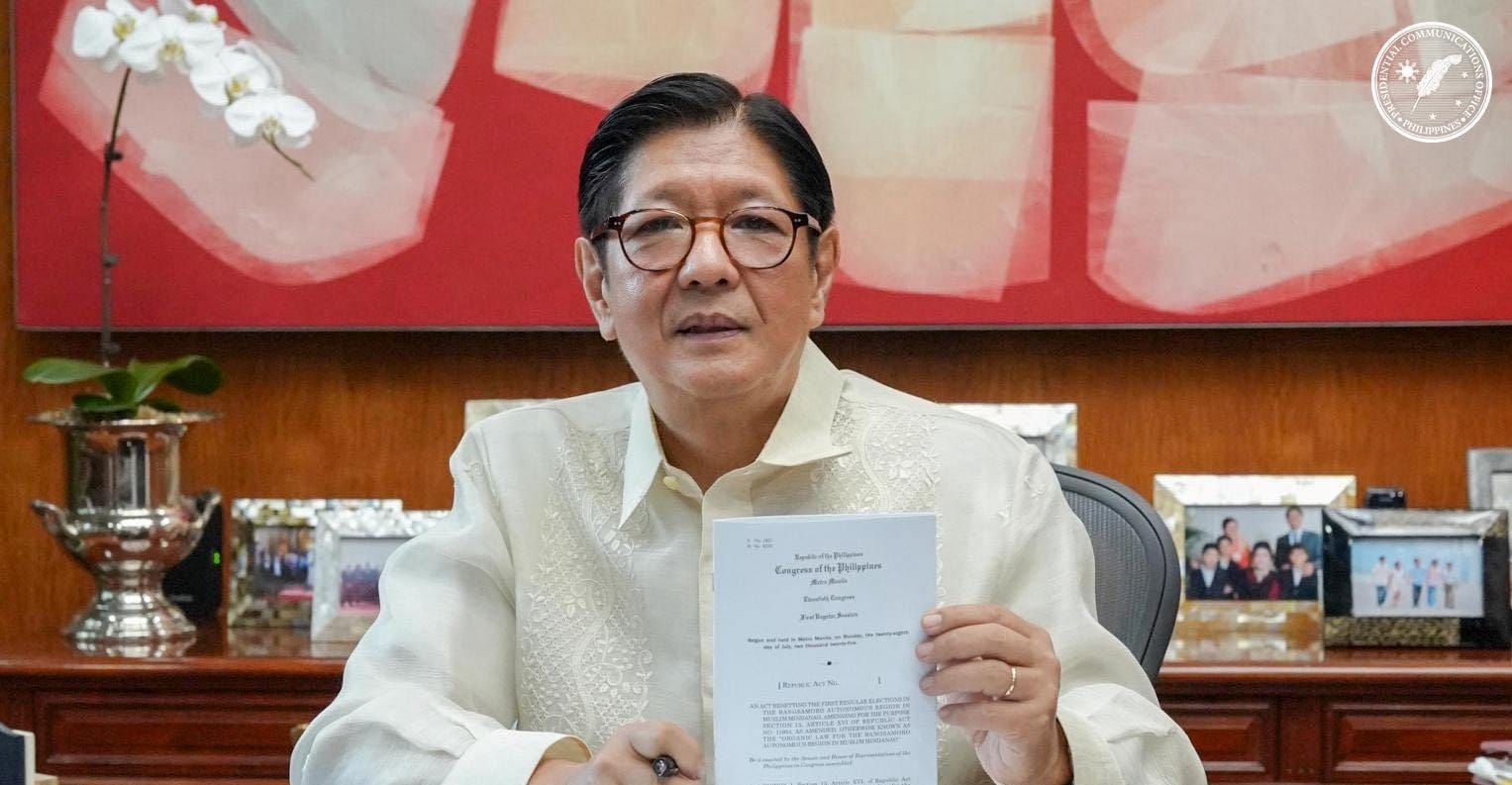
Elections in the Bangsamoro Autonomous Region in Muslim Mindanao (BARMM) have been postponed yet again after President Ferdinand Marcos Jr. has signed a new law on Wednesday resetting the polls to later this year.
Aimed at choosing officials for the newly-created BARMM, Marcos signed Republic Act No. 12317 ordering the elections to be held on September 14.
The law amended Republic Act No. 11054, or the “Organic Law for the Bangsamoro Autonomous Region in Muslim Mindanao,” which originally set the elections to be held alongside the Philippines’ May 2022 national and local elections.
There have been three postponements since then due to several reasons, including the removal of Sulu province from the regional formation. Sulu’s exclusion is being challenged in the Court.
Marcos’ new law allows the Bangsamoro Transition Authority to continue as the interim government for the Muslim region in southern Philippines.
After decades of struggle for autonomy and several peace negotiations between Manila and Bangsamoro movements, Muslim Filipinos now have the right to another political entity of their own composed of executive, legislative and judicial branches.
The BARMM replaced the earlier Autonomous Region in Muslim Mindanao entity created in the year 2000 and dissolved in 2019 following the ratification of the Bangsamoro Organic Law (BOL) via a plebiscite.
The BOL said the BARMM is “in recognition of the justness and legitimacy of the cause of the Bangsamoro people and the aspirations of Muslim Filipinos and all indigenous cultural communities,” in the region.
It added that the formation seeks to “secure their identity and posterity, allowing for meaningful self-governance within the framework of the Constitution and the national sovereignty as well as territorial integrity of the Republic of the Philippines.”
Subdividing the already divided
Creating the political entity, however, is not as easy as it seems as various political families are also demanding the creation of congressional districts their dynasties may control, contributing to the delays in the holding of elections.
Muslim Mindanao was the most politically-advanced region in the Philippines before Spanish colonial times and the location of the powerful sultanates of Sulu and Maguindanao.
The region resisted Spanish and American invasion, with calls for either autonomy or secession citing historical reasons of not being consulted if they wished inclusion when the Republic of the Philippines was created at the turn of the last century.
The area in the southwest part of Mindanao Island had 13 ethno-linguistic groups that have distinct cultures from the rest of the Philippines primarily due to its Islamic-Malay orientation. # (Raymund B. Villanueva)