
The Philippines is facing intensified legal pressure on journalists, as press freedom worldwide falls to its lowest level in 25 years, according to the 2026 World Press Freedom Index released by Reporters Without Borders.
Ranked 114th in the latest index, the Philippines reflects a broader trend across Asia, where governments are increasingly using laws tied to national security and public order to restrict journalism and silence independent reporting.
The report said the legal environment for journalism has deteriorated most sharply over the past year, with such laws increasingly deployed to limit access to information and criminalize media work. “Since 2001, the expansion of increasingly restrictive legal arsenals — particularly those linked to national security policies — has been steadily eroding the right to information, even in democratic countries,” RSF said.
In the Philippines, these pressures take multiple forms. Despite constitutional guarantees of press freedom, criminal defamation remains punishable under the penal code, carrying prison sentences that can reach up to six years. The Cybercrime Prevention Act imposes harsher penalties for online libel, reinforcing a climate that fosters self-censorship among journalists and media organizations.
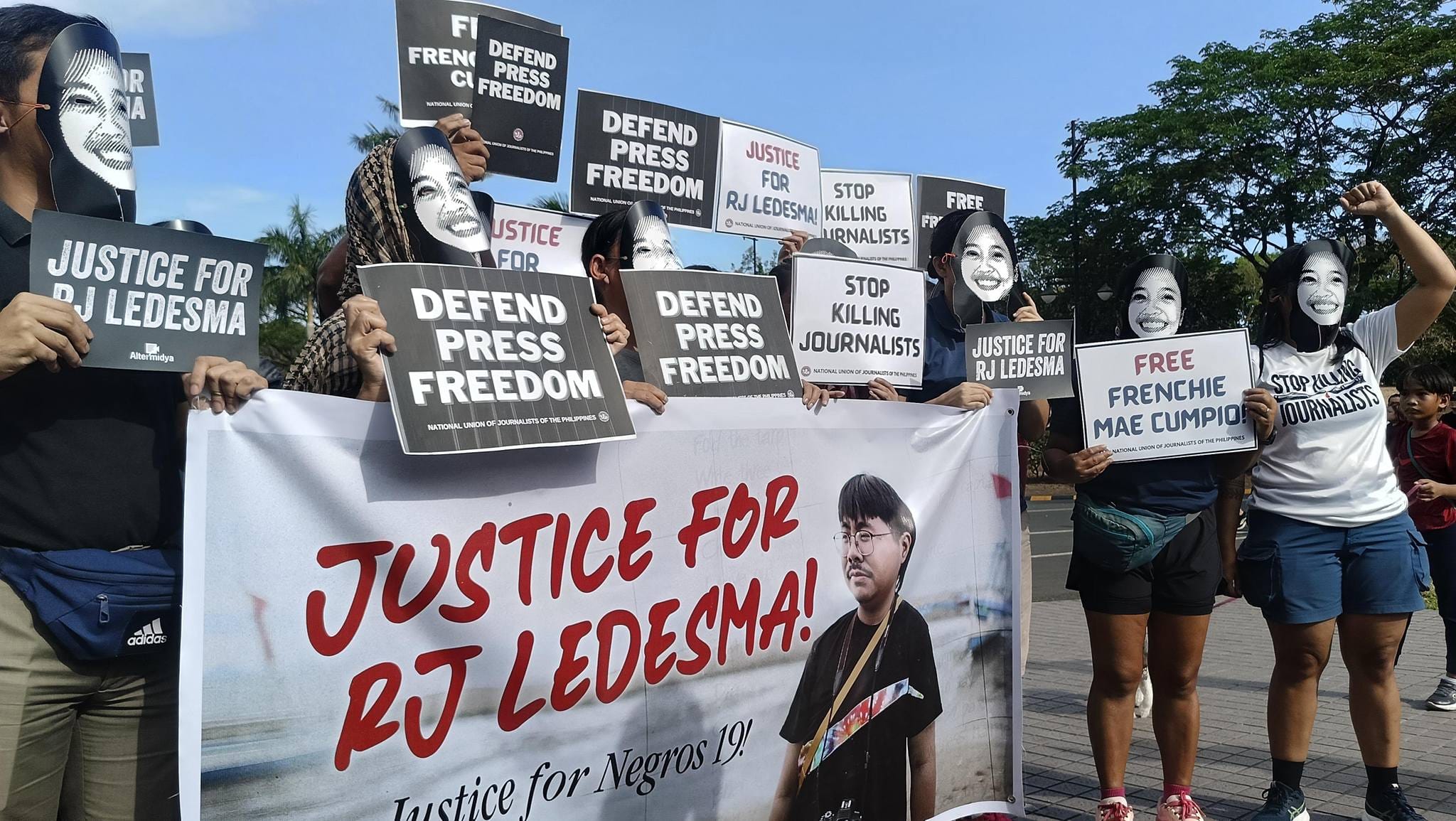
RSF also pointed to the use of terrorism-related charges against journalists. The case of Frenchie Mae Cumpio, who was convicted despite what the group described as a lack of tangible evidence, underscores how legal mechanisms are used to target critical reporting. The report said such cases mirror a broader pattern in which laws are used to constrain journalism rather than protect it.
Political pressure continues to shape the media environment. The report said the impact of former president Rodrigo Duterte’s administration, marked by legal action against critical media, persists. Under President Ferdinand Marcos Jr., authorities continue to resort to “red-tagging,” a practice in which journalists are labeled as subversives or linked to armed groups, exposing them to threats, surveillance, and prosecution. Several journalists from independent media networks have faced charges tying them to alleged terrorist activities.
Economic pressures also weigh on the media landscape. Ownership has become increasingly concentrated, with closer ties between media companies and political actors raising concerns about editorial independence. Broadcast media remains dominant, with major networks commanding large audiences, while ABS-CBN continues to operate primarily online after losing its franchise in 2020. Independent and regional outlets, including long-standing newspapers, face financial strain, limiting their ability to sustain operations.
The report also highlighted how disinformation and political polarization are reshaping the country’s information space. Widespread use of social media has enabled the rapid spread of false information, often amplified by networks of fake accounts. During the 2025 election campaign, a significant portion of online discourse was driven by inauthentic activity, distorting public debate and weakening trust in credible journalism.
Beyond legal and economic pressures, journalists in the Philippines continue to face serious safety risks. RJ Nichole Ledesma, editor of Paghimutad-Negros and Altermidya Negros regional coordinator, was killed on April 19 during a military operation in Toboso town, where authorities reported a clash with communist rebels. Rights groups and media organizations said Ledesma was in the area for immersion reporting and disputed claims that those killed were all combatants. His case is not yet reflected in the 2026 RSF Index.
The Philippines remains one of the most dangerous countries for journalists. RSF pointed to persistent impunity in killings, including the 2009 Maguindanao massacre, and said existing protection mechanisms have not been enough to stop attacks. Journalists, particularly in the regions, continue to face threats, harassment, and legal intimidation, while women journalists are subjected to gender-based abuse, including online harassment and threats of sexual violence.
RSF said the Philippines mirrors a wider regional pattern in which both democratic and authoritarian governments rely on legal measures to control the flow of information. Across Asia, authorities in India (157th) and Myanmar (166th) have used anti-terror laws to detain journalists, while China (178th) and North Korea (179th) maintain near-total control over the media.
RSF described the global trend as the “criminalization of journalism,” driven by misuse of laws and judicial processes. RSF Editorial Director Anne Bocandé said the decline is driven by “the misuse of national security laws, SLAPPs, and the systematic obstruction of those who investigate, expose and name names.”
The 2026 Index shows that more than half of the world’s countries now fall into the “difficult” or “very serious” categories for press freedom, the highest proportion recorded since the index was launched 25 years ago.
“For the first time in the history of the Reporters Without Borders (RSF) World Press Freedom Index, over half of the world’s countries now fall into the ‘difficult’ or ‘very serious’ categories for press freedom,” the report said.
RSF warned that legal pressure is increasingly central to how press freedom is curtailed.
“Journalism is being asphyxiated by hostile political discourse towards reporters, weakened by a faltering media economy, and squeezed by laws being used as weapons against the press,” the report said.
RSF said stronger protections and accountability mechanisms are needed, particularly in democracies where legal tools are increasingly used to curb press freedom.
“We need firm guarantees and meaningful sanctions,” Bocandé said. “The ball is in the court of democracies and their citizens.”