

By Mary Jean D. Villabeza
Claim:
The Philippine government and its economic team have always been adamant in their claim that increases in the price of oil products in the country are “beyond government control” because of the movement of oil prices in the world market. The narrative presented in this study argues that, being a net importer of fuel, the Philippines is a “price taker” and that its economy is at the mercy of the vagaries of the world market. Moreover, the Philippine government claims that the Downstream Oil Industry Deregulation Act of 1998 (RA 8479) has already safeguarded the welfare of the consumers by promoting a competitive environment where “market forces” dictate the “most efficient price” and prevent the government monopoly from “artificially” fixing the price.
Rating: Misleading / Violation by Omission
Though it is undeniable that crude oil prices worldwide are subject to various external factors, as Dubai crude oil has crossed the $80 per barrel mark in March 2026, the final price at the pumps is a result of domestic policy decisions. The “helplessness” of the State is a mere legal construct based on the failure of the State to exercise its power of oversight in regulating or amending the regressive tax structure in the cost of fuel. By adhering to a policy of non-interference, the State has failed in its “duty to fulfill” its international human rights obligations. The presence of legislative provisions to reduce fuel prices is a clear indication of the State’s failure being one of choice, not of power.
Impact on the Community:
The uncontrolled escalation of the price of oil has triggered a “domino effect” which has resulted in an undermining of social equity at all levels of Philippine society. With regard to the agricultural sector, the Department of Agriculture has recognized the inescapable relationship between the escalating prices of fuel and fertilizers, and the expenses of freight. This has resulted in the 9,700 farmers and 15,800 fisherfolk, or a total of 25,500, being trapped in a vicious cycle of debt, with production expenses being greater than the returns from the market. This is a direct attack on the “right to food” of ordinary Filipinos, including food producers.
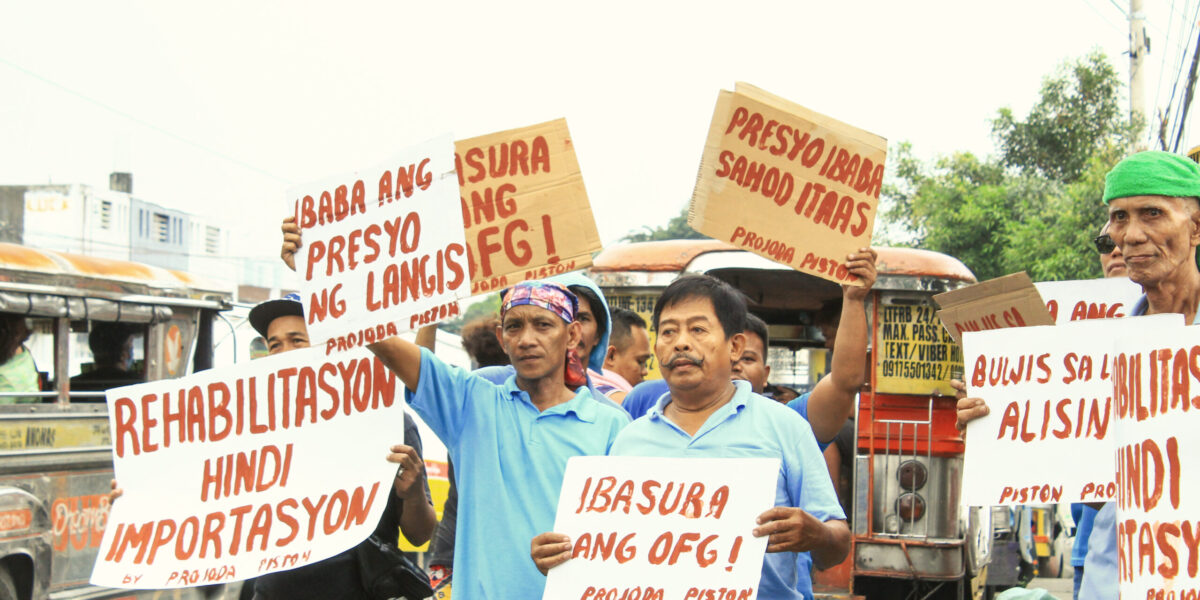
In the urban centers, the transportation sector is currently experiencing what the sector’s advocates have termed “hunger spells.” A 2024 qualitative study “Unveiling the Torments and Agonies of the Transportation Sector” established that the fuel price increases have resulted in a “perpetual state of anxiety” wherein parents have to choose between a child’s educational fare and the family’s basic needs. This is a direct collision of the right to education and the right to health. Moreover, when the prices of diesel oil increase by P17 per liter to P24 in a matter of a week (ABS-CBN News, 2026), the resulting inflation of basic commodities directly impacts the purchasing capacity of the low-paid employees of the transportation sector, whose members have no “cushion” to fall back on. This creates social unrest among the members of the transportation sector, as seen in the numerous transport strike actions initiated by PISTON, which is a legitimate exercise of the right to peaceful assembly of those who feel abandoned by the State’s regulatory silence.
Context and Facts:
The management of the Philippine oil industry is currently regulated under RA 8479 or the Downstream Oil Industry Deregulation Act of 1998, which effectively took away the regulatory power of the State over the prices of a basic necessity. By allowing the prices of oil to be dictated by the whims of ‘market forces,’ the State has created an economic system which is frequently at odds with the principles enshrined in the International Covenant on Economic, Social, and Cultural Rights (ICESCR), which the Philippines ratified in 1974.
Under Article 11 of the International Covenant on Economic, Social and Cultural Rights (ICESCR), the State is mandated to ensure the enjoyment of the right to “adequate standard of living.” However, when the State fails to ensure the enjoyment of the right to food, clothing, and shelter because of the inflationary pressures created by the prices of oil, the State is failing to ensure the progressive realization of human rights.
The government’s duty-bearer status is further assailed when the CHR often finds a violation by commission. Under the TRAIN Law (RA 10963), the State still imposes a fixed excise tax of P10 per liter on gasoline and P6 per liter on diesel oil, regardless of the price level of the base price. Even when the price of oil reached a record high in March 2026, the State initially prioritized the P136 billion in projected annual tax revenue from the Department of Finance (DOF) over calls for a total fuel tax suspension. While Executive Order No. 114 eventually suspended excise taxes on LPG and kerosene in April, the State still refuses to expand this relief to diesel and gasoline, citing a potential P43.6 billion loss per quarter. Critics argue this remains a violation by omission, as the State still failed to enforce “price unbundling.” This lack of transparency enables oil companies to keep the real cost of acquisition a secret from the public, leaving the latter unaware if oil price hikes are truly a result of market forces or corporate greed.
The government’s “helplessness” claim was officially refuted by the House of Representatives’ approval of House Bill 8418 on March 16, 2026. This piece of legislation vests the President with the power to suspend or modify the excise taxes imposed under Section 149 of the National Internal Revenue Code of 1997, as amended, on fuel products during economic emergencies or when the Dubai crude oil price averages $80 per barrel for one month or more. Clearly, the government has had the capability all along, but it was simply choosing not to act, preferring fiscal stability over social stability. While it offers “palliative” measures such as the ?2.5 billion fuel subsidy program, it is still a short-term solution that does not address the systemic failure of the 1998 Deregulation Law.
To achieve genuine freedom of the Filipino masses from the shackles of poverty, it is necessary that the government takes steps towards systemic changes that prioritize human dignity over corporate profit, as it is its duty as the guardian of human rights, not merely a passive observer of the economy.
*The article is an output from a training conducted by Bulatlat among the law students of the Far Eastern University Institute of Law under the class of Professor Josiah David Quising.
 Save as PDF