
It’s been a bloody way to start the school year.
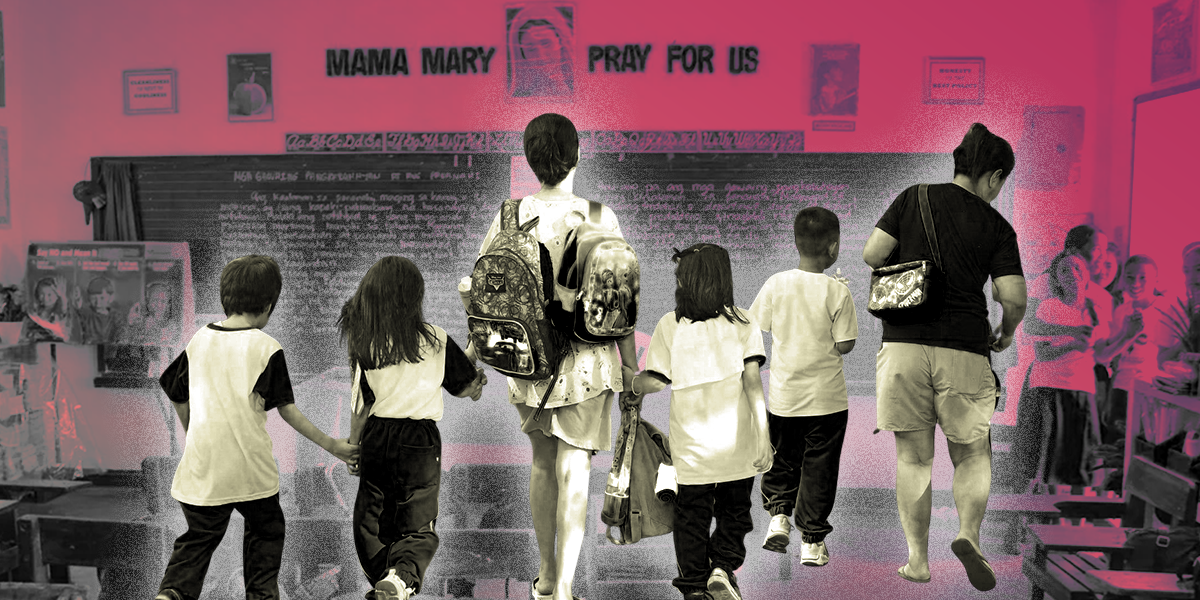
A disturbing trend is happening in schools. It is stirring old public debates on the country’s juvenile justice system and parent’s accountability for juvenile crimes. It is also bringing to public notice the growing military presence in schools—an outright violation of Republic Act No. 7610, the United Nations Convention on the Rights of the Child, and the Philippine Constitution.
People have even raised the culture of violence and impunity, which children learn directly from the highest office of the land, such as a past president’s violent expletives.
But let’s pause and look for a moment at the educational system—no blame game, just taking stock.
Not a safe space
On June 16, seven Grade 5 pupils of Bethal Academy in Gen. Trias, Cavite were injured after they were allegedly attacked by a Grade 8 student wielding a kitchen knife. Three days later, two Senior High School (SHS) students of Cavite National High School got into a fistfight until one pulled out a bladed weapon and repeatedly stabbed the other.
Then on June 22, two students aged 14 and 15 carried out a shooting attack inside the campus of San Jose National High School in Tacloban City, killing three and wounding 15 other students, while another five were injured during the panic and commotion that followed.
Pending ongoing investigation, these incidents are being treated as isolated cases. But they draw light once more on the safety of children and students, amid rising cases of peer violence including harassment and bullying, which are strongly linked to mental health concerns.
The UNESCO (United Nations Educational, Scientific and Cultural Organization) said that over 40% of Filipino learners aged 13-17 experience bullying at school in a year, and only 29% report that their parents or caregivers had understood their worries over a month. This is corroborated by Department of Education (DepEd) data, which noted an increase in bullying cases (2,500 cases in School Year 2024-2025 from 2,268 the previous year).
Can the DepEd cope?
The Alliance of Concerned Teachers (ACT) Philippines has called for stronger school safety measures and increased staffing in schools following the incidents. This means hiring more guidance counselors and psychosocial support personnel—something DepEd remains unable to accomplish.
During a Congressional hearing last September 2025, DepEd Secretary Sonny Angara said that there were only 4,069 licensed guidance counselors in the country as of 2022. This is a far cry from the more than 50,000 needed to meet the ideal global ratio of one counselor for every 250 students.
Angara also said that over 4,000 counselor vacancies were included in DepEd’s budget in 2025, but he admitted such number won’t be filled up in the next five years as universities are producing few graduates.
To address this, DepEd decided to scrap over 4,000 positions to create more positions for counselor associates that only require certain units in psychology and counseling. For 2026, the education department plans to hire 10,000 student counselor associates for public schools.
Need for radical shift
Creating a safe, nurturing and stable school environment is essential in improving learning outcomes for the country’s youth.
But this also demands a holistic and coordinated approach by the government and all stakeholders, in which the basic requirements of a decent family and community life are ensured.
While the incidents of violence can be traced to various individual and social factors, the myriad of challenges confronting learners and teachers demand not token reforms from those in power but a radical shift in approaching education and its social purpose.