
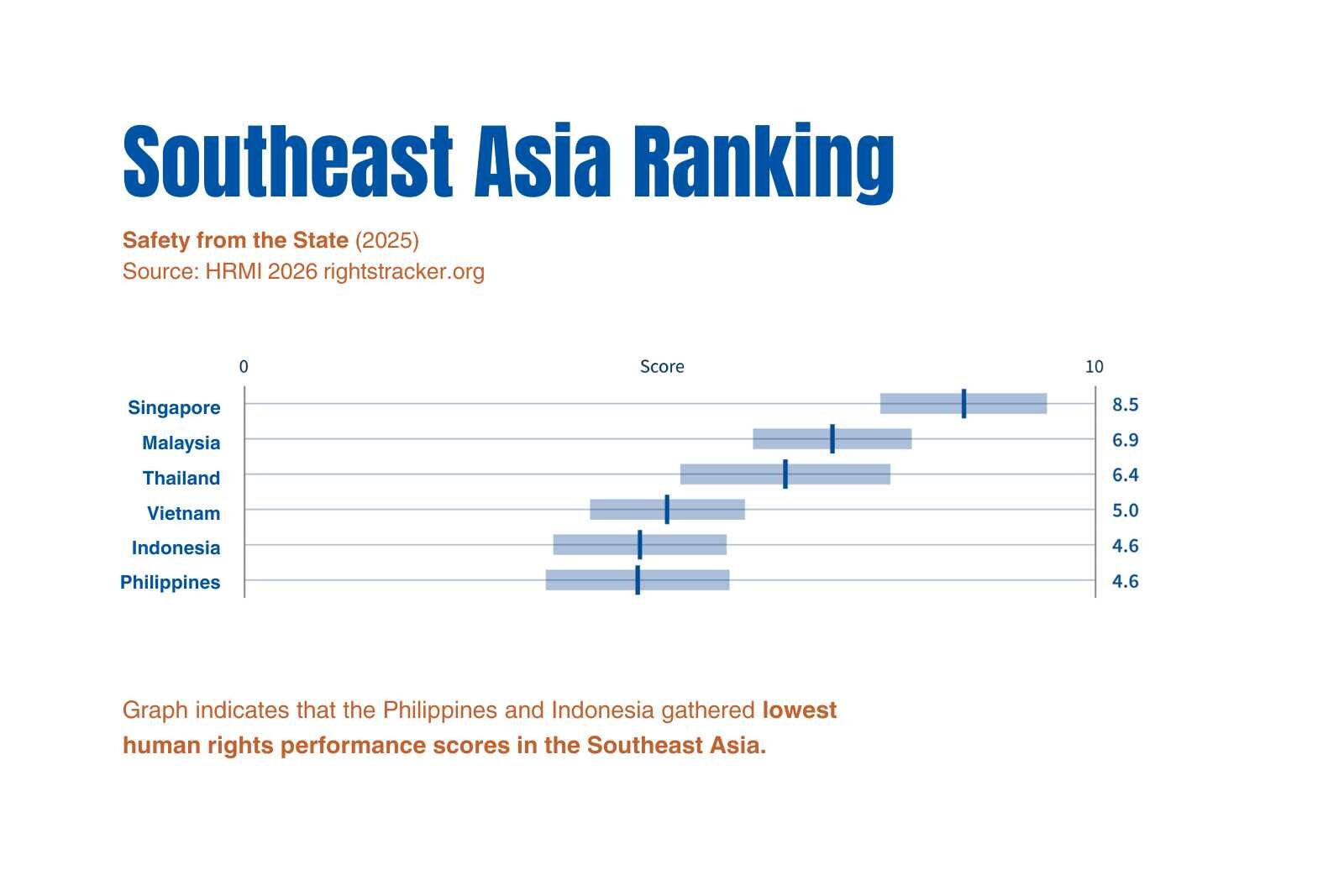
MANILA — The Philippines ranks among the lowest performing countries in the region when it comes to human rights, according to the global independent non-profit organization Human Rights Measurement Initiative (HRMI).
Based on the data released recently by HRMI, the Philippines obtained low scores across all metrics on human rights compliance.
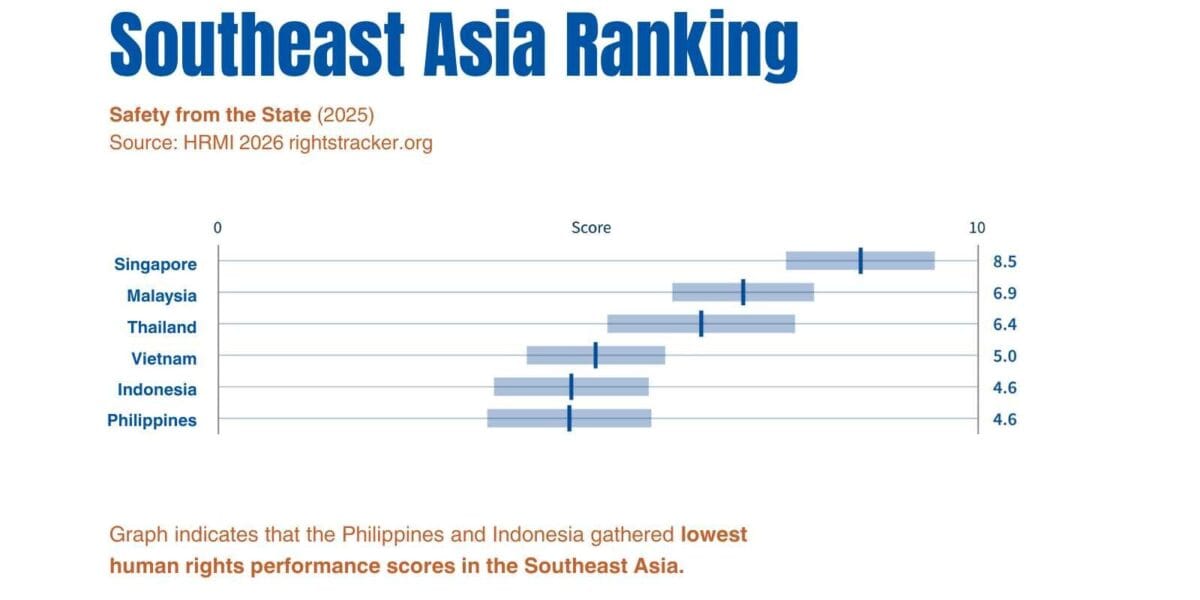
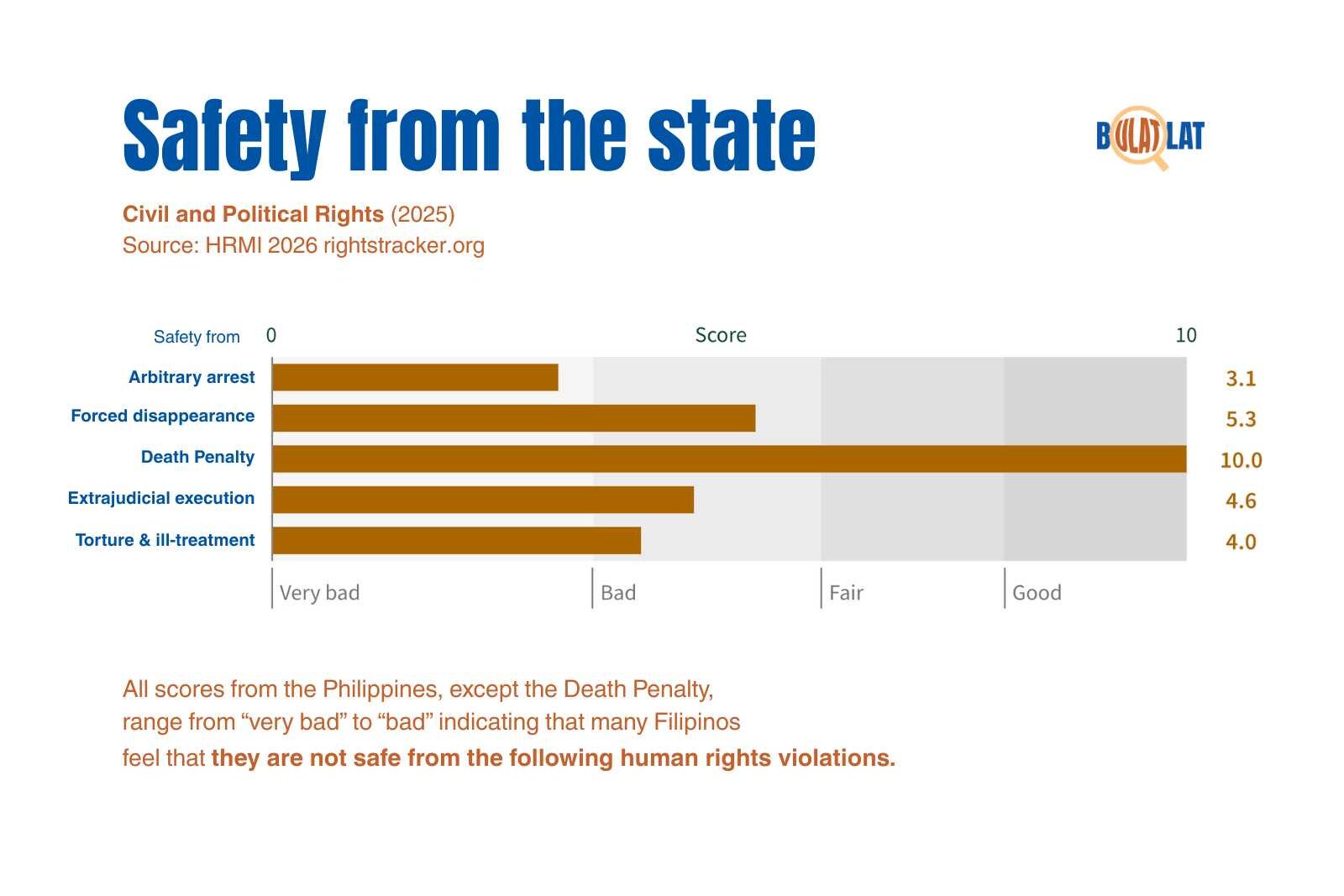
The Philippines, together with Indonesia, received a score of 4.6 out of 10 in the Safety from the State metric. This indicates that many people are not adequately protected from arbitrary arrest, torture and ill-treatment, forced disappearance, and extrajudicial killing.
The country’s score for freedom from arbitrary arrest is also low, at 3.1 out of 10, which falls within the “very bad” performance range of the report. It is the lowest score recorded among Southeast Asian countries surveyed by HRMI.
“The exceptionally low score for freedom from arbitrary arrest should be a wake-up call. Everyone should be able to exercise their rights without fear of unjust detention or retaliation,” said Keshia Mahmood, HRMI Southeast Asia engagement lead, in a statement.
The recent glaring incident of arbitrary arrests took place during the anti-corruption protest on September 21, 2025. Authorities arrested 216 protesters and bystanders, including 91 minors. Two died when the violence ensued. First responder lawyers and human rights workers confirmed that there were indications of torture and ill-treatment against the victims.
Read: Police violence, torture cases surface as new anti-corruption protest looms
The report also revealed that the performance of the Philippines in the freedom of assembly and association is considered “bad” with a score of 4.3. The overall average of 5.4 out of 10 in the Empowerment metric suggests that many people are not enjoying their civil liberties and political freedoms.
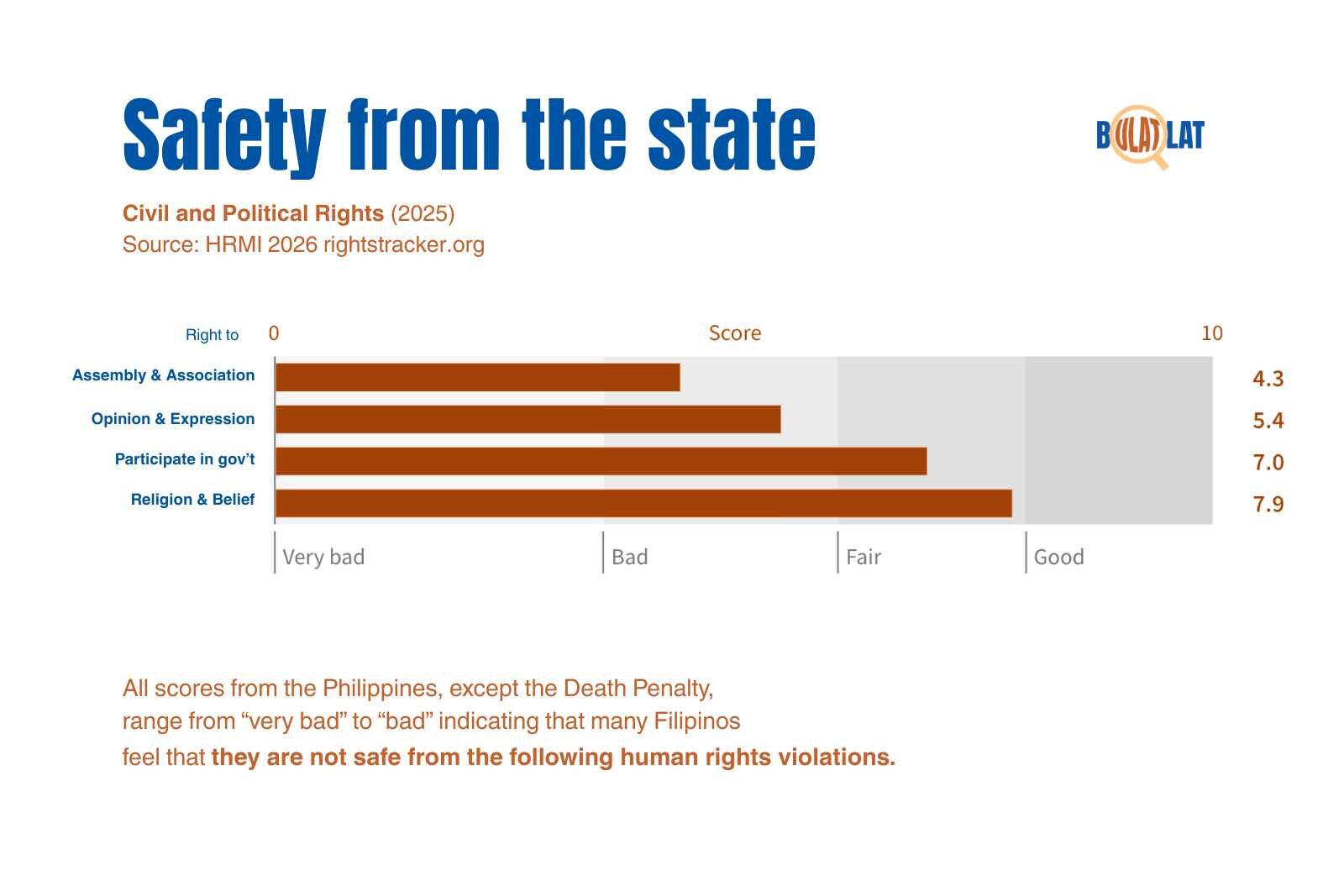
The scores were derived from HRMI’s comprehensive and secured survey accomplished by human rights defenders in the country.
The survey identified people suspected of terrorism, people who protest or engage in non-violent political activity, activists and human rights defenders, Indigenous peoples, and labour rights advocates as among those most vulnerable to violations of their safety and security by state actors.
Interconnectedness of human rights
More than the civil and political rights, the Philippine standing in “Quality of Life” metrics – economic, social, and cultural rights – is very low. The data sources come from the 2023 reports of United Nations (UN) agencies, World Bank (WB), and Organisation for Economic Cooperation and Development (OECD).
Compared with other countries in Southeast Asia, the country is performing worse than average again. It garnered the third lowest score, with Thailand and Vietnam indicating highest scores.
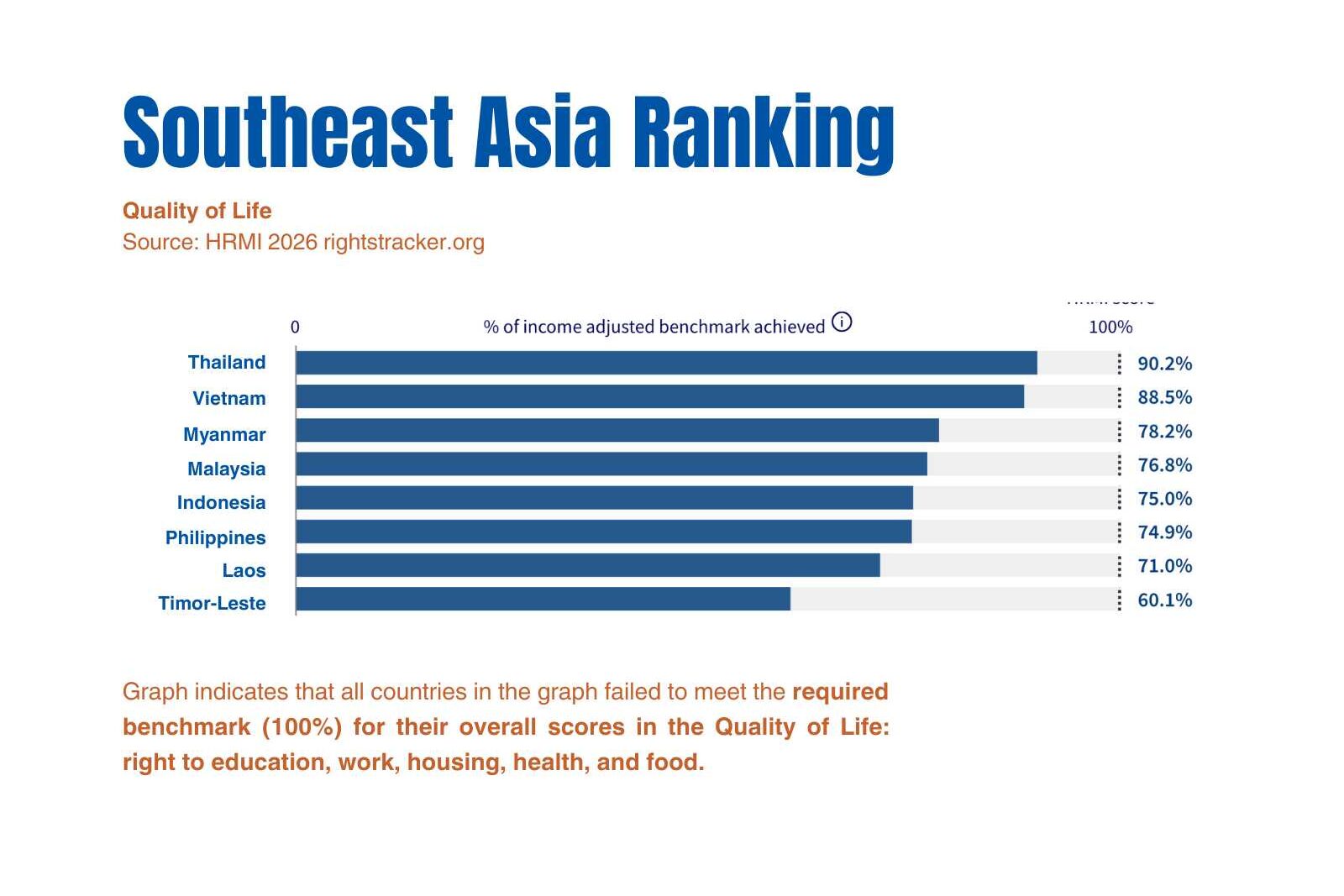
The country’s weakest areas are the right to education (66.1%) and the right to food (65.9%), both of which fall within the ‘very bad’ range. The data also point to a worrying trend in education, with the right to education score declining since 2017.
“While the Philippines has the resources to achieve better outcomes, our data show it is currently not fully meeting its economic and social rights obligations under international human rights law,” said HRMI Co-Executive Director, Thalia Kehoe Rowden.
The HRMI’s data states that anything less than 100 percent indicates that a country is not meeting its duty under the international human rights laws.
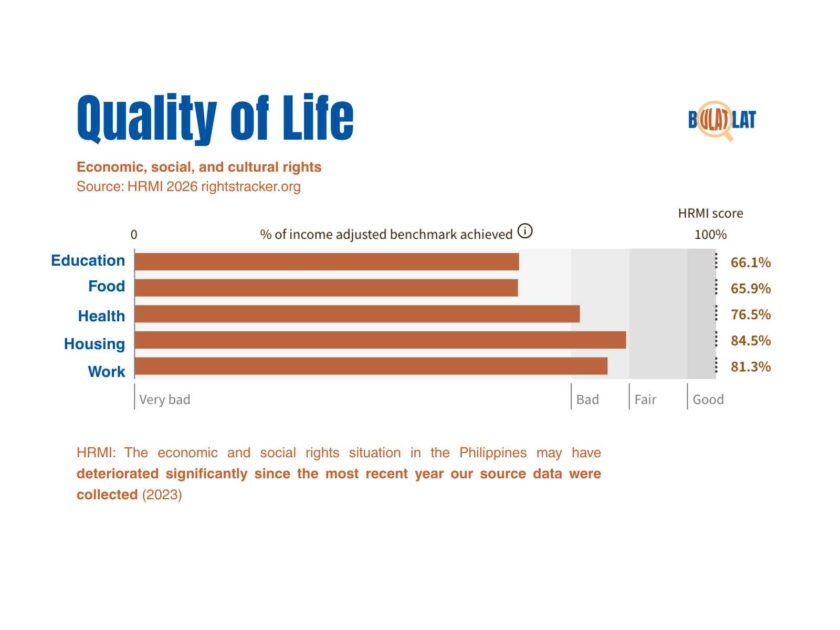
“Our assessment is that the Philippines has a very long way to go to meet its immediate economic and social rights duty,” the report states, noting that the Philippines failed to meet the minimum standards of fulfilling peoples’ right to education, work, food, health, and housing.
Meanwhile, in the Quality of Life metrics, the most at risk are indigenous peoples, the homeless, the economically disadvantaged, internally-displaced people, children, people with disabilities, and people affected by climate change, among others.
“Combined with the civil and political rights findings, these new data paint a troubling picture of the challenges many people continue to face. Meaningful reforms are needed to ensure that everyone in the Philippines can live safely, freely, and with dignity,” Rowden added.
Not the first time: Flagging civic space
It is not the first time that the Philippines has been flagged by the international community for its human rights performance. Global human rights watchdog CIVICUS added the country to the Monitor Watchlist flagging serious concerns about its civic space.
“There is a deeply troubling pattern of state actions against protests that is restricting the democratic space and stifling fundamental freedoms,” said Josef Benedict, CIVICUS Monitor Asia researcher. “It is creating a chilling effect for many in the Philippines who seek to speak out and organise.”
Read: Philippines on human rights watchlist due to crackdown on dissent
The Philippines has been rated “Repressed” for five consecutive years, the second worst rating a country can receive, indicating severe restrictions to the freedoms of expression, peaceful assembly, and association.
Human rights record and failed bid
The Philippines recently lost its bid for a non-permanent seat at the United Nations Security Council (UNSC), a primary international organ that can make legally-binding decisions before the UN-member states.
Human rights group Karapatan said that the failed UNSC bid is not merely a diplomatic setback but an indictment of its own human rights record, laid before the international community. They warned that no amount of lobbying and aggressive campaigning could conceal the ground reality.
“Marcos Jr. regime has lost a platform for its brazen hypocrisy on the Philippines’ dirt-and-grime human rights record,” said Cristina Palabay, secretary general of Karapatan. “It has used the UN and the international stage to whitewash the regime’s violations of human rights and international humanitarian law before the world.”
Read: Philippines’ failed bid for UNSC seat reflects human rights record
Beyond the Philippines, HRMI also released the human rights performance scores of more than 200 countries, tracing patterns of shrinking civic space and democratic erosion in countries such as the United States, Indonesia, Kazakhstan, Nepal, and the United Kingdom, among others.
Read: Measuring government’s human rights compliance via Rights Tracker
The annual report has been used by civil society and international organizations (e.g. Amnesty International, CIVICUS, International Service for Human Rights) in the development of Universal Periodic Review reports, research, and national and international level advocacy. It is also being used by the National Human Rights Institutions (NHRI), and sometimes by the governments themselves. (AMU, RVO)
Disclosure: The author is the Philippine consultant of the Human Rights Measurement Initiative.
 Save as PDF