

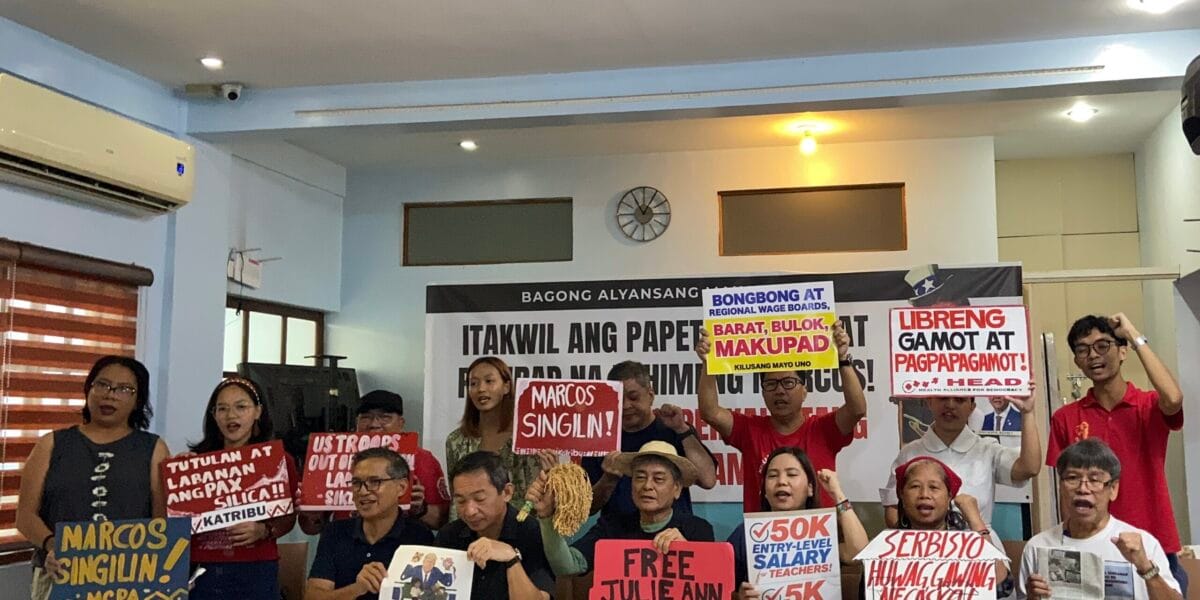
Progressive groups urged the people to join the July 27 People’s SONA.
By Kasheena Camacho
Bulatlat.com
MANILA — Abuses of puppets as the state of the nation.
Progressive groups said that this year’s People’s State of the Nation Address (SONA) will highlight Ferdinand Marcos Jr.’s “puppetry” to the United States, stressing that his administration’s close alignment with Washington brought about worsening economic conditions, human rights violations, and militarization.
During a press conference on July 17, Bagong Alyansang Makabayan (Bayan), the Makabayan coalition, and leaders of various people’s organizations said that around 10,000 protesters are expected to join the July 27 mobilization. The groups plan to start their program at noon along Commonwealth Avenue.
Karapatan Secretary-General Cristina Palabay said that under the present administration, human rights violations intensified despite portraying itself as different from its predecessor. She said that under Marcos Jr., Karapatan documented 147 extrajudicial killings. The Anti-Terrorism Act has been used against 250 individuals while more than 20 organizations, nongovernment organizations, and church institutions have had their bank accounts frozen. There are now 560 political prisoners, 165 of whom were arrested under the Marcos Jr. administration. Karapatan also documented 16 victims of enforced disappearances. “Malacañang’s recent declaration supporting the United States’ position on international issues is a clear manifestation of puppetry.”
For Danilo Ramos, chairperson of the Kilusang Magbubukid ng Pilipinas (KMP), the country’s worsening food insecurity and unresolved landlessness reflect the administration’s neglect of farmers. “Seven to eight out of every 10 farmers still do not own the land they till. Under Marcos, the problems of landlessness and food insecurity have only worsened. Marcos is anti-farmer and the country’s number one puppet.”
Alliance of Concerned Teacher Philippines (ACT) Chairperson Ruby Bernardo said that the education crisis continues to burden both teachers and students. “Instead of higher salaries, teachers received more work. Although it’s a new school year, students are facing the same old problems—from a shortage of 165,000 classrooms, around 50,000 of which are already more than 50 years old and no longer safe for use, to a lack of around 300,000 teachers and educational support personnel.” She added that nine out of every 10 teachers remain trapped in debt, stressing educators have not benefited from the promised reforms.
Read: New school year, same old problems: K to 12, shortages in classrooms, teachers
In the health sector, Sandrine Anika Yasay of the Philippine Nursing Students’ Association National said that one in every two Filipino children under five experiences food poverty. “How can healthcare be considered affordable when 41.2 percent of total health expenditures still come directly from people’s pockets. Despite programs such as Zero Balance Billing, YAKAP [Yaman ng Kalusugan Program] and PhilHealth, more than 15,000 of the country’s over 42,000 barangays still have no health station.” She also cited the shortage of YAKAP-accredited centers and healthcare workers as continuing barriers to accessible public healthcare.
Gabriela Youth spokesperson Fran Reyes said that women continue to bear the burden of low wages, precarious work, and rising debt. “There is nothing new for Filipino women under Marcos’ so-called ‘New Philippines.’ He has only made our situation worse. That is why anger and dissatisfaction will greet his fifth State of the Nation Address.”
Kim Falyao of the Indigenous Peoples group Katribu warned that mining and military-linked projects continue to threaten indigenous communities and ancestral lands. “They take our natural wealth and leave behind toxic waste. Our resources are being used to produce weapons while Indigenous communities suffer displacement and militarization.”
Progressive groups urged the people to join the July 27 People’s SONA, where they said various sectors would present the country’s “real state of the nation” and press demands for accountability, higher wages, lower prices, genuine land reform, and the protection of human rights. (AMU, DAA)
 Save as PDF