

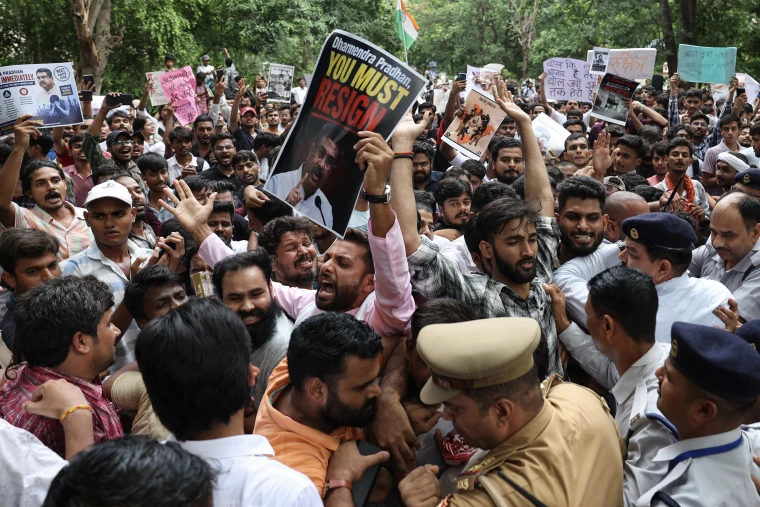
Thousands of students have returned to the streets of New Delhi following a violent police crackdown on a mass march last July 20 demanding the resignation of Education Minister Dharmendra Pradhan over a series of examination scandals that have affected millions of young people across India.
More than 100 students were reportedly injured after police used tear gas and force to disperse demonstrators who marched toward Parliament on Monday, July 20. Despite the crackdown, protesters regrouped the following day, vowing to continue their campaign.
The protests have emerged from growing anger among India’s youth over leaked examination papers, alleged grading irregularities, and what students describe as government inaction. The scandals have disrupted the futures of millions of students seeking university admission and public-sector employment, while reports indicate that more than 20 students have died by suicide amid the crisis.
Organizers accused the government of responding with repression rather than addressing the grievances raised by students. Protesters described scenes of chaos as police confronted demonstrators near Parliament, leaving roads littered with abandoned belongings, broken barricades, and signs of violence.
The movement has been spearheaded by student groups and the Cockroach Janta Party (CJP), a youth-led political pressure group that adopted its name after India’s chief justice reportedly likened government critics and unemployed youth to “cockroaches” and “parasites.” Protesters have since embraced the label as a symbol of resistance.
“This government is treating us like criminals for demanding accountability,” said one student protester. “We are here to reclaim our future.”
The demonstrations gained additional momentum after authorities removed prominent activist Sonam Wangchuk from a protest site and transferred him to a government hospital, a move protesters described as an unlawful detention. Wangchuk had been participating in a hunger strike demanding Pradhan’s resignation and later announced he would resume his fast after witnessing the police violence against students.
Student leaders say their demands include the resignation of the education minister, compensation for families of students who died by suicide, and a transparent investigation into examination irregularities.
The protests have also evolved into a broader challenge to the government of Prime Minister Narendra Modi. Demonstrators increasingly accuse the administration of undermining democratic rights and suppressing dissent through police force and legal intimidation.
Critics argue that the crackdown reflects a wider pattern under Modi’s fascist rule, including restrictions on civil liberties, the targeting of activists, journalists and opposition figures, and the use of security forces against social movements. Student organizations, labor unions, farmers’ groups, and minority communities have repeatedly accused the government of narrowing democratic space while promoting majoritarian and corporate interests.
India’s student movement also emerges against the backdrop of persistent youth unemployment, rising living costs, and growing frustration over unequal access to education and opportunities. Despite being home to the world’s largest youth population, millions of graduates continue to struggle to find stable employment. Strikingly, joblessness is highest among educated youth, with roughly 40% of graduates aged 15–25 unable to find work due to a massive gap between educational output and industrial skill demands
Political analysts note that the scale of the protests presents a significant challenge for the government, particularly as discontent among young people grows. While authorities have filed criminal cases against protesters and accused some participants of violence, organizers insist the movement will continue.
By Tuesday, protest camps were once again filled with students, signaling that the crackdown had failed to quell the demonstrations.
As one protest organizer declared after the police operation: “This was only the first march. There will be more.”
Post Views: 98
