
As the 5th State of the Nation Address (SONA) fast approaches, research group IBON said that the worsening economic crisis burdening ordinary Filipinos—from high fuel and food prices to the lack of decent jobs and rising poverty—will deepen as the Marcos Jr administration clings to a failed market-driven framework that favors big business and the wealthy few. The group said that the administration is already hard-pressed to conceal the deep policy failures driving widespread hardship.
“The world has changed with huge geopolitical and geoeconomic shifts,” IBON Executive Director Sonny Africa said. “The Philippines can’t stay on its current path of underdevelopment that generates wealth for the few at the cost of high prices, joblessness and worsening poverty for the majority.”
The government claims that the Philippines’ upper middle-income country (UMIC) status reflects its “effective economic policies.” Africa said this is not felt by ordinary Filipinos because “the growth model that resulted in the statistical reclassification can expand economic output but is unable to create decent work with livable pay for the majority of Filipinos.”
“It is clearer than ever that growth from trade, real estate, privatized utilities, BPOs, foreign investment enclaves, and labor export cannot materially improve the conditions of the majority,” he stressed. “It is critical to reverse agricultural decline, industrial erosion, and worsening technological dependence with a determined program of rural development and Filipino industrialization that qualitatively transforms the economy’s productive structure.”
Manufacturing sector growth averaging 2.5% in the 2023-2025 period is the slowest in over 15 years, excluding the pandemic lockdown in 2020. This has resulted in manufacturing falling to just 17.4% of gross domestic product (GDP) in 2025 which is the smallest in 76 years since 1949. Meanwhile, agriculture’s 7.9% share in the economy in 2025 is the smallest in history.
This is the structural driver to the latest labor force data that shows weak job creation, rising unemployment, and millions of discouraged workers not counted in official figures. Around 4 of 5 (78%) employed Filipinos are informals consisting of the estimated 38.7 million self-employed, own family farm or business, private households, and workers in informal establishments, as of May 2026. Officially reported unemployment of 2.5 million can increase to as much as 4.5 million if around two (2) million jobless Filipinos statistically excluded from the unemployment count and classified as not in the labor force are included.
Wages lag far behind the rising cost of living. The average daily nominal wage rate nationwide of Php512 covers just 39% of the Php1,301 family living wage for five.
This jobs crisis and insufficient incomes are pushing more Filipinos into poverty and hunger. Since the start of the Marcos Jr administration, families who consider themselves poor rose by 2.3 million to 14.5 million, while those experiencing involuntary hunger increased by 3.6 million to 6.5 million from Q2 2022 to Q1 2026, based on Social Weather Stations (SWS) data. Inequality is worsening: 62% of Filipinos (70 million) are in families making less than Php22,000/month, while only 1.5% (1 million) make above Php180,000 to Php17 million or more per month.
Africa added that the country’s hyped UMIC status is further contradicted by its weak regional performance. In Southeast Asia, the Philippines has the lowest GDP growth at 2.76% compared to Thailand (2.84%), Malaysia (5.4%), Indonesia (5.6%), Singapore (6%) and Vietnam (7.8%); the highest unemployment rate at 4.8% compared to Indonesia (4.7%), Malaysia (3%), Vietnam (2.2%), Singapore (2%) and Thailand (1%); and the 3rd fastest inflation rate at 6.4% (June 2026) after Lao PDR (7.4%) and Cambodia (7.2%).
Africa said these outcomes are due to long-standing structural problems, including the neglect of domestic agriculture and Filipino industries, which also leave the economy vulnerable to external shocks, like the spike in oil prices. “The exhausted growth model amid sluggish global growth, trade and investment with growing big power protectionism compels a different development strategy,” he said.
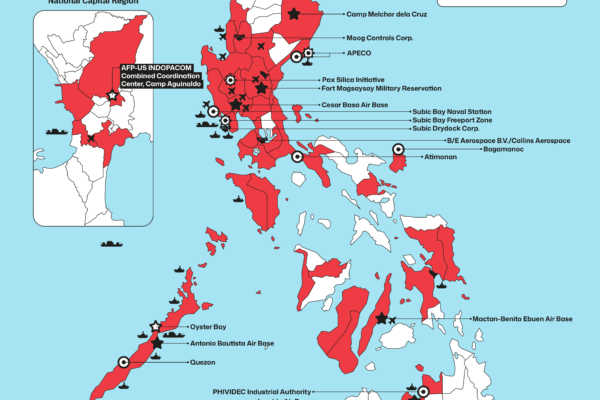
“Yet the Marcos administration is doubling-down on the same market-driven policies that created the economic crisis and mainly benefited big local and foreign businesses,” Africa said. “Mega-hyped efforts like the US-led Luzon Economic Corridor and Pax Silica will not deliver promised industrialization because these will be implemented under the same one-sided foreign investment regime that has held the economy back for decades.”
Africa stressed that genuine development and improving the lives of Filipinos is not just about foreign factories locating in the country. It is about building national productive power with: Filipino firms producing complex high-technology goods with Filipino science and technology; Filipino firms using local labor, skills, science and natural resources; and Filipino firms raising economic productivity and employment quality. “There will likely be a lot of official optimism during the SONA,” said Africa. “But this will ring hollow because the Marcos administration is unable to deliver real economic reforms while the people’s conditions continue to worsen.”