
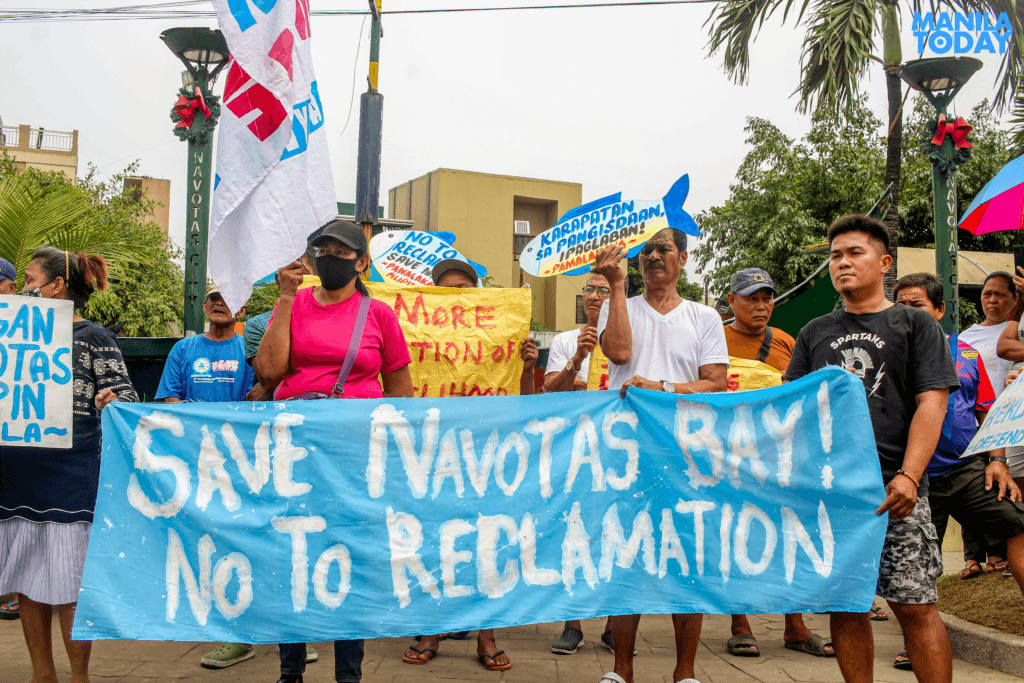
Ninety-five percent or more than thousands of the mussel farms were demolished in Navotas coastal waters to make way for the construction of the 650-hectare Navotas Coastal Bay Reclamation Project (NCBRP).
According to Rommel Escarial, president of PAMALAKAYA Navotas, his journey to sea with Manila Today marked his last trip on his boat and mussel farm last March.
“We’re just doing pakyawan (wholesale) now, splitting the proceeds. It takes about a week before they get divided,” Escarial added.
In these wholesale arrangements, fishermen and mussel farmers collectively work to sustain the group’s needs. They stock their harvests and make dishes such as adobo, Bicol express, and shanghai from mussels. It has since become their business due to the ongoing threats.
Rommel’s children have also stopped attending college and elementary school due to the lack of a steady livelihood following the demolition of his mussel farm.
“It’s not the same as before; I can hardly provide for my family’s needs anymore because we have no income, no livelihood,” he said.
Over 20 kilometers of fishing structures are constantly being dismantled by order of the Navotas local government unit (LGU) under Mayor John Ray Tiangco. This order, however, contradicts the Marcos administration’s statement in 2023 that it had halted all reclamation in Manila Bay.
The NCBRP is part of over 23 reclamation projects in Manila Bay. Led by San Miguel Corporation (SMC) in partnership with the Navotas LGU, it has been dubbed the “Southern Gateway” to the Manila International Airport or Bulacan aerotropolis, another SMC project that displaced over 700 farmers in Taliptip, Bulacan.
Red-Tagging, surveillance, and impersonation threats resurface
On May 6, students from the University of the Philippines – Manila, together with Tulong Kabataan National Capital Region, held an activity in Navotas.
During the activity, the youth and the mussel farmers experienced surveillance from civilian-clothed police. According to the mussel farmers, at least 10 individuals, covertly and openly, filmed while they are doing the program.
“One personnel even approached the plaza shirtless, as if showing they could intimidate us. Some of my fellow members are now scared; we’re really being harassed. We actually see what they’re doing,” said Arvin Escarial, Rommel’s brother.
After the event, rumors spread in their barangay labeling the youth as members of the New People’s Army (NPA) and that the fisherfolks were advised not to trust them.
“They also made accusations to the students. Not long after they left, some people within the barangay said the students were NPA. They told us they were NPA,” Rommel shared.
That evening, Rommel received a call from a police officer inviting him to the barangay for a conversation. He was unsure how they obtained his number.
“He said he just needed to talk to me. He claimed we might cause trouble or rally. I told him there’s nothing wrong with explaining how we lost our livelihood,” Rommel recounted.
Such surveillance incidents have continued that extended to Rommel’s wife and other members of PAMALAKAYA Navotas and the Samahan ng mga Magtatahong at Mangingisda sa Navotas (SAMPAMANA).
“Four days after the activity, people were looking for me at home. My cousin said a man and a woman, both in plainclothes, were asking for me. That’s why I was cautious going home,” Rommel shared.
“On September 20, while with Rommel, I saw two individuals—big-bodied men—who then backed off when we approached. They immediately left the area soon as we got closer to them. I warned our members to be careful because we’re being under surveillance,” Aaron added.
Last October, Aaron encountered two officers in a shop in P. De Vera, asking for the whereabouts of Rommel’s wife without any details.
“They mentioned her full name. I was surprised that they even used the nickname we’re teased with—’talong.’ That’s what we’re often called,” said Aaron.
In June, Norma Maluenda, current vice president of PAMALAKAYA Navotas, reported an incident where someone impersonated a relative looking for her.
“A man was looking for me, even asking my husband to accompany him. He also used our family name, Maluenda. I asked my husband what he wanted, he said he just wanted to meet other Maluendas and have someone come along. But it was already around seven in the evening. When I came down, he was gone,” Norma recounted.
In relation to this, just on November 7 when Rommel was interviewed, rumors circulated about a supposed aid program in their community using their organization, PAMALAKAYA Navotas.
“It’s confirmed that they’re using PAMALAKAYA to supposedly provide aid. We don’t know anything about it,” Rommel said.
Last August, they also learned that a group of uniformed men rented a place nearby claiming to be on-the-job (OJT) trainees.
“There are many of them, claiming it’s OJT. When we pass by, we feel watched. There are around 20 of them. In the morning, they go to the Navotas city hall; when they return, sometimes they hang out by the court,” Aaron explained.
On one occasion, the trainees brought other people along whom Aaron noticed were intently watching them.
These cases of surveillance and red-tagging are not new in Navotas City. In 2019, CAMANAVA was labeled a “communist hotbed” due to the intensified Oplan Kalasag under Executive Order 70 from the former Duterte administration.
Oplan Kapanatagan is a joint operations of the Armed Forces of the Philippines (AFP) and Philippine National Police (PNP) as a counter-insurgency program of the former Duterte administraion.
This has since fostered fear among residents, especially the fisherfolk and mussel farmers.
In Brgy. Tangos, Joint Task Force – National Capital Region, a combined force of the AFP and PNP, would frequently visit the homes of Pagkakaisa ng Manggagawa at Mangingisda sa Navotas – PAMALAKAYA (PAMAMANAPA) members which then instilled fear among their families.
“I’m not scared. We’re just fighting for our livelihood. We are not turning against the government; we’re simply standing up for our rights,” Rommel said.