
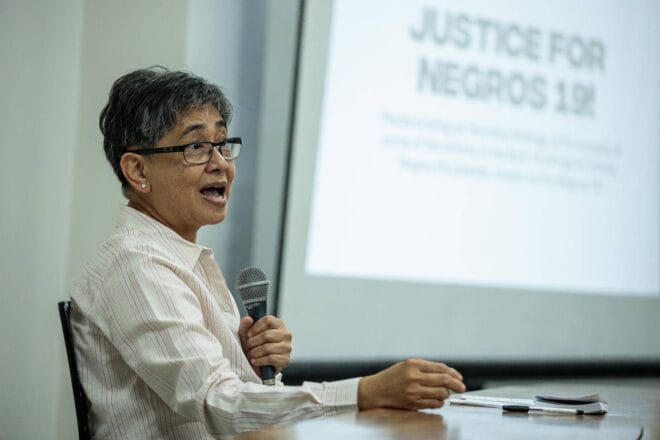
FORENSIC pathologist Dr. Raquel Fortun has raised a series of disturbing concerns over the military’s handling of both the remains and the alleged crime scene where 19 individuals were killed in Toboso, Negros Occidental, on April 19.
In a press conference at the University of the Philippines-Diliman on Thursday, May 7, Dr. Fortun presented initial findings from the autopsies she conducted on five of the 19 victims in what the Armed Forces of the Philippines claims was a legitimate encounter between troops of the 79th Infantry Battalion of the Philippine Army and guerrillas of the New People’s Army.
The five bodies, she noted, were already in an advanced state of decomposition by the time they were examined.
Among the most alarming issues she identified were the apparent absence of a credible crime scene investigation; the mis-identification of the remains of several victims, including Errol Wendel, whose family reportedly received the wrong cadaver; and the removal of the victims’ clothing, a critical piece of forensic evidence, which was later piled together and discarded.
Dr. Fortun noted that authorities gave Errol’s family a cadaver that was “too short” and had no hair on the top of the head. That, she said, was clearly not Errol.
‘Shot in the back’
In her initial findings, Dr. Fortun identified several gunshot wounds on the cadavers. She declined to discuss specific details as her inquiry remains ongoing and she has only preliminary observations.
But she revealed that some victims sustained gunshot wounds to the back. Though she stopped short of definitively concluding that the victims were unarmed, contrary to military claims, she said she found it revealing that several appeared to have been shot from behind.
“One had multiple gunshot wounds, shot four times. But then the three (other bodies) where we found the bullets, (did not die from gunshot wounds),” she said.
She also observed that one body suffered a gunshot wound to the leg that punctured veins, suggesting the person may have remained alive for some time before bleeding to death.
This raises a critical question, she said: why were the wounded not given timely medical assistance? Refusing aid to a wounded hors de combat, Dr. Fortun noted, is generally considered a war crime under International Humanitarian Law.
She also noted that another body had a wound in the throat.
“The other one looked like he aspirated blood because his airway, his throat, was hit. We found blood in the mouth,” Dr. Fortun added.
The military and police who handled the bodies failed to take note of these details.
“The point is, if you don’t examine the body and you do not perform a forensic autopsy, you do not know what to check. You lose these things. Even small injuries, we document them, like small abrasions and contusions. That can help you reconstruct what happened,” she further said.
No system
Dr. Fortun lamented the lack of proper systems for preserving and processing potential crime or homicide scenes, such as the one in Toboso. Investigators, she said, could have left the bodies undisturbed, especially those not submerged in water, to allow trained crime scene personnel to properly document and examine the area.
She also criticized the military for claiming that one of the bodies tested positive in a paraffin test, a test now widely considered by modern forensic experts to be obsolete and inconclusive.
“I keep saying this is the 21st century. The fact that you (military and police) are still doing it, and the fact that you’re even proud of doing it, you should be ashamed. That particular body was in the water, soaked in water. For you to check for what we call gunshot residue, you have to protect the hands, and those hands were not protected. In non-paraffin testing, you’re looking for trace metals, trace meaning small amounts, so you protect the hands. And I’m sure those hands were not protected,” Dr. Fortun explained.
Because of these many disturbing issues in the handling of the bodies, she appealed to other families of the so-called “Negros 19” to allow independent autopsies to be conducted on the remains of their loved ones.
In addition, she urged the Commission on Human Rights to assist in recovering and identifying the remaining human remains, saying local police and military authorities in Toboso appeared either unable or unwilling to properly account for all the victims.
Dr. Fortun further called on the independent fact-finding mission being organized by human rights groups in the coming weeks to gather additional forensic evidence that could help establish what truly happened in Toboso on April 19.
One of the country’s few forensic pathologists, Dr. Fortun also criticized what she described as the lack of transparency among state security forces in cases involving alleged human rights violations. She lamented the failure to use scientific and forensic methods to establish accountability and uncover what truly happened that day.
“This is impunity,” she said. “This has been happening again and again in our country.”

Marienne, wife of Filipino American activist Lyle Prijoles, who was among the Negros 19, was present at Dr. Fortun’s press conference and could not contain her anger over how the government handled the bodies.
“I’m very angry. These are 19 people who were killed. (I’m feeling) a lot of anger, (asking) a lot of questions, why it happened and how the investigation has been put together, or not put together. Why are we not allowed in the area? Where are his clothes?” she said.