

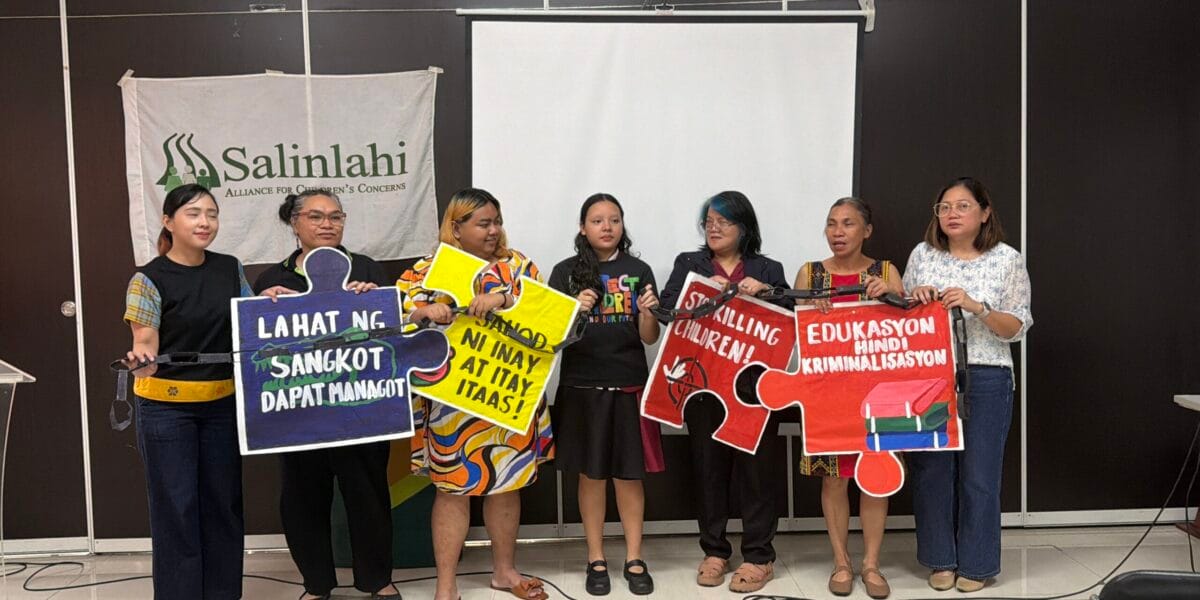
“Instead of lowering [the minimum age of criminal responsibility], the government must ensure first that our children and youth are growing up in a safe environment, whether inside their homes, schools, and in the community.”
By Elisha Beatrice Umali
Bulatlat.com

MANILA — The longstanding problems of a Filipino child continue to persist under the Marcos Jr. administration.
Different child rights organizations cited poverty, faulty basic education systems, lagging early childhood care and development (EECD), stunting and malnutrition, as well as systemic rights abuses as main issues children face in the country.
“Nine percent of Filipino children come from the working class and farmers that experience extreme poverty. This means that a child’s life is not separate from the lived realities of their families,” said Salinlahi Alliance for Children’s Concerns spokesperson m Elle Buntag.
A 2026 UNICEF study shows that 17.9 million children are living in poverty as of 2023, placed in the context of the international poverty line at (approximately $785.49 USD) per capita/year.
“A comparison of population and poverty shares of children and adults shows that children are over-represented among the poor. In 2023, children accounted for half of the poor population in the Philippines (50.5 per cent) even though they only accounted for a third of the total population (32.3 per cent),” the study pointed out.
In an interview with Bulatlat, Buntag said poverty remains the top problem of Filipino children. “As long as poverty remains in our country, there will be no good future for the children,” she said in Filipino.
Foundational lapses
Child development centers, expected to provide early childhood care, education and health services to children from birth to five years years, also face a backlog of approximately 33,000 as of 2024.
“Supposedly, all barangays should have child development centers but not all [barangays] have it. At the same time, not all parents are capable of enrolling their children to private schools providing childhood care and development,” Buntag explained.
Salinlahi also reported a 240,000 backlog in daycare workers nationwide. “Child development workers sometimes handle up to 20 kids, even though only a 1 worker to 10 kids is the ideal ratio,” added Buntag.
The basic education sector also faces backlogs. According to the Second Congressional Commission on Education (Edcom II), the country now faces over 166,000 in classroom backlogs with only 200 classrooms built per year.
Read: New school year, same problems
Edcom II’s findings also showed that students become less literate as they reach higher grade levels. “While improvements were observed in earlier grades in elementary, these appear to taper off in later grades, and especially in Grades 7 to 10, with many learners unable to become independent readers as academic demands become more advanced,” stated the commission.
Systemic repression and abuse
Rowena Legaspi of the Children’s Legal Rights and Development Center (CLDRC) criticized the current implementation of the Juvenile Justice and Welfare Act (JJWA). While the law itself was strengthened in 2013, its implementation remained insufficient to support Children in Conflict with the Law (CICLs).
“The failure is in the implementers… Let’s ask them, what did you do for this law? What was your contribution to having an effective diversion program at the barangay level? As long as you do not have a contribution, do not push for the lowering of the criminal liability age,” said Legaspi.
Read: Child rights advocates oppose lowering criminal responsibility age
CLRDC’s latest data from 2023 to 2025 shows that most offenders are aged 15-17 years old. These offenders mostly commit serious offenses such as murder and rape.
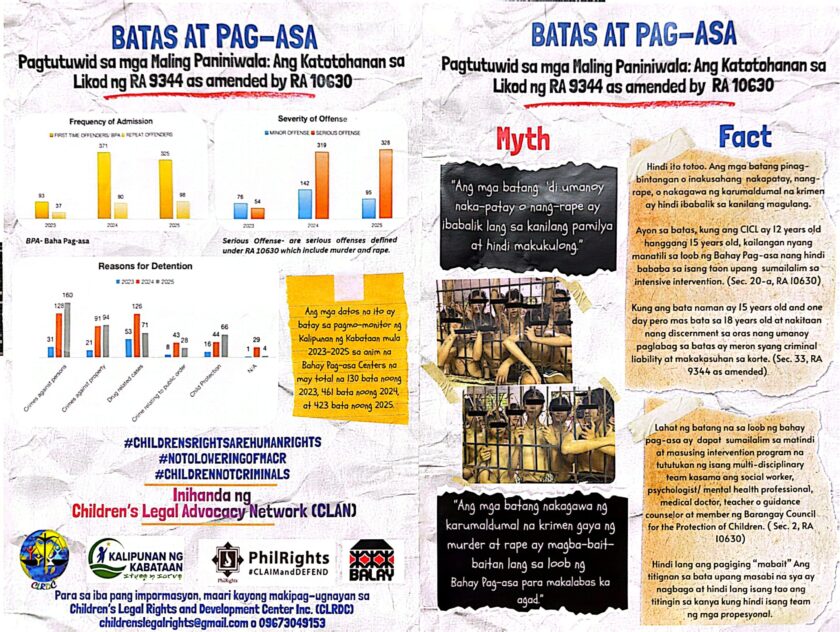
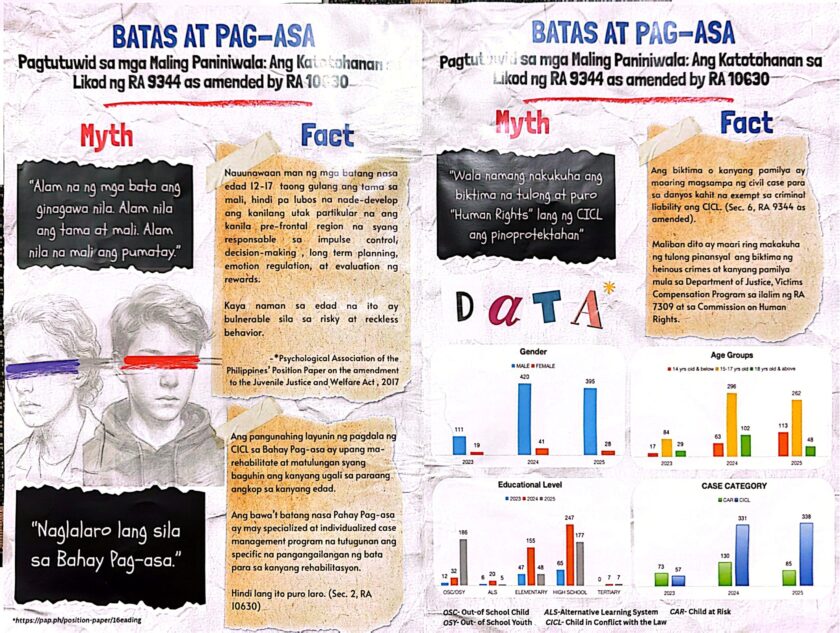
Brochure given by CLRDC with the latest data on CICLs from years 2023 to 2025. Photo by Elisha Beatrice Umali
The Philippine National Police Women and Children’s Protection Center recorded 1,275 school-related incidents involving CICLs from the years 2022 to 2025.
“Instead of lowering [the minimum age of criminal responsibility], the government must ensure first that our children and youth are growing up in a safe environment, whether inside their homes, schools, and in the community,” said Legaspi in Filipino. “What will children think when they see policemen [in school premises?]”
The Children’s Rehabilitation Center (CRC) noted the existence of “learning tours” in Negros Occidental, Kalinga, and Bukidnon, where the Armed Forces of the Philippines expose children to firearms..
CRC data during the Marcos Jr. administration also show the consistent attack on children’s rights. In conflict areas and provinces with high incidence of land grabbing and land conversion use, children fall victim to physical abuse and killings by state forces such as the military and police.
CRC noted 14 community bombings and strafings displacing children and their families, 21 child fatalities perpetrated by the police and military, two incidents of torture, 23 illegally detained, 10 victims of physical and sexual abuse, nine abduction cases, and nine political prisoners arrested as minors.
This dataset does not include the illegal arrest and mistreatment of over 90 student protesters during the September 21, 2025 protest against the flood control scandal.
Read: Groups slam baseless charges, excessive bail vs Sept. 21 student protesters
Read: Rights groups, lawyers refute police’s ‘outright lies’ on maltreatment of Sept. 21 detainees
“What we should collaborate on as child rights advocates is further exposing and properly understanding the struggles of the Filipino child. We should also form broad alliances with the citizens, particularly, child rights advocates,” Buntag said. (RTS, RVO)
 Save as PDF