

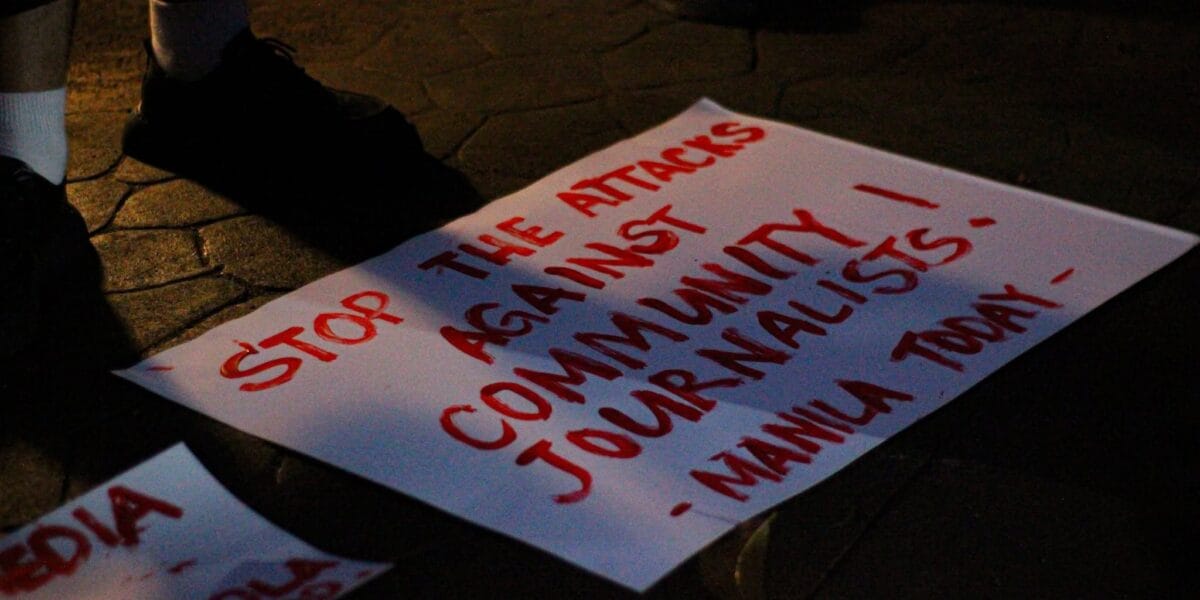
“Protecting press freedom is a shared responsibility. Without it, the public’s right to know and the foundations of democratic society are at risk.”
CAGAYAN DE ORO — Four years since Ferdinand Marcos Jr. assumed the presidency, press freedom violations continue.
Eleven journalists and media workers were killed under his administration, according to the National Union of Journalists of the Philippines (NUJP), although two of them were initially reported as not work-related. The latest case happened in May when Nestor Micator, radio broadcaster of D’Empire Radio, was shot dead by an unidentified assailant in Malidegao town which is under the Special Geographic Area of the Bangsamoro Autonomous Region in Muslim Mindanao (BARMM).
Community journalist RJ Nichole Ledesma was also killed during a military operation in Toboso, Negros Occidental, in April. He was reportedly in the area doing community work. However, the Philippine Army stressed that he was a New People’s Army (NPA) combatant, a claim assailed by media and human rights organizations.
Roxas City-based broadcaster Jay Lavapiez, meanwhile, encountered a near-death experience after he was ambushed in June.
In May, the Presidential Task Force on Media Security (PTFoMS) and the National Bureau of Investigation (NBI) signed a memorandum of agreement (MOA) for what they called stronger collaboration and case buildup efforts.
PTFoMS also signed a MOA with the Commission on Human Rights (CHR) last year. Aside from advocating to expedite the resolution of cases, the agreement would establish a rapid response mechanism, psychosocial assistance for victims, and capacity-building and prevention for media workers.
The Philippine National Police (PNP), in partnership with PTFoMS and other government agencies, launched the PNP Media Security Vanguards program aimed at enhancing the safety and security of media practitioners.
Read: Media groups decry harassment of journalists, activist during protest
The NUJP, however, stressed that the State has failed to bring to justice the masterminds behind these killings. Among them were the murders of Renato Blanco, Percival Mabasa, Cresenciano Bundoquin, Juan Jumalon, Juan Dayang, Erwin Segovia, Noel Samar, and Julito Calo. “While four suspects behind two of these killings have been arrested, no mastermind has been brought to justice,” NUJP said in an earlier statement.
Read: Philippines remains dangerous for journalists
The group backed the proposal of Special Rapporteur on Freedom of Expression and Opinion Irene Khan for the Philippine government to establish a “Special Prosecutor” for crimes against journalists and human rights defenders.
On the other hand, the local press freedom group also monitored the filing of cases against journalists and media workers. Aside from libel and cyberlibel, the Data Privacy Act and unjust vexation were reportedly weaponized as a usual form of retaliation against the media community.
Bacolod-based journalist Marchel Espina surrendered to the authorities upon learning that there was an arrest warrant issued against her for an unjust vexation case which stemmed from an opinion piece published in SunStar Cebu in 2024 when she was still the editor-in-chief.
The same charges were filed against Negros Occidental-based journalist Erwin Delilan in the first quarter of 2026 after the complainants got annoyed with his Binalaybay—a term used for Hiligaynon poems—commentaries on social media. Delilan was arrested twice prior to posting bail.
Lavapiez and his wife, India, who is also a radio broadcaster, also faced multiple cyberlibel cases filed by local officials. In August 2025, the Sangguniang Bayan of Sigma declared the two personas non grata for allegedly disseminating false and misleading information.
Cases of alleged violation of the Data Privacy Act were also filed against the late DZRH reporter Misael Gonzales Jr. after publishing the details indicated in an arrest warrant, as well as iFM Cagayan de Oro News Director Menzie Montes for posting screenshots of her conversation with a local official.
The NUJP monitored 15 libel and cyberlibel cases and 17 other forms of judicial harassment so far. These formed part of the overall 250 press freedom violations under the Marcos Jr. administration.

Tacloban-based journalist Frenchie Mae Cumpio has been in detention since February 2020 because of trumped-up criminal charges. While she got acquitted on other charges, she was convicted for allegedly financing terrorism. Her conviction is being appealed.
NUJP pointed out the possible effects when journalists are slapped with cases. Aside from financial burden and psychological trauma, it reiterated that it has a chilling effect which could lead to self-censorship and content takedown, to name a few.
In a forum organized by NUJP and the De La Salle University-Department of Communication on July 25, lawyer Gilbert Andres, executive director of the Center for International Law (CenterLaw) Philippines, underscored the importance for journalists and media workers of knowing the available and appropriate legal remedies.
He said that journalists and media workers could also take legal attacks by filing complaints for damages against those who filed cases against them.
In its State of Media Freedom report released in this year’s World Press Freedom Day, the media watchdog Center for Media Freedom and Responsibility (CMFR) urged the Philippine government to revisit laws that may be used against journalists.
“Protecting press freedom is a shared responsibility. Without it, the public’s right to know and the foundations of democratic society are at risk,” CMFR said in its report. (DAA)
Disclosure: Bulatlat editor-in-chief Ronalyn Olea is the secretary-general of the National Union of Journalists of the Philippines.
 Save as PDF