

BEYOND THE COURT/HOUSE
By Kaloi Zarate
“No joke, no joke.”
Those four words, uttered by Vice President Sara Duterte during the livestream presser on November 23, 2024 now at the center of her impeachment trial, have echoed through the Senate chamber far louder than any lawyer’s objection.
Days later, arriving briefly at the Senate before leaving the proceedings to her lawyers, she invoked another set of words, William Ernest Henley’s Invictus: “I will be bloodied but unbowed.”
Between those two declarations now lies the constitutional question confronting the Senate.
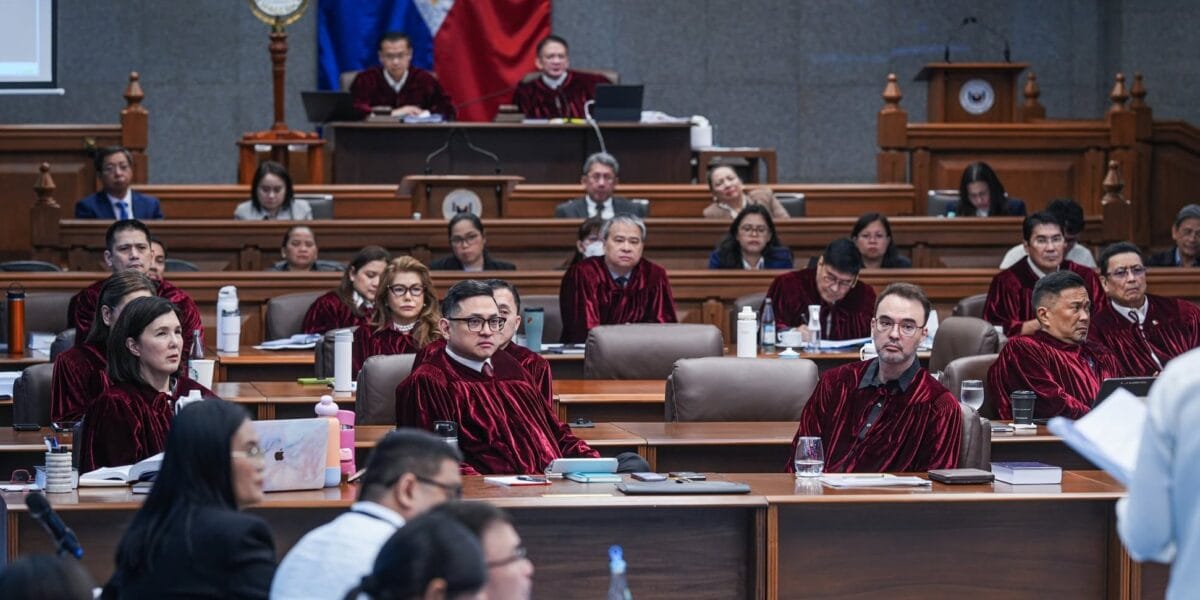
For three days, the impeachment court has heard arguments not simply about politics but about the limits of public power and the responsibilities carried by one heartbeat away from the presidency.
The first day established the opposing narratives. The House prosecution spoke of constitutional accountability. The defense denounced the impeachment as political persecution. Those competing stories were expected. Every impeachment begins that way.
By the second day, however, the battle had moved beyond political rhetoric and into the discipline of evidence.
Even before the House prosecutors could present their first witness, the defense launched a series of procedural objections. It challenged the prosecution’s opening presentation, objected to the testimony of National Bureau of Investigation Cybercrime Division Senior Agent John Mark Calilung, and argued that he should not even be allowed to testify because his name did not appear in the original impeachment complaint.
The Senate rejected those objections.
Senate President Francis Escudero ruled that the witness had been properly identified during pre-trial proceedings and that impeachment could not be confined to the abbreviated summaries contained in the Articles of Impeachment.
The prosecution then presented what has become the center of gravity of the case: the November 23, 2024 livestream in which the Vice President allegedly declared that she had contracted someone to kill President Ferdinand Marcos Jr., First Lady Liza Araneta-Marcos, and former Speaker Martin Romualdez should anything happen to her—a statement she herself emphasized was “no joke.”
Calilung’s testimony was deliberately limited. He did not claim personal knowledge of any assassination plot. His task was to establish the authenticity of the digital evidence. He explained how the NBI preserved the livestream, coordinated with Meta to secure its integrity, and verified through accepted forensic procedures that the recording had not been altered.
From that point, the defense’s strategy became increasingly apparent.
Its repeated objections were directed less at disputing the existence of the recording than at limiting the circumstances under which the Senate could consider it. Whether those objections reflected a legitimate insistence on due process or a calculated effort to blunt the prosecution’s strongest evidence is ultimately for the senator-judges—and the Filipino people—to assess.
By the third day, the battlefield had quietly shifted.
The authenticity of the livestream was no longer the central issue. The defense instead sought to narrow its legal significance, emphasizing that authenticating a recording is not the same as proving an actual conspiracy to kill.
That distinction matters.
Through cross-examination, Calilung acknowledged that his expertise was confined to digital forensics. He could testify that the recording was genuine, but he could not testify from personal knowledge that a hitman existed.
The senator-judges themselves pushed the proceedings further. Senator Bam Aquino asked whether the prosecution intended to present additional witnesses to establish the existence of the alleged assassin. The prosecution answered that it would.
The burden has therefore become heavier.
It is no longer enough to prove that the Vice President uttered the words. The prosecution must persuade the Senate that those words, together with the surrounding evidence, constitute culpable conduct and a betrayal of the public trust.
The defense, meanwhile, has begun asking the Senate to see those statements through the prism of supposed political persecution and emotional strain rather than as stand-alone threats.
Maybe it’s a legitimate legal strategy, but it also places before the Senate a question that reaches beyond the fortunes of any administration or political dynasty.
The Constitution does not judge public officials only by how they exercise power when circumstances are favorable. It also judges the restraint they display when confronted by anger, pressure, political conflict and power’s inevitable temptations. What is expected is not a meltdown or advocating homicidal actions. The higher the office, the heavier the burden of self-restraint.
That is why impeachment occupies a singular place in constitutional government. Unlike a criminal trial, it is not confined to determining whether a penal law has been violated. It asks whether the conduct of a public official remains compatible with the extraordinary trust the people have vested in that office.
As the hearings become increasingly consumed by forensic protocols, affidavits, and procedural objections, the Senate would do well to remember that it is not merely deciding the admissibility of digital evidence.
It is defining the constitutional standard expected of those who may one day occupy the highest office in the land.
Hash values may establish authenticity. Technical objections may shape admissibility. Political narratives may influence public opinion.
The Filipino people are not merely watching lawyers’ debate digital evidence. They are watching the constitutional standard for public power being written in real time.
Outside the chamber, the Vice President chose to leave the Senate with the words of Invictus: “I will be bloodied but unbowed.”
Henley’s poem celebrates courage in the face of adversity. But constitutional government asks something more of those who wield public power. It demands not only resilience after words are spoken, but also responsibility before they are uttered.
If, as the Vice President herself insisted, those words were “no joke,” then the Senate cannot treat them as one.
And neither, history suggests, should the country, the Republic. #
= = = = = =
The author is a long-time public interest lawyer, a former three-term legislator representing Bayan Muna Partylist and now a Senior partner of the La Vina Zarate and Associates (LVZ Law).