
By Rosario Brenda Gonzalez
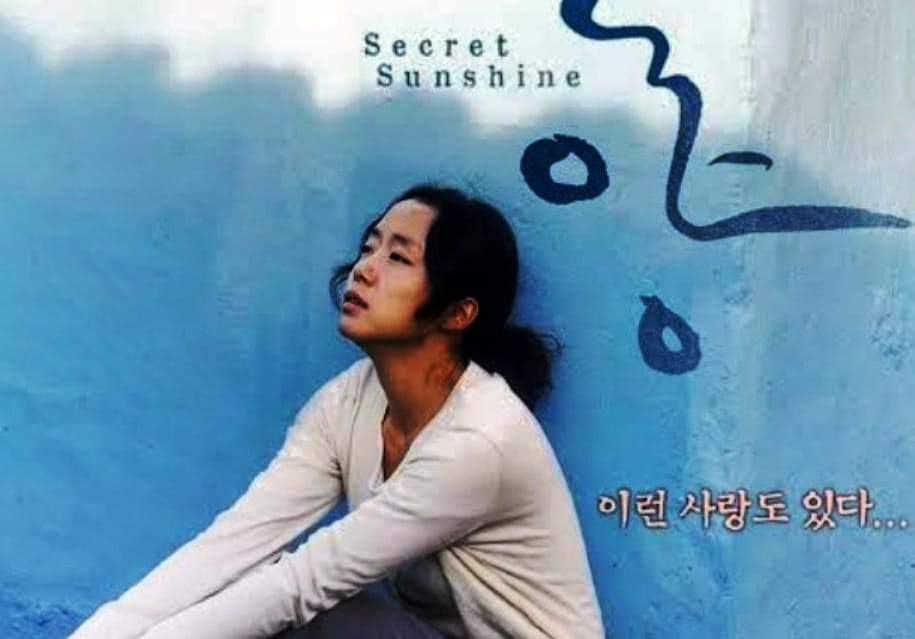
Directed by the former high school teacher and novelist Lee Chang-dong, Secret Sunshine is a film that reflects a theme most Filipinos themselves seem to grapple with: self-redemption in the name of God’s perceived, oftentimes imaginary absolution. Memory might as well remind us of scenes familiar and abominable. Or, for instance, a traditional politician convicted of double murder who said he will soon be released as “this was God’s will”.
The ways of coping with pain and grief are almost tragically showcased in this 2007 Palme d’Or nominee in the Cannes Film Festival starring Jeon Do-yeon and Song Kang-ho. The former went on to become the first Asian to win Best Actress in the said film festival while Song Kang-ho is one of the most critically acclaimed South Korean actors appearing in movies of the globally renowned Bong Joon-ho (Parasite, Memories of Murder) and Park Chan-wook (Sympathy for Mr. Vengeance, Joint Security Agency).
Starting with a trip to Miryang, her now deceased husband’s hometown, Shin-ae (Jeon Do-yeon), along with her young son, is set to embark on a new life in an environment where their first support system is the amiable but sometimes dense Jong-chan (Song Kang-ho). Scenes of a small town’s typical community and school activities are played out, with Shin-ae trying her best to fit in. She is not always successful, as when she is vocal about her criticism of a boutique owner’s presentation of her wares and later on, when she gives in to her weaknesses. The latter would see her pretending to be wealthy and in search of a land to buy. Economic prosperity is viewed here as a way to be in the inner elite circle. Jong-chan would then help her seek a real estate businessman for this new venture.
Word easily gets around, and soon enough, Shin-ae would assume a reputation for having excess cash, leading to the kidnapping of her son. Unable to provide the ransom money, Shin-ae faced bleak prospects. Her worst fear materialized, with her son being killed by the kidnapper. This is where the cinematic brilliance of Secret Sunshine comes to the fore. The moment Shin-ae is faced with another death in her immediate family is the time for her to rise up to the challenge. But it is not a straight and easy road to resilience. With nary a tear to shed, she came to her son’s burial forlorn and dejected, yet her mother-in-law was angry at her for not showing enough anguish, as if saying that losing her two loved ones may as well have been her fault or bad luck. What is there to do when one can seemingly no longer carry the burden of life’s misfortunes? Or is it really?
Shin-ae would again turn to a community rather than inwardly, the better to be visible, making her cross a little lighter to carry. Being open to participating in a prayer meeting, which she has previously ignored, is her way of unburdening herself. The complex emotions of a hurt and mourning, suddenly-alone family member are mixed in the heady welcoming voices of a congregation. One needs the other so that a certain level of peace of mind is achieved. Yet this is not enough for Shin-ae. She wants to meet the murderer of her child and grant him forgiveness. Her ever-loyal sometimes clueless friend Jong-chan asked why this is necessary when forgiveness can be given even in the absence of the guilty party. Shin-ae insists on facing her tormentor believing that this is her way of control of the situation although she never once spoke of it.
What would transpire later is a study of trauma and how one person will handle it. It is the most powerful scene in this Lee Chang-dong motion picture. The moment Shin-ae meets his son’s killer rendered her speechless heavily questioning why this man has the look of radiance, even peace of mind. “How dare God absolve him when I have not forgiven him?” is a recurrent line playing on her mind. God’s absolution is a thought perpetuated by the murderer.
It is also part of a lie that criminals frequently assure themselves to make life not merely bearable but joyous. It will resonate with every individual who has experienced injustice coming face-to-face with the source of this crime who looks at him/her with calmness and contentment. It is not the fault of one’s idea of a God or of God himself/herself but the dark intent of the perpetrator, whose public persona can easily be manipulated.
The timeliness and relevance of Secret Sunshine are such that we are made to think of society’s acceptance of crimes because those who did these persist on the myth of divine forgiveness or, in the case of some, the overarching justification of God’s will. The deviousness of a system of religious beliefs, coupled with societal norms, is utilized to allow criminal acts to go unpunished or worse, to be perceived as justified actions of a decisive and strong leadership.
The chain of events after Shin-ae’s talk with her son’s murderer in prison will jolt the audience into greater awareness of shock, psychological trauma, faith, and healing. The story has been laid out so coherently that everything will come into place. Shin-ae will descend into self-destruction, but similar to the opening scene of blue skies on a sunny day and the movie ending of a light illuminated on a patch of land, darkness cannot reign forever. #
= = = = = = =
Rosario Brenda Gonzalez is a long-time development worker who discovered South Korean films and television series during the pandemic. She was encouraged to review 18 South Korean movies, 2 South Korean television series, and 1 Japanese television series upon realizing that many of these tackled social issues in an informative and entertaining manner.
A BA Journalism graduate of UP Diliman, Ms. Gonzalez has been a project evaluator and development management trainer for more than three decades. Prior to that, she was a human rights and church worker.