

Trigger warning: Recollection of state violence.
MANILA — Memory is brutal for the families of drug war victims. Sally Ramos had to cover her daughter’s head with a cloth because her skull had been shattered, just so she could hug her one last time.
Ramos holds on to that memory with unwavering resolve, refusing to give up the fight for justice to all the victims of drug-related extrajudicial killings.
“Even if the Dutertes kill me, I will not stop fighting for justice,” Ramos told Bulatlat in Filipino. “I still could not accept my daughter’s passing. She was my eldest. It was heavy on me and our family.”
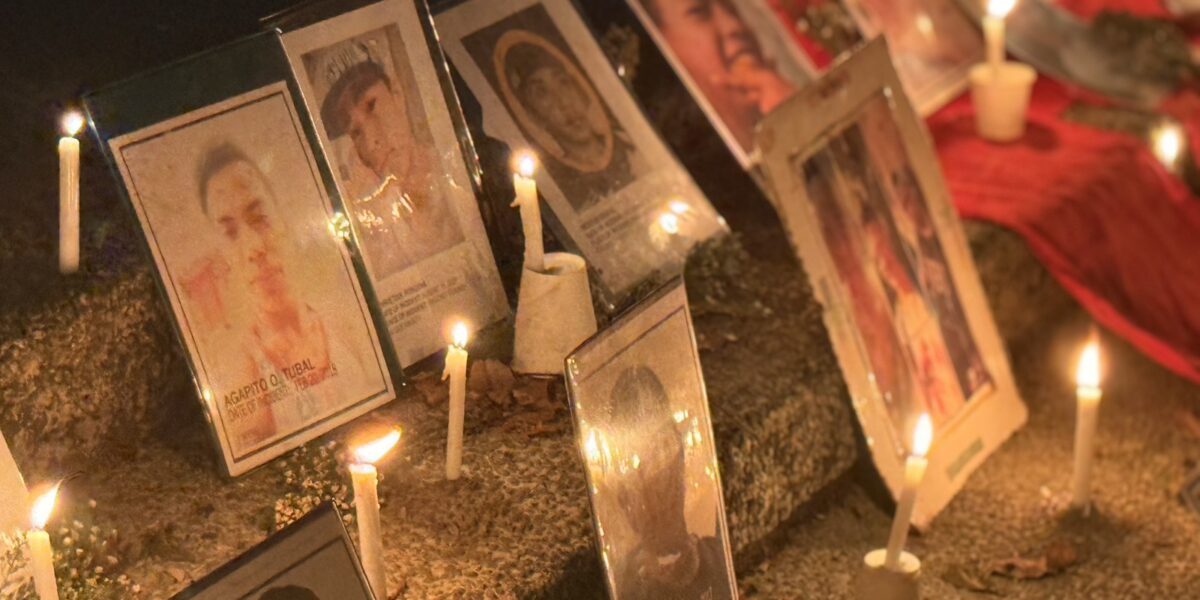
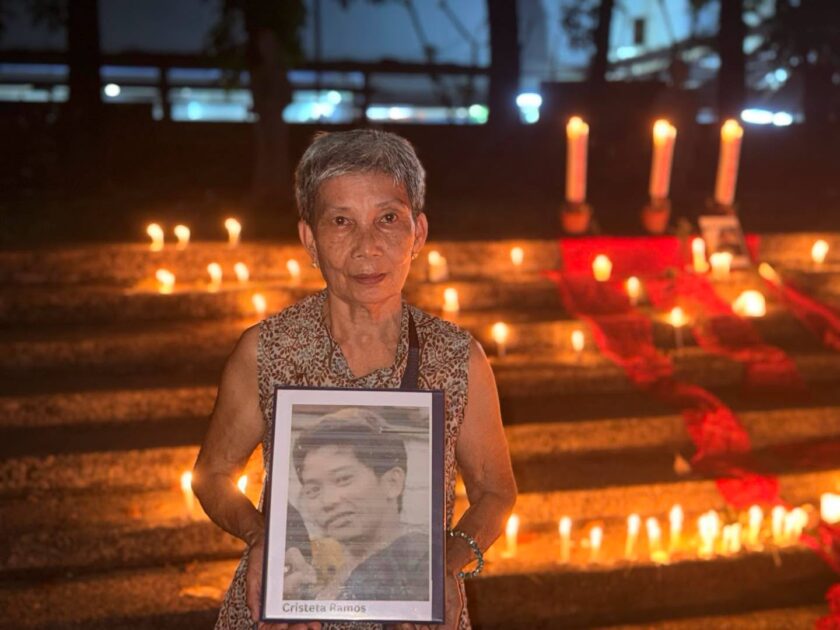
On July 1, families of the victims, survivors, and human rights groups gathered at the Bantayog ng mga Bayani to light candles in honor of their loved ones who were killed in Rodrigo Duterte’s campaign against illegal drugs. They also launched Dekada ng Sama-samang Pag-alala, Pagkakaisa para sa Hustisya or Dekada (A Decade of Collective Remembrance, Unity for Justice).
This year marks 10 years since the Duterte administration launched Oplan Tokhang, a campaign against illegal drugs that claimed thousands of lives.
“Oplan Tokhang” is derived from Filipino words of “knocks and pleads” which became a standard procedure for the Philippine National Police (PNP) in enforcing the campaign. But many of its victims were killed under the guise of “nanlaban” (self-defense) during police operations. Some victims were also killed vigilante-style where perpetrators were unidentified. For the families, it became an official kill order for their loved ones.
For those left behind, the mastermind and enforcers of “drug war” should be prosecuted before the International Criminal Court (ICC).
“When my son was killed, not one investigation prospered. Even until now, no one dares to investigate the killing of my son,” said Nanette Castillo, a mother whose only and eldest son Aldrin was killed by unidentified gunmen in 2017.
Human rights groups said there are more than 30,000 individuals killed in Duterte’s anti-illegal drug campaign. Only five cases resulted in conviction, according to Amnesty International Philippines, Human Rights Watch, and the Truth Commission.
The ICC Pre-Trial Chamber I unanimously confirmed all three counts of crimes against humanity brought by the Prosecutor against Duterte. His trial will start on November 30, 2026.
Currently, the ICC identified the following co-perpetrators: Senator and then police-chief Ronaldo “Bato” Dela Rosa who is at-large, Senator and former presidential aide Cristopher “Bong” Go, former Manila Police District Director Vicente Danao, former Philippine National Police Chief of Staff Camilo Cascolan, another former police chief Oscar Albayalde, former National Bureau of Investigation Director Dante Gierran, former PDEA chief Isidro Lapeña, and former justice secretary Vitaliano Aguirre II.
Read: ICC identifies Duterte’s co-perpetrators in ‘drug war’
“At least, we are seeing the light this time,” Llore Pasco of Rise Up for Life and for Rights said in Filipino in an interview with Bulatlat. “It has been ten years, but the trial is only starting. We hope that this continues further.”
All of the families condemn Dela Rosa’s escape from the enforcement of the ICC arrest warrant. His whereabouts remain unknown.
Challenges for the victims
ICC common legal representative Gilbert Andres told Bulatlat that the major challenges for the victims are the pervasive harassment and disinformation. “The disinformation and physical harassment have been brought about by the proceedings in the ICC, so much that even the presiding judge already referred to fake news last week.”
ICC Presiding Judge Joanna Korner raised serious concerns over the spread of misinformation and disinformation related to the Duterte case.
“The victims are wary of their security. They do not even speak about it explicitly in their communities, because there is still this culture that says that [drug war] is necessary. We need to break through that culture of impunity,” Andres added.
The victims’ families, especially women, face rising cases of technology-facilitated violence and artificial intelligence (AI)-assisted disinformation.
During the ICC confirmation of charges hearing, drug war families Pasco and Sheerah Escudero, together with Rise Up for Life and for Rights coordinator Rubilyn Litao, were subjected to a hate campaign. Their photo was altered to show that they were flaunting expensive handbags at The Hague. The original photo was taken by One News and it did not show the expensive bags.
Read: AI-assisted disinformation used vs drug war families
More than the disinformation, Castillo said that the political influence of Duterte remains strong in the country. This influence continues to create a culture of fear for the families, forcing them to not only relive the trauma, but also to defend themselves from coordinated hate campaigns.
“My only hope is that they never experience the pain we suffered,” Castillo added.
Duterte’s daughter Sara is the incumbent Vice President of the Philippines and has expressed intentions on running as the President. She is the first Vice President to be impeached twice for allegations of corruption and will soon be on impeachment trial at the Senate.
Fight for justice continues
The fight for justice continues as long as drug-related extrajudicial killings continue. The University of the Philippines (UP) Third World Studies has recorded more than 1,200 victims killed in the current administration of Ferdinand Marcos Jr.
“The Marcos government’s claim of a bloodless anti-drug campaign rings hollow,” Human Rights Watch (HRW) Southeast Asia researcher Lian Buan said. She said Oplan Tokhang has never left, and is done differently now.
This is why victims’ families are urging the Marcos Jr. administration to rejoin the ICC and stop drug war killings. “Even now, it feels like we are being ignored. We challenge this administration to rejoin ICC and enforce the ICC arrest warrants against the co-perpetrators,” Pasco said.
The Philippines withdrew from the ICC on March 17, 2019. While the country is no longer a state party, the ICC retains jurisdiction over alleged crimes against humanity committed when the Philippines was still a member-state from November 1, 2011 up to 2018.
“We should rejoin the ICC. We are invoking international law during the South China Sea dispute and the arbitral award. We always invoke international law when we’re being bullied by bigger states, so if we want to be consistent, we should adhere to international criminal justice by rejoining the ICC,” said Andres.
Holding the portraits of their loved ones close to their chests and lighting candles in their memory, the families of the victims renewed their commitment to resist brutality and ensure that the continuing violence is never buried in silence.
“As a bereaved family, I feel the weight of losing hope, strength, and trust. But like those who choose to keep standing and fighting despite exhaustion, grief, and repeated disappointment, I am here to remind the world and the government that we will keep demanding justice so our loved ones will not be forgotten,” said human rights lawyer Aileen Almora, now with the Ateneo Human Rights Center, in Filipino.
Almora’s brother Ryan Dave was killed in July 2016 at the height of the drug-related extrajudicial killings.
“It is not just about the past, but about the present and the future. This fight is to ensure that no more children are orphaned over mere accusations, that such blatant abuses of power never happen again, and that no more families are forced to embrace a photograph because that’s all left from them,” she added. (AMU, RVO)
 Save as PDF