
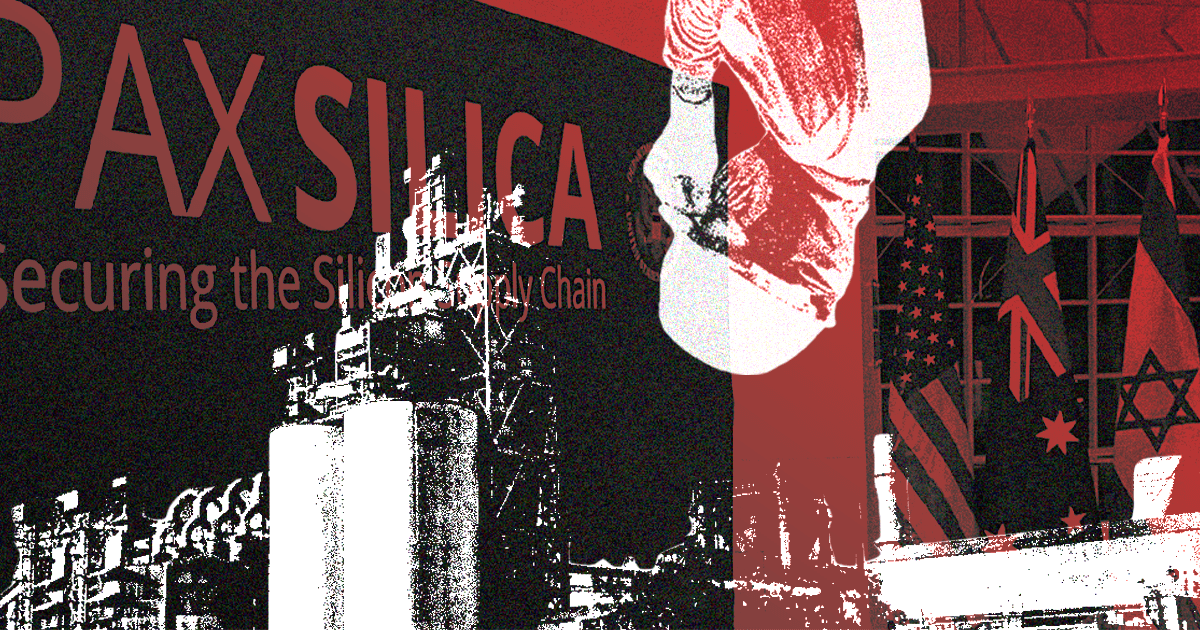
While the Marcos Jr government eagerly joins Pax Silica—the United States-led initiative to secure semiconductor and microchip supply chains for its military-industrial complex—the country’s own manufacturing base is in the doldrums.
Finance Secretary Frederick Go said being a signatory to Pax Silica would ensure the Philippines’ mineral resources and strategic location are not sidelined in global industries but leveraged to build the industries of the future. It’s such a misguided ambition, given how the Philippine government has long failed to utilize these same assets to drive domestic manufacturing and national industrialization.
Philippine manufacturing is stuck in underdevelopment. Domestic industries struggle with weak capacity, limited technological upgrading, and years of wrong policy choices, one of which is allowing foreign players to take control of the country’s resources and manufacturing direction. Yet, the Marcos government persists with neoliberalism, even as the current realities of war underscore the urgent need for a strong domestic manufacturing base.
A structural crisis
The steady decline of manufacturing reflects the impact of neoliberal policies. Macroeconomic indicators reveal the scale of the structural shift. In the 1970s, the manufacturing sector accounted for more than one-fourth of the local economy. In 1974, manufacturing’s share of the gross domestic product (GDP) peaked at an all-time high of 29.1 percent. The share of the production sector—combining agriculture, fishery, and forestry (AFF), manufacturing, construction, and mining and quarrying—was at its highest, representing the peak of Philippine industrialization.
But over the following decades, the role of the manufacturing sector slowly diminished. By 1990, the sector recorded a decreased share of 25.5%, down to 22.5% in 2000, until its historic low of 17.3% in 2025. The same case with the broader production sector, with an average share of 61.6% in the 1970s, down to 52.2% in the 1990s, and to its lowest recorded share of 33.0% in 2025.
In the same period, the services sector expanded dramatically. Its average share in the 1970s was only 32%, expanding to 38.8% in the 1990s, to its peak share of 56.6% in 2025—already more than half of the economy’s total output. This transformation has produced a service-driven economy rather than a production-focused one. While services are important components of modern economies, the decline of the manufacturing sector reveals deeper economic structural issues.
A cog in the global value chain
In place of broad-based industrial development, the Philippine government, starting from the Marcos dictatorship, designed the manufacturing sector to attract foreign direct investment (FDI), which surged from the 1980s until the mid-2000s. FDI increased after succeeding administrations implemented policies that relaxed foreign equity restrictions in various economic sectors.
Yet, despite the majority of FDIs flowing into the manufacturing sector, manufacturing capacity remained limited. This is because the large accumulation of FDI in manufacturing is only to make the country a part of transnational corporations’ (TNC) global value chains. The country’s participation in global manufacturing is concentrated in the low-value-added segments, including assembly and packing operations, which rely on imported components and foreign technology. In short, the country simply serves as the location of TNC manufacturing segments—import-dependent and export-oriented, and providing cheap infrastructure and cheap labor.
The Marcos Sr government created export processing zones (EPZs) to host TNCs and foreign firms engaged primarily in export-oriented manufacturing and services. In 1995, the Ramos government created special economic zones, along with the Philippine Export Zone Authority (PEZA), to be broader, more diversified, and larger-scale areas offering not only manufacturing but also agri-industrial and commercial services. SEZs contain industrial estates, EPZs, free trade zones, and tourist and recreational centers.
Today, 8,070 firms are operating in different locations across the country; the majority of them are in general manufacturing (2,053) and the semiconductor industry (1,692), while some are engaged in real estate, information technology services, logistics services, among others. The majority of firms are operating with FDI from Japan, US, China, Singapore, Australia, the United Kingdom, and other countries.
Electronic products comprise 53.4% of total exports as of 2024, with a total value of US$39.1 billion. Likewise, the country’s largest merchandise imports are electronic products, with a share of 21.5% of total imports and a value of US$27.4 billion. The country is barely earning from such trade. Compared to its Southeast Asian neighbors, the Philippines registered a 0.4% growth in its total manufacturing trade, compared to Indonesia’s 3.7%, Malaysia’s 9.2%, and Singapore’s 6.7% growth.
Meanwhile, high-value activities, such as research and development (R&D), advanced manufacturing, and product design, are conducted somewhere else. This structure limits manufacturing from contributing to technological advances and industrial knowledge transfer. As a result, Philippine manufacturing remains shallow, with limited backward linkages to local suppliers and domestic industries.
A jobs crisis
Manufacturing plays a crucial role in generating gainful employment. But it has been limited to a narrow set of activities, particularly export-oriented manufacturing, and it has not developed into robust local industries capable of producing a wide range of commodities.
The share of manufacturing in employment has not exceeded 10% since 1987, and has now reached its historic low of 7.1%, slightly lower than the share of agriculture. Meanwhile, the services sector has a 53% share in total employment, coming from only 33.1% in 1987.
The manufacturing sector could have created meaningful jobs for the Filipino workers. But the structural defect of the economy, where the services sector is dominant yet production is stagnant, has resulted in an employment situation where at least 7 out of 10 so-called employed are engaged in informal work. Meanwhile, the government continues to promote and facilitate the export of labor to generate billions of dollars in overseas workers’ remittances, in turn, to boost the local economy that is reliant on household consumption for growth.
The government encourages the entry of business process outsourcing (BPO) investments, which are now also located in the SEZs, to provide services to foreign firms. Job opportunities are mainly located in the SEZs and urban centers, contributing to uneven regional development as more and more Filipinos choose to live and settle in overcrowded urban areas. The whole structural crisis has created a condition where TNCs, foreign investors, and big local companies can demand cheaper wages.
Nailing the coffin
One of the most significant turning points in manufacturing occurred during the neoliberal economic reforms implemented starting in the 1980s and becoming more rapacious in the 1990s. After the global debt crisis in the 1980s, the Philippines adopted a series of structural adjustment programs (SAP) imposed by international financial institutions, mainly the International Monetary Fund (IMF) and the World Bank. SAP introduced the policies of liberalization, deregulation, privatization, and reduced state support for local industries.
The Philippine government lowered tariffs, dismantled quantitative import restrictions, and opened up domestic industries to greater foreign control and ownership. This started with the implementation of the first tariff reform program (TRP I) in 1982, TRP II in 1991, TRP III in 1995, until the early 2001 through TRP IV. Under these programs, average nominal tariff rates were significantly reduced, and protectionist measures for local produce were removed.
The first three TRPs were crucial to the Philippines’ accession to the World Trade Organization (WTO) in 1995, which further subjected local producers to intense competition with foreign corporations. These reforms were implemented not to strengthen local productive capacity but to allow foreign investors and traders, along with big local businessmen as partners, to profit from cheap manufacturing. Local industries have been subjected to competition without adequate and strong productive and technological support from the national government.
As a result, many small and medium manufacturing firms, especially those producing for local needs, weakened and eventually disappeared, while cheaper imported products flooded the local market. The country became heavily reliant on imported goods, from capital goods to consumer goods, including food and agricultural products. Trade liberalization sealed the coffin of local manufacturing for local needs.
Asserting national industrialization
Manufacturing served as the centerpiece of structural transformation for several countries. It led to the advancement of technology, productive employment, and sustained economic growth. Japan, South Korea, China, and Vietnam achieved their industrialization success through decisively developing their domestic industries and building strong manufacturing sectors.
The Philippines, on the other hand, has diverged sharply from that trajectory. Instead of sustained industrial expansion, the country has undergone a prolonged process of deindustrialization. Its economic growth has been increasingly driven by services, consumption, and overseas remittances, rather than the expansion of domestic productive capacities.
Instead of strengthening the manufacturing sector for inclusive and sustainable growth, especially with the prolonged stagnation of the global economy and the escalation of geopolitical tensions and wars, the Marcos Jr government continues to rely on foreign trade and investments. This is countercurrent to the rise of protectionist policies globally, where even the US is increasing protection from foreign products and capital and reshoring its manufacturing firms back to their homeland. US president Donald Trump has pushed for reciprocal tariffs to this end, alongside efforts to position countries like the Philippines as manufacturing hubs for US AI war materiel.
The Marcos Jr administration has repeatedly rejected the notion that national industrialization is a viable development path by insisting that the country only needs foreign investments to develop. It has provided incentives toward this end, including lowering corporate income taxes to an all-time low of 20% under the CREATE MORE law. It extended tax perks for strategic investments for up to 27 years, even if it meant losing Php5.9 billion in tax revenue from 2025 to 2028.
President Marcos Jr also passed the executive order, Green Lanes for Strategic Investments, to hasten approvals of strategic projects. Bongbong Marcos has likewise eased foreign equity restrictions to retail trade, public services, and land lease, among others, and amended anew the Foreign Investment Act.
National industrialization is possible, but there is apparently a need for reorientation—first on what it can achieve and next on what it requires. The Filipino people deserve a strong and productive local economy for their quality of living—this should be the ultimate aim of an economic development policy, where the people enjoy their rights and welfare to the fullest.
To achieve this, there should be an active industrial policy that supports technological upgrading and the development of strategic industries based on the available resources and capacity. There should be support and protectionist policies in place for the small and medium manufacturing firms for them to develop and modernize their technology. This should go hand-in-hand with implementing genuine agrarian reform and rural development to build forward linkages to industrial manufacturing. It is crucial in national industrialization to ensure livable wages and working people’s rights and welfare, regularization of work, strengthening of labor laws, and ensuring that there is accessible education and knowledge formation for the workers to reach their full potential.
In all of these requisites, state intervention is essential. There is a need for the government to reject neoliberal policies that have only resulted in the decline of the economy’s productive capacity, enrichment of a few, and impoverishment of the majority. The steps to having a responsible state require coherent industrial policy, long-term public investment, and a national commitment to strengthening domestic production. Given the current failings of the government, however, the case becomes clear: national industrialization is an assertion of national sovereignty.