

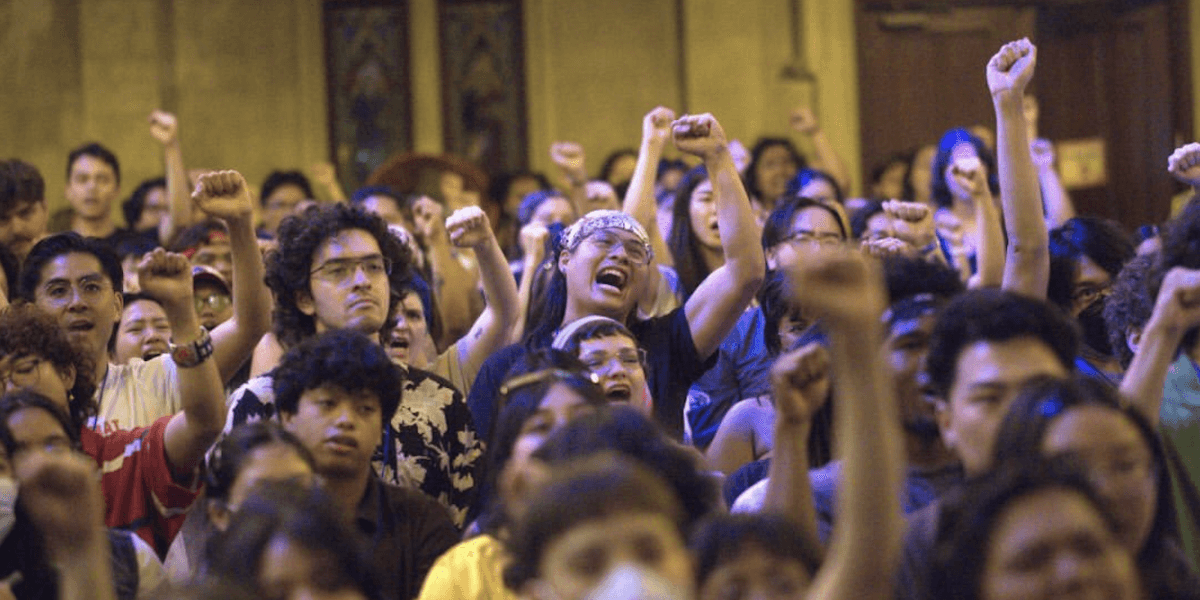
Thousands of Filipinos marked the country’s 128th “Independence Day” with protests denouncing US imperialism and calling for genuine national sovereignty, while Filipino communities in the United States gathered in a historic conference and mass mobilizations demanding genuine justice and freedom.
On June 12, thousands marched toward the US Embassy in Manila under the banner of Bagong Alyansang Makabayan (Bayan), condemning what they described as the country’s continuing subservience to the United States despite formal independence.
Protesters opposed the expansion of US military presence in the Philippines, including intensified joint military exercises, the deployment of US missile systems and military facilities, and the establishment of a so-called “Pax Silica” hub that critics say integrates the country into US military-industrial and strategic supply chains.
Hundreds of police blocked demonstrators along Kalaw Avenue and Maria Orosa Street. Protesters dismantled barbed-wire barricades erected by authorities and proceeded with a protest program despite police restrictions.
Parallel actions were held across the country. Bayan-Cavite and Bayan-Southern Tagalog organized protests in Kawit, Cavite—the site where Philippine independence was declared in 1898—as well as in Bacoor City. Organizers reported repeated attempts by police to block delegations travelling to the protests, while suspected state agents allegedly vandalized vehicles belonging to participants.
Mobilizations were also held in Cebu, Iloilo, and Davao.
“The freedom that the Filipino people enjoy is fake as long as US imperialism controls our economy, politics, military, and culture,” Bayan said in a statement.
The alliance criticized the Marcos Jr. administration for deepening military and economic ties with Washington while continuing neoliberal policies that have worsened the burden on ordinary Filipinos. It pointed to rising fuel prices, privatization, taxation policies, and the country’s vulnerability to global crises resulting from US-led wars and interventions.
“The government’s theme of ‘Freedom, Future, History’ is hollow while the country’s resources and sovereignty are being surrendered to foreign interests,” the group said.
Bayan called on Filipinos to continue the struggle for genuine independence, national democracy, and an independent foreign policy free from foreign military domination.
On June 26-27, more than 1,000 Filipinos from across the United States gathered in Los Angeles, California for Kalayaan: A People’s Conference for Justice and Freedom.
The conference was organized by BAYAN USA, Migrante USA, Malaya Movement USA, and numerous Filipino community organizations seeking to strengthen collective efforts against detention, repression, labor exploitation, poverty, hunger, militarization, and attacks on migrant communities.
Participants discussed the conditions facing Filipino migrants, workers, caregivers, youth, and families, while forging greater unity in confronting the challenges affecting Filipinos both in the homeland and abroad.
Just days later, on June 29, more than 400 people rallied outside the Philippine Consulate in Los Angeles after a delegation of Filipino migrant workers, caregivers, and mothers experiencing crises sought assistance from Philippine government officials but were reportedly denied support and treated with hostility.
Organizers said the conference and subsequent mobilization reflected a growing determination among overseas Filipinos to link migrant struggles with broader campaigns against corruption, war, militarization, and fascist attacks.
In the conference’s adopted Kalayaan Unity Statement, participants affirmed their commitment to collective action and solidarity.
“As one Filipino people, we will fight for a better future and world for all of us, where genuine freedom is not just aspirational,” the statement read.
Organizers said the actions demonstrated how the struggle for national liberation and social justice continues to unite Filipinos across borders.
Post Views: 54
