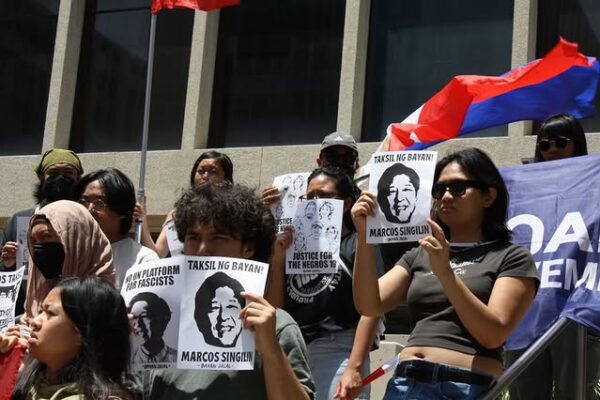


Agricultural workers condemned Congress for its approval of land ownership in the Philippines by foreigners, calling the measure “treacherous.”
Unyon ng mga Manggagawa sa Agrikultura (UMA, Federation of Agricultural Workers) chastised both houses of Congress for approving 99-year land leases to foreign corporations and business owners.
UMA said the legislation would fast-track President Ferdinand Marcos Jr.’s realization of predecessor Rodrigo Duterte’s vision of surrendering at least 20% or 1/5 of the country’s total agricultural lands to foreign corporations.
It added the measure would surrender control of Philippine patrimony to agri-business venture arrangements (AVAs) that are sure to expand the plantation system in the country.
The Senate approved Bill No. 2898 last Monday extending the maximum term for land leases to foreign investors from 75 to 99 years, amending the 31-year-old Investors’ Lease Act.
Last Tuesday, the House of Representatives also passed its version by a 175-3-2 vote, including protections for foreign investors entering into lease agreements.
Only nationalist Makabayan representatives France Castro of ACT Teachers’ Partylist, Arlene Brosas of Gabriela Women’s Partylist, and Raoul Manuel of Kabataan Youth Party voted against the measure.
‘Sell-out’
UMA said the “railroaded” measure is a virtual sell-out of Philippine patrimony by circumventing the Constitution’s prohibition of foreign land ownership.
“[The] lawmakers themselves engaged in the facilitation of landgrabs by imperialist forces, foremost of them agri-business corporations,” UMA chairperson and former lawmaker Ariel Casilao said.
Casilao said the bills’ passage is “charter change by other means” in that the 99-year land lease legislation gave way to what the 1987 Philippine Constitution forbade.
He pointed out that even business leaders agreed this was the case, citing Chris Nelson of the British Chamber of Commerce who saida 99-year lease “negates the risk of non-ownership of the land.”
George Barcelon of the Philippine Chamber of Commerce and Industry also said the measures are “almost equivalent to land ownership,” UMA cited.
“Sa pagdiriwang ng mga korporasyon sa katrayduran ni Marcos Jr., ipinagdiriwang din nila ang gutom ng karaniwang mamamayan,” Casilao complained.
“Ginagamit nila ang batas para lalong agawan ng lupa ang hikahos nang pesante at baratin siya bilang aliping sahuran sa sariliing lupa,” Casilao said.
Still, landlessness
Seven to nine out of 10 peasants remain landless in the Philippines.
It was this systemic landlessness that pushed peasants into the wage relation that turned them into agricultural workers, Casilao explained, working the soil they had lost to the corporate plantation system through lopsided AVAs in exchange for poverty wages.
Plantation workers receive with the lowest wages in the local labor force, receiving an average of P250/day — below legal minimum wage standards in most regions and barely 21% of the family living wage.
This would even be lower in plantations where the ‘pakyawan’ system was allowed and in place.
UMA said plantation expansion through the 99-land lease bills would impact not only the low-wage agri-workers Marcos Jr. stripped of land through AVAs; it would also aggravate the entire country’s food insecurity already worsened by record rice imports projected to reach 4.7 million metric tons next year amid observed declines in palay production.
“This was why the President had been forgiving amortization debts incurred by agrarian reform beneficiaries (ARBs) all along: to corner ARBs enjoying zero support for agricultural production amid state importation of food staples into selling their lands — or lease them for close to a century,” Casilao explained.
By selling agricultural lands off to agri-corporations interested only in high-value crops like oil palm, pineapple, and the disease-riddled Cavendish banana, the government is leaving Filipino farmers with nothing to cultivate food staples on, thereby justifying imports and the exorbitant prices they came with, the farmer leader said.
“Sa tahasang panloloko ni Marcos Jr. sa mga pesante, pinapaypayan niya ang galit ng uring magsasaka,” he warned.
“Ibaon pa niya sa krisis ang karaniwang mamamayan, at aani siya ng mga protestang mas mayabong pa kaysa mga sakiting tanim sa anumang plantasyon,” Casilao ended. # (Raymund B. Villanueva)