
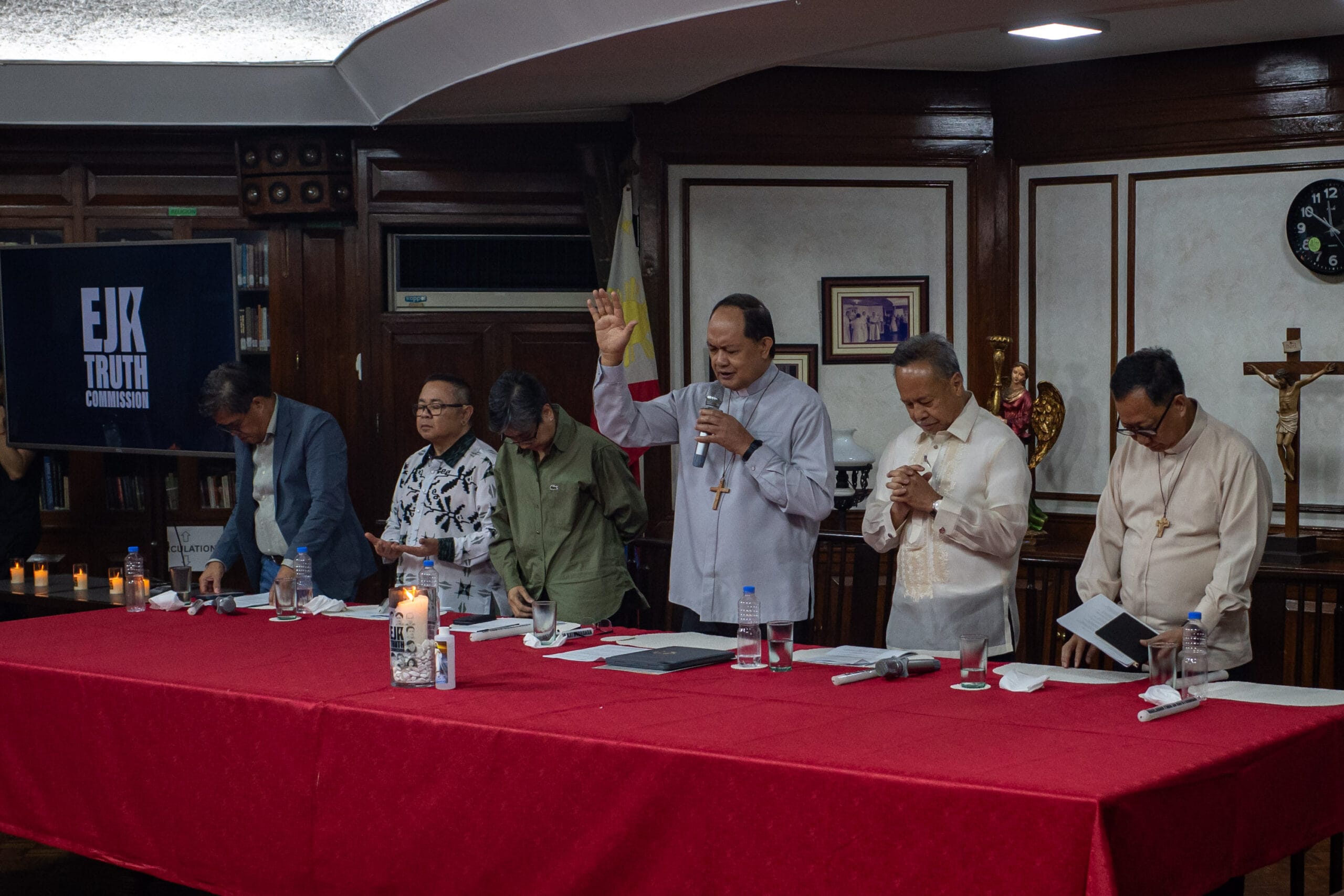
Church leaders, human rights defenders, forensic experts, and academics launched a civilian-led truth commission on Wednesday, May 27. The commission aims to document extrajudicial killings linked to former president Rodrigo Duterte’s anti-drug campaign and preserve the testimonies of victims, survivors, and witnesses.
The Truth and Reconciliation Commission, formally launched in Mandaluyong City, wants to build a public record of killings carried out during Duterte’s “war on drugs,” which human rights groups say left thousands dead beginning in 2016.
Backed by Cardinal Pablo Virgilio David, the commission brings together church leaders, lawyers, forensic experts, trauma specialists, journalists, and educators in what organizers described as an independent effort to pursue truth, accountability, and healing.
“The Philippine Truth and Reconciliation Commission is about finding out the truth. The truth that was buried together with the people who were said to have ‘fought back’,” David said during the launch.
“The phrase ‘nanlaban’ carries a heavy weight. We forget that they were human beings like us,” he added.
A civilian initiative
David said that while the courts focus on determining criminal liability, the Truth Commission aims to uncover the broader realities behind the killings. This will be done by listening to victims, survivors, families, and others in order to understand how the abuses happened and how they can be prevented in the future, David added.
Former International Criminal Court judge Raul Pangalangan will chair the commission. Organizers emphasized that the commission will focus on truth-telling and public documentation while helping strengthen “future accountability efforts”.
“For us, our goal is to establish the truth hand in hand with the victims,” Pangalangan said.
He said the commission’s reports and documentation may later support local and international investigations.
“We will issue our report and we will make sure that responsible government agencies will receive our report,” Pangalangan said. “If they find materials in those testimonies that can advance their own investigations, for me, that will be a most welcome development,” he added.
Pangalangan also pointed to what he described as institutional failures that allowed the killings to persist, saying there was “almost a conspiracy of silence among government entities” that enabled those behind the anti-drug campaign “to have their way and exact such an immense toll on our people.”
Human rights researcher and journalist Carlos Conde, who serves as executive director of the commission, said the documentation gathered by the body could help pressure state institutions to pursue accountability.
Conde underscored the role played by journalists and human rights workers in documenting killings during Duterte’s presidency, saying the human rights community “would have struggled to document all of this” without media organizations and reporters who partnered with rights defenders in investigating the killings.
Pursuing the truth
Among the commissioners is forensic pathologist Raquel Fortun, who said weak death investigation systems in the Philippines allowed many killings to go undocumented or improperly examined.
“Just because they have died does not mean they no longer have anything to say. Science is used for this,” Fortun said.
She added that many cases lacked proper autopsies and documentation, noting that in countries with functioning medical examiner systems, all deaths caused by violence would automatically undergo forensic examination.
Forensic science, Fortun said, is fundamentally about pursuing the truth, which is why she considered her role in the commission important.
Psychosocial and trauma specialist Al Fuertes said the commission also aims to address the long-term trauma left by the killings.
“Trauma is usually transferred. Trauma is usually transmitted,” Fuertes said. “Part of the overall vision of the commission is to prevent the impact of what happened from becoming transgenerational traumatization.”
Fuertes said the commission would create spaces where victims, survivors, and former perpetrators could safely share their experiences.
Moral direction
Vincentian priest and theologian Daniel Franklin Pilario said silence about the killings risks allowing false narratives about the drug war to shape younger generations.
“There was a time in November and December of 2016 that we were burying eight to 10 young men, some single, others young fathers, who were killed just like that,” Pilario said, recalling his ministry in Payatas.
Pilario said the commission’s findings should eventually be integrated into schools and universities.
“If the whole society remains silent about what happened in the past ten years, what moral direction can we give to the youth?” he said.
Citing Pope Francis’ encyclical Fratelli Tutti, he stressed that remembrance was necessary for healing and accountability, saying society “can never move forward without remembering the past”.
‘Consultations must be integral’
The commission’s initial focus is on the killings linked to Duterte’s anti-drug campaign, though a victims’ group later urged the body to also examine killings and rights violations under the current administration.
During the launch, Rise Up for Life and for Rights, an organization of families of drug war victims, posted an online statement raising questions about the commission’s composition, framework, and victim representation.
“What will make this process different? Victims advocacy groups have been documenting the violations for years,” said Llore Pasco, whose sons Crisanto and Juan Carlos Lozano were killed during Duterte’s anti-drug campaign.
“We want to know: who is commissioning the panel? How are the victims represented? What truth is the panel going to uncover? What is their framework of ‘reconciliation’?” Pasco said.
Jane Lee, wife of drug war victim Michael Lee, said victims’ families should be directly involved in shaping the process.
“When our loved ones were killed in Duterte’s ‘war on drugs’, we were stigmatized. Many falsehoods and lies were in the news,” Lee said, adding, “Consultations with the victims and our families must be integral in the process.”
The group also urged the commission to broaden its scope beyond Duterte’s anti-drug campaign, saying killings and human rights violations under the current administration should also be examined alongside cases involving farmers, workers, women, youth, and human rights defenders.
Lee said that while their immediate focus remains on the trial at the International Criminal Court, any truth commission should address continuing patterns of violence and impunity beyond the Duterte years.