

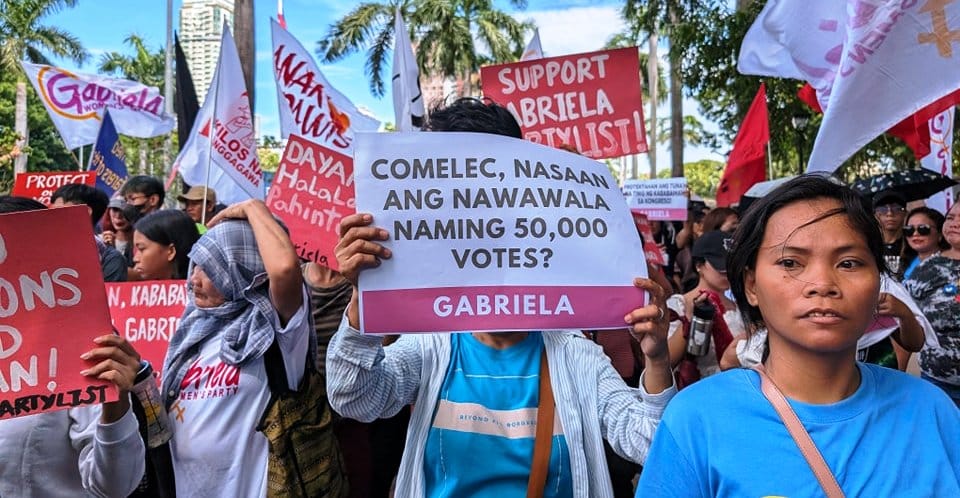
Gabriela Women’s Party (GWP) demanded that the Commission on Elections (Comelec) explain the loss of nearly 50,000 of their votes in the ongoing canvassing of the partylist elections.
In a letter sent Friday and addressed to Comelec chairperson George Erwin Garcia, the women’s party said that according to data from the poll body’s transparency media server it garnered 252,562 votes as of 2:03 AM of May 13.
“However, by 2:20 AM, this number had inexplicably decreased by 49,614 votes,” Gabriela Rep, Arlene Brosas and first nominee and former Kabataan Party Rep. Sarah Elago said.
The leaders attached screenshots from ABS-CBN, sourced from Comelec’s transparency server as proof of the “alarming discrepancy.”
GWP said the unexplained reduction raises serious concerns about the integrity and transparency of the electoral process.
“If votes for a sectoral party representing women and other vulnerable sectors can simply vanish without explanation, it risks disenfranchising not only the candidates but the countless women and marginalized communities whose voices they seek to represent,” Gabriela added.
The Comelec had also been bombarded with questions regarding the apparent reduction of up to five million votes for senatorial candidates early Tuesday morning.
Garcia said the fault lies with the receiving servers whose software programs did not have “proper filtering” of so-called duplicate entries transmitted from polling precincts.
“The [partial and unofficial] count had an excess of five million because of this because the [receivers] did not have a program that would filter the duplicate [entries] as a result of processing,” Garcia said.
The poll chief denied there was poll shaving and padding of votes.
Earlier, several parties and candidates slammed Comelec for inexplicably using an unaudited version 3.5 of the source code used by the automated voting machines on Monday’s polls.
Manufactured by South Korea’s Miru Systems at a cost of Php18 billion pesos for the government, the use of the new machines is a project of the Garcia-led Commission.
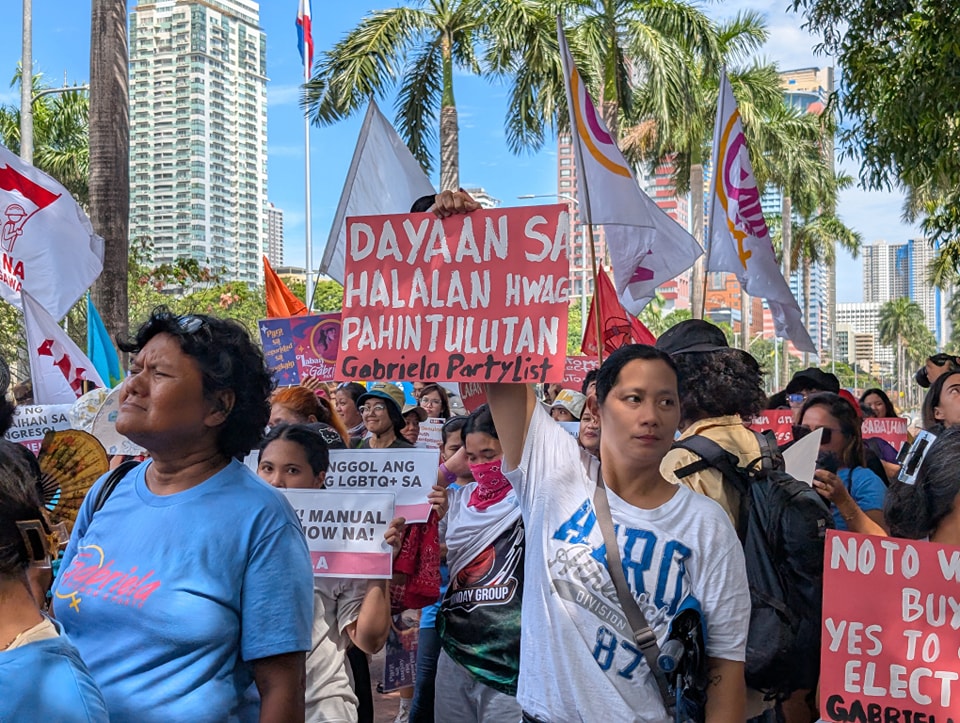
But GWP said it is not just the problem of reduction of votes by a supposed high technology system that surfaced on Election Day.
“Data from National Citizens’ Movement for Free Elections suggests a staggering 18,499,817 uncounted votes due to overvoting, with 3,315,487 of which being partylist overvotes,” it pointed out in its letter.
Voters complained that the machines refused to count their votes due to “overvoting,” likely the result of ink seeping to the reverse side of the ballots.
The women’s party said “such discrepancies significantly impact the overall partylist election results, thereby disenfranchising millions of voters and distorting the genuine representation that marginalized sectors such as women rightfully deserve.”
It added that the anomalies are made worse by systematic red-tagging and vilification targeting GWP, its representative, leaders, members, and supporters throughout the campaign period.
GWP demanded an immediate investigation on the discrepencies, adding Comelec should initiate a manual counting of votes as the credibility of the democratic processes is at stake. # (Raymund B. Villanueva)