

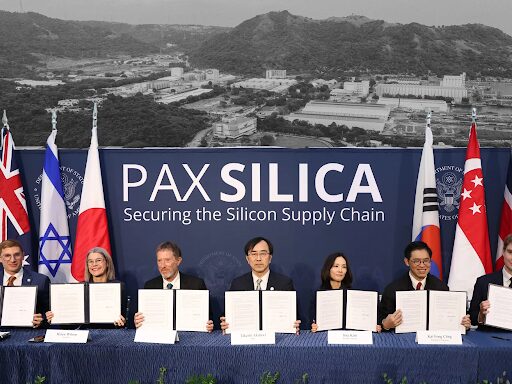
While Pax Silica is framed as a promising venture between two longtime allies against China, history shows a picture of wanton labor exploitation, aggressive land conversion and expansion, and massive resource extraction.
With the US-led initiative of Pax Silica gaining headline-after-headline in news outlets, its supporters often framed by it as a way of modernizing the Philippine economy. However, stripped of the geopolitical vocabulary and promises of high-tech job creation, the reality is different.
Pax Silica is not a catalyst for domestic industrial development. It is a continuation of the framework that had historically put the Philippines in the lowest level of the global supply chain, only this time with techie terms like “artificial intelligence.”
For context, we have to understand the Export Processing Zone (EPZ) framework during the first Marcos regime in the 1970s.
An EPZ is a specialized industrial estate that is legally and administratively “outside” the normal customs territory. It is a special fenced-off area where factories mainly produce goods for export and get tax breaks and more relaxed rules from the government. Firms inside can bring in machines and raw materials with fewer taxes and less paperwork as long as most of what they make is sold abroad. The general idea of an EPZ is to attract foreign companies, create jobs, and earn dollars by making an area “business-friendly” almost isolated from the entire country’s domestic economy and regulations.
In November 1972, two months after the declaration of Martial Law, Ferdinand Marcos Sr. issued Presidential Decree No. 66, formally creating the Export Processing Zone Authority (EPZA), initially focusing on Mariveles, Bataan. EPZA was established as the main government agency to plan, develop, and manage export processing zones. Prior to that, construction of the Bataan Export Processing Zone was already ongoing. Other EPZs soon followed such as Mactan EPZ and Cavite EPZ. In the Letter of Instructions No. 1033 dated May 30, 1980, Marcos Sr. ordered the development of EPZs in Northern Luzon, La Union, Clark Field Area, Batangas, Iloilo, Tacloban, and other areas.
Along with the creation of EPZs during the dictatorship, Marcos Sr. also issued General Order No. 5 which prohibited all demonstrations, picketing, and strikes in “vital industries.” This was reinforced by Presidential Decrees (PDs) 823 and 849 in 1975 after the historic La Tondeña strike which shattered the climate of fear during the dictatorship. The decrees imposed an absolute ban on strikes. Section 7 of PD 823 also barred foreign organizations from directly engaging with trade union activities.
Despite these zones being called a “paradise” for foreign companies, workers did not waiver. In June 1982, workers from the Interasia Container Industries, Inc. went on strike to protest the illegal termination of union members and inhumane working conditions, with one such case of a single employee operating six looms. It resulted in the arrest of 54 strikers detained in inhumane conditions. Outraged by the harsh detention of Interasia strikers, 14,000 workers across the BEPZ organized a strike resulting in international publicity that led to an agreement releasing the arrested individuals and reinstatement of workers. In October 1983, Astec Electronics, Inc. workers who had recently unionized launched a strike after management retaliated by laying off several hundred employees. BEPZ police were reported to have harassed women on the picket line. This led to a 1983 General Strike by other workers in the zone leading Astec to lay off all its workers and its total closure.
The Cavite Export Processing Zone (CEPZ) tells another story. It was heavily policed as part of Cavite’s “no-strike” industrial policy. The CEPZ Authority used violent and intimidating tactics to clear land for the zone’s expansion. On March 20, 1991, CEPZA officials and armed police arrived in Barangay Bacao with a bulldozer and crane to level local farmlands. Two months later, the same group returned to the area yet again, handcuffing a private resident and holding residents helpless at gunpoint to bulldoze the area.
After the People Power uprising that ousted Marcos Sr. in 1986, EPZs remained central as vehicles for foreign direct investment (FDI) and other non-traditional exports and was reformed to a more diverse “special economic zones” (SEZs) that included tourism, agro-industrial, and freeport forms. In 1995, the Special Economic Zone Act of 1995 formally established the SEZ form, recognizing different types of zones. Republic Act No. 7916 formalized the creation of the Philippine Economic Zone Authority (PEZA), the successor of EPZA and it also codified income tax holidays, tax and duty-free importation of capital equipment and raw materials. In the early 2000s, PEZA started designating information technology (IT) parks and IT buildings as SEZs, allowing office-based export of services particularly those in software development, business process outsourcing (BPO), and shared services.
Even with these restructuring of the EPZ and nominally democratic administrations, labor suppression were still found as labor groups accuse companies in SEZs of using lawfare to harass union leaders. Violations of minimum wage standards and the contractualization of labor were also widespread to avoid giving due benefits even for long-time employees. The basic needs of workers and their families are continually not being met with the minimum wage being prevalent.
Historically, EPZs have hosted a lot of electronics and semiconductor assembly and testing operations that belong to the lower-value segments of the global semiconductor chain rather than high-end chip design or fabrication. This means that technology transfer tends to be focused on operating and maintaining imported equipment and not on core research and development (R&D) or cutting-edge fabrication technology. The Philippine plants of Texas Instruments, a multinational semiconductor company, focus on high-volume, precision testing and packaging. Amkor Technology Philippines, located in major industrial parks like the Laguna Technopark, imports raw silicon where workers and automated lines package and test the components before they are sent worldwide. Nexperia, focused on high-volume production of essential standard components, does not have core design centers in the Philippines with its Cabuyao facility dedicated exclusively to assembly and testing.
Pax Silica is anchored on the promise that investing in the Philippines’ labor force would lead to fruitful development in the country’s economy. Its explicit though undeclared goal is to bypass and counter China’s continuing dominance in the global technology stack. As of July 2026, the Bases Conversion and Development Authority (BCDA) is rushing to finalize a framework agreement with the US State Department, aiming for a formal signing in November 2026.
The initiative relies on the Philippines for two key structural assets, (1) critical minerals and (2) established low-cost assembly and testing workforce. As the Philippines is home to vast reserves of nickel, copper, and cobalt, it is no wonder that the US and its allied countries are keen to tap on these reserves as a response to China’s monopoly on rare earth minerals which control an estimated 85% to 95% of worldwide refining capacity and roughly half of all known global reserves. In other words, Pax Silica is a wholesale extraction of the Philippines’ natural resources for the United States and China’s geopolitical chess game where the Filipino people are the pawns.
The scale of Pax Silica is massive. It aims to use the geographic area known as the Luzon Economic Corridor, aiming to form an integrated manufacturing and logistics belt connecting Subic Bay, Clark and Tarlac, as well as Manila and Batangas, including mining areas in the peripheries. It promises “AI infrastructure” that could mean anything from software development offices to outright AI data centers that require immense amounts of land, continuous water cooling, and massive drain on the local power grid.
We have to look beyond the agreement on paper. While Pax Silica is framed as a promising venture between two longtime allies against China, history shows a picture of wanton labor exploitation, aggressive land conversion and expansion, and massive resource extraction. Many might point out the potential of a technology and skill transfer but this has been promised 50 years ago. It is futile to expect fulfillment now.
In the end, Pax Silica reflects a deeper, structural submission to foreign economic and military interests, trading off local mineral wealth and cheap labor to bolster US hegemony in its standoff with China. The devil is still yet to reveal the details but history has shown that export-oriented, foreign-dominated enclaves do not yield technology transfer or sustainable domestic growth. They deliver instead labor repression, environmental degradation, and perpetual economic dependence. As state rhetoric gears up to present Pax Silica as a national triumph, working-class movements, scientists, and the broader public must reject this false promise. We must demand an end to unequal economic frameworks and push for an independent foreign and economic policy, one rooted in labor rights, environmental justice, and a self-reliant economy built for the Filipino people, not foreign superpowers. (DAA)
 Save as PDF