

By Viggo Sarmago
Bulatlat.com
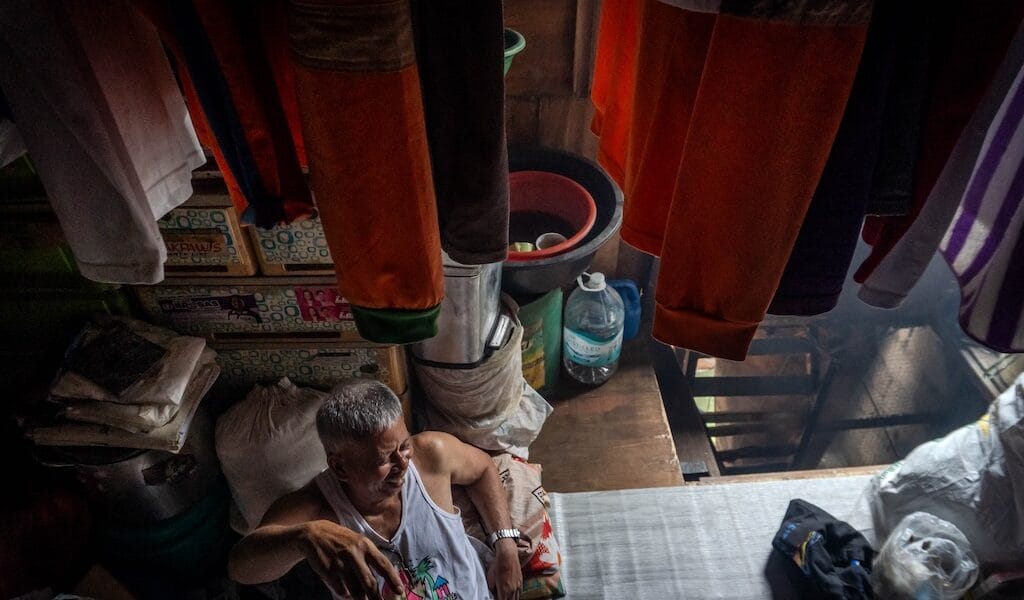
MANILA — Since 1989, ‘Ka Boy,’ a custodian working under Manila North Harbor Inc., the company controlling the country’s busiest port, has collected articles from alternative newspapers, various documents of their local struggles, educational discussions, books, and concept notes pertaining to the labor movement in the port area. He has also kept other materials such as photographs of various mobilizations and strikes that were held during their two-decades long battle against port privatization that lasted until the Arroyo administration.
Read: Manila North Harbor Workers Slam Impending Deal’s Provision
He stores the collection in his house near the pier, in a makeshift bodega. He compiles paper documents, such as newspapers and magazines in layers of plastic bags to protect it from sunlight, dust and water damage, and tuck them in a dry corner of the room. Books are wrapped in plastic and stored in buckets, though some materials are no longer recoverable due to pest infestations or severe degradation from the environment. He also stressed the need to be prudent, citing that state surveillance and red-tagging in his community are a threat to his archival practices.


For Ka Boy, archiving is an effective way to strengthen the foundations of the labor movement, and to continuously vitalize it for future generations. “It is important to preserve because it is necessary to have a concrete analysis of the labor movement. How can you be enlightened with a clear understanding of the movement if you don’t have documents to back it up?” he said.
“That’s why I got the idea to preserve [my documents]. We want to be able to preserve the movement, have more people involved, and to look at its past results, and learn from past victories and even defeats,” he added.
Like Ka Boy, the Philippine Labor Movement Archive (PLMA) documents workers’ movements of both past and present through community archiving.
PLMA is a collective effort by Tambisan Sa Sining, Kilusang Mayo Uno (KMU), MayDay Multimedia, Ecumenical Institute for Labor Education and Research (EILER), and Balai Obrero Foundation, Inc. The project sought to utilize community archiving to educate future generations of workers about the history of the labor movement and the fight for just wages, regular work, unionism, and human rights after observing the historical revisionism employed by the Duterte-Marcos tandem campaign during the 2022 presidential elections.
Spearheading the ongoing archival efforts are Adrian Mendizabal and Tel Delvo who have been doing the project for four years.
For them, community archiving in the Philippines is an emerging practice that seeks to immortalize memories from the grassroots. It focuses on the collective effort of organizing individual collections, to unearth and relearn the history of the workers movement from the community themselves.
“The definition of community archiving is evolving, it’s where you value the history from the ground. History itself is political, it is usually written by the educated or those with big names…Through community archives, you showcase and have proof of the real experiences of the masses, and we want to break that through the context of the labor movement” Delvo explained.
Community archiving is unique in that the archivist’s ability and capacity to archive is tied to their social realities. It requires social investigation or immersion to figure out the best way to archive for a particular community. Throughout the years, they encountered situations where a unionist’s access to their collection was impossible due to precarious conditions, and even state repression.
The PLMA currently holds two main collections from KMU and veteran photojournalist Boy Bagwis, and smaller collections from MayDay Multimedia, Tambisan sa Sining, Pagkakaisa ng mga Samahan ng Tsuper at Opereytor Nationwide (Piston), and EILER.
At present, the PLMA is archiving the labor movement in Tondo, where the first May 1 protest was held, back in 1903. It was led by Union Obrera Democratica de Filipinas, and saw thousands of dockworkers and tobacco workers mobilizing in Plaza Moriones to demand for humane working conditions. During Martial Law, in October 1975, the workers of La Tondeña Distillery were the first to strike for higher wages and regular work. Despite its rich history, the community is facing displacement and recent fires allegedly due to so-called development projects such as the South Access Link Expressway (SALEX), Pasig River Expressway (PAREX), and the North South Bridgeway, all linked to capitalists Ramon Ang and Enrique Razon.

“It’s a different process, of coming together, so the model in Tondo is different. [A] community archive always starts with an individual from a community, then it becomes bigger as more people join in, until it creates a coherent collection of the community and its history,” Mendizabal explained.
On April 28, International Workers’ Memorial Day, PLMA, along with Pagkakaisa ng Mamamayan ng Tundo (Pamatu), a coalition of urban poor and workers in Tondo, opened an exhibit titled “Manggagawang Tubong Tundo: Binhi ng Militanteng Paglaban ng Kilusang Paggawa,” to display the progressive history of the workers of its community. Since then, they continue to document and gather materials for archiving, and are collaborating with a local workers’ community archivist.


The future of community archiving and alternative media
For Delvo and Mendizabal, another avenue community archiving can be used in is through helping alternative media outlets in historicizing events to deepen their reports and paint a fuller picture of events.
Delvo mentioned the Kowloon workers’ strikes that transpired in West Avenue, Quezon City. To recall, on April 15, workers held a strike because of a P25 ($ 0.41) wage increase and benefits the company refused to implement despite a previous Collective Bargaining Agreement back in August 2021. After a six-day strike, they won a P40 ($ 0.65) wage increase and service charges owed to them. In 2008, workers held an almost 4 month strike at the same place for the unjustified and abrupt layoffs of 73 workers. Eventually, the National Labor Relations Commission (NLRC) Third Division ordered the reinstatement and full compensation for the 73 workers.
“While it was not the [union’s] first strike, there were many members that fought for the first time. At the same time, there were also 2008 veterans who still joined, so it paints a beautiful picture,” Delvo said.
Read: Kowloon house workers win fight for wage hike, release of service charges
Read: Kowloon workers clinch initial victory
“This is what we envisioned for PLMA…It will open fresh perspectives of the movement, because [archiving] exposes us to events we tend to forget,” Mendizabal added.
Looking ahead, they hope that communities like the one in Tondo will be able to archive on their own for generations to come. They called for more organizations to start archiving to safeguard the genuine history of the masses, and to teach new generations the struggles their predecessors fought for, and eventually, won.
As of writing, the PLMA is looking to apply a postcustodial model for archiving Ka Boy’s collection. This means that Ka Boy will maintain the ownership of the collection while the PLMA will digitize or scan his collection for further safekeeping. The PLMA intends to donate a Durabox to better protect Ka Boy’s collection.
Ka Boy underscores the importance of archiving in combating disinformation and propaganda made by the ruling elite, and disputing ‘wrong interpretations’ of the movement.
“[Archiving] allows the readers to distinguish those who peddled idealist perspectives, or revisionists perspectives, and who advanced the genuine workers’ perspective that is grounded on [Marxist-Leninst-Maoist] theories…Readers will be able to discern the patterns from the documents or papers, of what serves the masses, and what serves the ruling class and their propaganda,” he explained in Filipino.
Delvo shared the same insights. “Our enemies have the resources, and the power to perpetuate the history of the ruling elite, which is why we should sustain the history on the ground to resist those who perpetuate those narratives,” Delvo said.
Real name hidden upon request
Note: $1 is equivalent to P61.51 as of June 10, 2026, foreign exchange rate.
 Save as PDF