


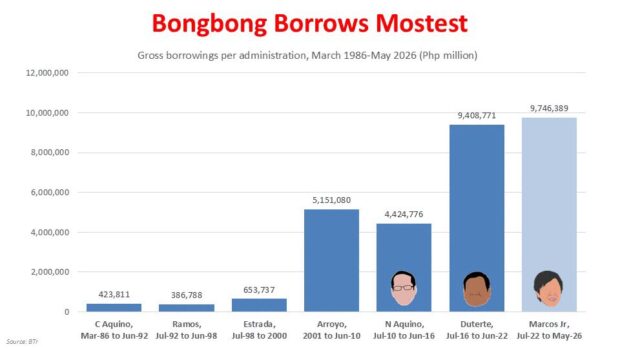
President Ferdinand Marcos Jr. is Philippines’ biggest borrower in the last 40 years and among seven administrations, an independent economic group revealed. Marcos has officially surpassed the Covid19-driven P9.4 trillion borrowing over the entire six-year Rodrigo Duterte administration.
He has so far borrowed P9.7 trillion in the first four years of his term, independent economic group, IBON Foundation said.
But is Marcos getting ahead of Philippines’ fiscal shortfall? Are ever-increasing local and international loans serving the needs of the Filipino people?
Why is the Philippines a perennial borrower?
IBON executive director Sonny Africa blames the country’s wrong policies and taxation laws. The economist cited taxation laws such as the Corporate Recovery and Tax Incentives for Enterprises (CREATE) and its amendment CREATE MORE that lowered corporate income taxes for big and foreign businesses.
“It’s not helping that tax cuts for big corporations and rich families cost the government P400-500 billion in foregone revenues annually,” Africa said.
The Philippine government also loses substantial amounts due to corruption in its revenue agencies. Local news channel Bilyonaryo reported that as much as P200 billion (Dh 12 billion) is lost annually due to corruption, undervaluation, and smuggling within the Bureau of Customs. This translates to about 15% to 16% of the agency’s yearly revenue collections.
Another agency, the Bureau of Internal Revenue (BIR), loses P500 billion annually due to corrupt practices, such as abetting tax evasion by businesses and their owners. While the BIR collected a record-high P3.105 trillion last year, it still fell short of its target, largely due to systemic leakages.
Broader corruption across all government sectors drains P1.4 trillion every year, the Philippine Department of Finance admitted.
Is borrowing the only solution?
With less income and overspending due to corruption, the easy solution for the Philippine government is to borrow funds locally and internationally. But borrowed funds by the Philippine government do not automatically benefit ordinary Filipinos, IBON Foundation said.
“[S]ome 80 centavos out of every peso borrowed goes straight back to debt service, instead of being spent productively to improve the government’s revenue-generation or the economy’s debt-repaying capacity,” Africa said. “This is aside from too much of what’s left over still going to pork barrel funds of corrupt politicians,” he added.
Africa proposes the radical solutions of stopping “robotically paying all debt,” as well as deciding more rationally, such as which debts to service.
He also raised the possibility of passing congressional bills that seek to raise taxes on large corporations as well as rich families.
“We should also pretending to be an ‘upper middle income’ economy,” Africa concluded, noting that the Philippines still has to rely on loans to meet its financial requirements. # (Raymund B. Villanueva)