
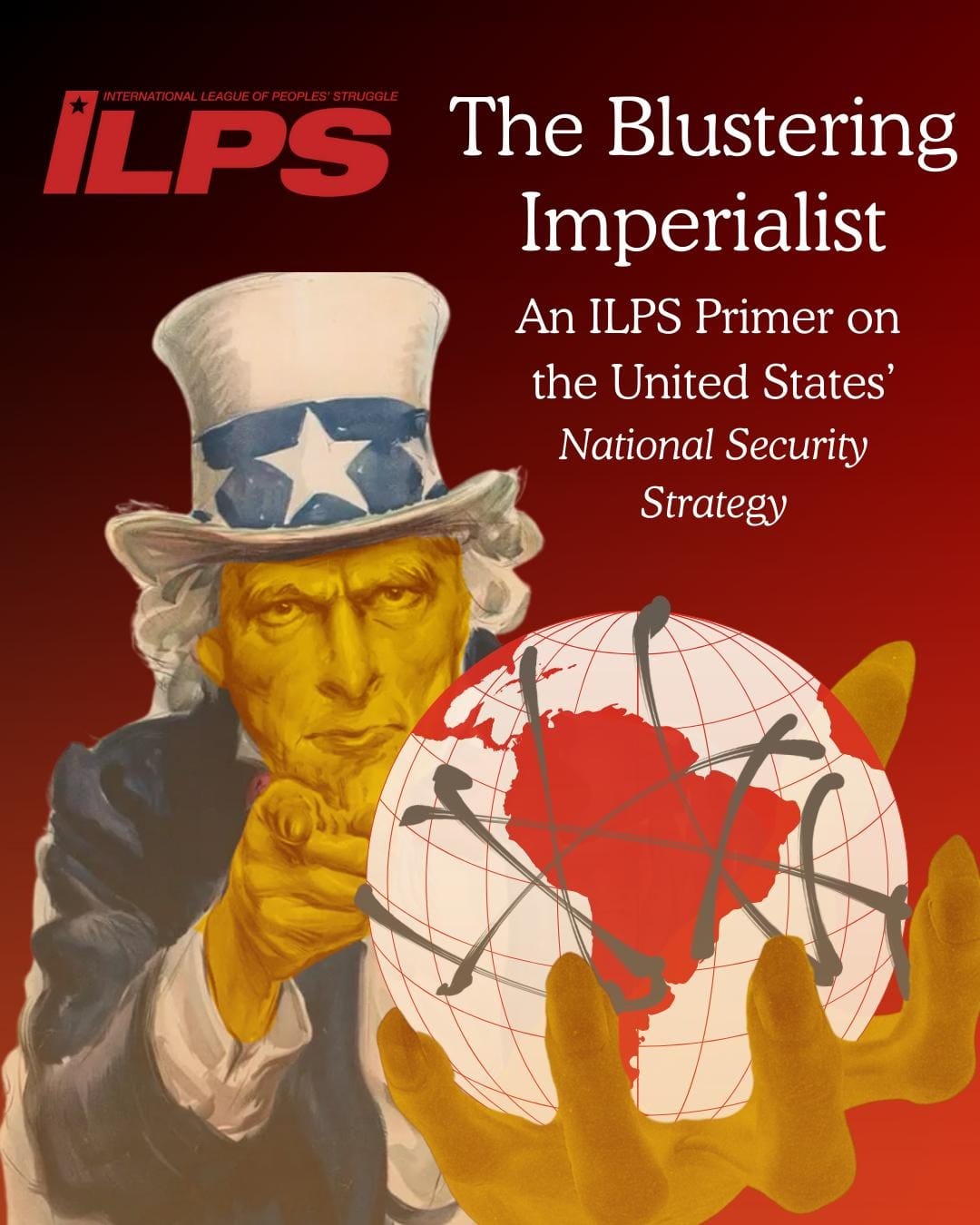

An ILPS Primer on the United States’ National Security Strategy
Download the primer for sharing and printing here.
Introduction
The United States government has come out with two strategic documents in the past few months, the National Security Strategy (NSS) and the 2026 National Defense Strategy (NDS). These documents are key in understanding the dilemma that US imperialism faces in the 21st Century. The name of the dilemma is China. In other words, the major contradiction in the imperialist system today is between the imperialist powers, which is well articulated in the NSS.
The US, even after its much-touted military might, has not been able to translate the gains of invasions and occupations to stabilize its economic power. The formation of the World Trade Organization (WTO) and the bid to create monopoly control over international trade to exploit labor, raw material and other resources of the colonies and semi-colonies has not yielded the super-profits it desires. The US has an approximate debt of $38.5 trillion, and in these last few years the interest rates have now exceeded military expenditures. The reality is that US imperialism is slipping off the top of the ladder, and has to bolster its control over the various regions to reap profits that allow its economic failings to be corrected.
For building popular support, the fascist state’s call is ‘Make America Great Again (MAGA);’ fascism builds its support on creating a narrative that would appeal to the common person, using slogans such as ‘pro-American workers’ and ‘America First.’ Of course, the failing economy is not blamed on the actors most responsible: the main players of monopoly capital, the financial and industrial corporate giants who in their thirst for seeking super-profits, wage continuous wars of aggression, create and foment conflict, terrorize, and exploit the masses, all while looting and plundering people’s resources, especially in the colonies and semi-colonies.
In the end, in order to maintain its global hegemony, the US, on one hand requires a whipping horse (or horses), and on the other (in order to scare off competition, namely China) the US state must parade itself as the goliath of the day. In the NSS, the whipping horses could be considered to be the so-called drug cartels, terrorist gangs, human trafficking and mass migration, and interestingly a domestic problem, cited as cultural subversion, a racist tactic to label minorities as inferior and target them as ‘enemies’. The goliath is of course ‘the world’s most powerful and capable military’ needed for frightening off its imperialist adversary, China, and all others who dare to question the free market doctrine and US imperialism. The NSS and NDS, using ‘America First’ as their base, provide a number of ‘prescriptions’ with the belief that the result will be the US as ‘the world’s strongest, richest, most powerful and most successful country for decades to come.’
Areas of Economic Interest
The NSS has made clear that for the US, economic supremacy is the primary goal of ‘America.’ And for attaining this goal, it has a two-pronged approach; one, what needs to be tackled abroad, and two, what needs be done inside the US itself.
The reiteration of the Monroe Document, the declaration by US President Monroe in 1823 declaring that the rising imperialist US was the only state with the right to shape the future of all other countries in the Western Hemisphere, and its addendum, the ‘Trump Corollary,’ is the clearest ultimatum that the US has given, not only to the Latin American and Caribbean region, but in essence to the entire global community, proclaiming itself as the hegemonic super power of the world.
The prime sectors in Latin America and the Caribbean (LAC) are declared to be of ‘vital national core interest;’ the US has made it abundantly clear that it will ensure free access to key strategic locations and at the same time, the region has to be ‘free of hostile foreign incursion or ownership of key assets, and that support critical supply chains.’ Of course, ‘free access’ is not free to all, least of all the people of the LAC region itself, but free for the US and whoever it deems should be allowed to plunder the peoples’ resources.
No doubt, ‘hostile foreign incursions’ is a reference to the presence of China in the LAC region (or the Western Hemisphere as referred to in the NSS), who is now not only a top trading partner for many of the countries in the region but has also invested heavily in mining and infrastructure projects. Further, of the 33 countries in the LAC region, 21 have signed agreements with Belt and Road Initiatives (BRI). US competition with Chinese imperialism in the ‘Western Hemisphere’ is the driving force behind the Monroe Doctrine and the Trump Corollary.
One way to curtail Chinese investment, trade and political influence in the region is through the creation of an enemy, namely drug cartels and ‘narco-terrorists.’ Use of derogatory terms to define territories and populations to be conquered and controlled is nothing new. It is an old time-tested strategy of not only the US but of all colonial powers, where labelling of countries and communities with particularly derogatory terms to create ‘devils’ that have to be obliterated, or ‘heathens’ to be brought into the fold of western context of so-called civilization, is a tool of domination.
The presence of so-called ‘narco-terrorists’ is being used to control and eliminate sovereign governments who are not willing to kneel to US supremacy and aim for national liberation, or reformist states who are tilted toward building political and economic relations with China and/or Russia. The kidnapping of the Venezuelan President Maduro and First Combatant Flores is a case in point. The NDS proudly claims that the Operation Absolute Resolve was in response to a neighbor not willing to defend and advance US interests – and therefore ‘America’s military stands ready to enforce the Trump Corollary to the Monroe Doctrine.’
The US Department of War’s NDS has categorically stated that it will:
“. . . provide the President with credible options to guarantee U.S. military and commercial access to key terrain from the Arctic to South America, especially Greenland, the Gulf of America, and the Panama Canal. We will ensure that the Monroe Doctrine is upheld in our time.”
It is interesting to note that while the US openly claims priority rights over the LAC region (or, one can say, considers it to be its colony), but in China’s own home ground, i.e. Asia Pacific, the NSS considers China a ‘foreign presence’ as well; the following are dictates presented by the NSS for Asia and the Pacific:
- Halting and reversing the ongoing damage that foreign actors inflict on the American economy which include state-subsidies and industrial strategies, unfair trading practices, intellectual property theft and industrial espionage;
- Maintaining secure and reliable supply chains;
- Ensuring Access to critical minerals and rare earth elements
- Keeping the ‘Indo-Pacific’ free and open, preserving freedom of navigation in all crucial sea lanes.
Much of the above demands are directed to China, and Chinese state-owned companies. China has a tremendous trade surplus. On one hand it provides subsidies to its state-owned corporations, and on the other hand it has used its surplus to provide loans to various countries for political and economic leverage.
In order to ‘make America great again,’ the faltering US state has made numerous demands (or one can consider them threats) on countries and regions globally. These demands include that countries must decrease their imports from China, and ‘help rebalance’ China’s economy by absorbing its surplus production in its own domestic markets. At the same time, the US has advised Europe and Asia to send their exports to other countries and step away from China. In the meantime, while threatening China and all other nations who trade with China, the US still engages with it but on ‘non-sensitive factors,’ which means not trading in minerals, critical supply chains, and not risking trade on products that could infringe on US intellectual property rights.
A ‘whipping horse’ has also been prepared for China as warnings have been issued on the ‘exports of fentanyl precursors that fuel America’s opioid epidemic.’ In addition, in spite of high tariffs levied on Chinese products, China is able to send products to the US through third countries, which then harm US industry while contributing to unemployment. These are all points of contention for the US and will continue to be addressed, but for the moment not through direct military might, instead through trade wars and even diplomacy.
The America First policy has monopoly capital as the fulcrum of economic activity. The role of the private sector as the main player has been made clearly; the US government will identify strategic investment and business opportunities for its corporations, globally, including through its embassies making foreign government contracts a priority. It has also been made clear that, for countries that are dependent on the US, there must be sole-source contracts for its corporations. So while critiquing Chinese state-owned corporations, the US fully intends to provide full coverage (economically and militarily) to its corporations, the true owners of monopoly capital. These strategies speak to the tactics used during the post-WTO era, the difference being that instead of building the multilateral trading system of which the US was the main aggressive proponent, it has now moved to a similar aggressive path while favoring bilateral relationships to strong-arm countries one-by-one.
The US believes that by carrying out these strong-arm tactics, it will be able to increase its $30 trillion economy to a $40 trillion economy to be able to maintain its ‘status as the world’s leading economy.’
In context to the second set of policies directed towards its ‘homeland,’ the priorities are pegged to maintaining a free market doctrine, the base for monopoly capital to thrive. The mantra is that national security is intertwined with economic prosperity. Therefore, the militarized state is nothing but monopoly capital itself. The major policy directives to maintain US imperialism include the following:
- Reindustrialization of the economy and control supply chains and production capacities.
- Economic freedom through tax cuts and deregulatory efforts – making the US the prime business place and for investment
- Unleashing of energy production capacity as a strategic priority
- Investment in emerging technologies and basic science (for prosperity, competitive advantage and military dominance)
Reindustrialization includes ‘re-shoring,’ that is bringing back industrial production to US soil. Corporations and investors are being provided with incentives such as tax cuts and deregulation so that the state does not try to minimize profit-seeking mechanisms, allowing monopoly capital a free hand. There is emphasis on not only production for consumption at home but also for exports.
In the previous decades, environmental protection policies such as the Clean Air Act had become a barrier to rampant abuse by industrial sector. Many industries had left the US to be able to avoid the regulatory indictments for carbon emissions and for seeking cheaper production sites. The Trump administration has made the development of the energy sector, which prioritizes fossil fuels, a key pillar of its national security strategy. The working class is being enticed with the promise of cheaper, abundant fuel that will not only bring down daily living costs, but also provide ‘well-paying’ jobs and help in the reindustrialization of America.
There is strong emphasis on industrial research and innovation and a tilt toward cutting edge technologies that include artificial intelligence (AI), quantum computing technologies, and biotechnology.
Of course financial monopoly is the highest form of imperialism, and the hegemony of the US dollar over financial and capital markets allows it to wield power globally. The NSS has not failed to emphasize the US superiority in financial and capital markets, and the directives are to maintain US ‘leadership’ in digital finance and innovation. In short, AI and advanced technologies are being emphasized to maintain and deepen US hegemony, globally.
However, the mighty imperialist power does seem to be trying to figure out how to claim control on the trillions of dollars that are held by Europe and various countries including Japan, South Korea as well as international financial institutions (meaning of course the IMF, World Bank and the Asian Development Bank) so to find the financial means to counter Chinese strategy of providing loans to be invested in various regions.
The US America First ideology speaks more to a new era of colonization, where countries have to either do the US’s bidding or run the risk of being invaded and occupied. The NSS also provides direction to regions on what parts of the globe could be designated as their sub-colonies. For instance, the NSS provides directives to the countries in West Asia, the so-called “Middle East”, to extend their economic interests in Africa and other parts of the world, where they could develop ‘friendly and open markets.’ However, Africa is not only a major playing ground for Chinese investment and corporations, it is also attracting investments from Arab states especially UAE and Saudi Arabia. Hence, on one hand the intent is to deter Chinese investments, and on the other for so called capital to work, not independently, but in coherence with MAGA policies.
Military Might
US imperialism is clear-eyed on what is needed to make the world do its bidding. The US Department of War (DoW), recently aptly renamed from the decades-old “Department of Defense,” has stated its readiness to be the ‘nation’s sword and its shield,’ or in other words, be the bully on the block. However, the different military approaches the US has taken with the LAC region and Asia and the Pacific are interesting.
Shamelessly positioning itself as the only imperialist force in the Western Hemisphere, it has already shown that it will do whatever it takes to control the region – but this show of force is based on gauging the military strength of its adversaries in the LAC region. The same can be said for Asia and the Pacific. The treading is much more cautious – and the slogan is peace through strength. The formula is that as long as ‘trade flows openly and fairly, we can all prosper’. Therefore, supposedly no kidnapping or use of force will be used outright, but threatening with words not only adversaries but also allies and partners.
The MAGA approach is to force allies and partners to increase their military spending. The US has made it amply clear that it will not alone take responsibility for security arrangements of its allies and partners; it has also coerced its NATO members to increase their defense spending, while the same strategy is presented for others through ‘arms sales, defense-industrial collaboration, [and] intelligence-sharing . . .’. According to the NSS, the ‘burden-sharing model’ offered by the US will provide help through economic incentives such as favorable treatment on commercial matters, technology sharing, and defense procurement.
This policy yields different benefits for the US. First, it’s not only a military strategy but also an economic policy, as it ensures mega profits for MAGA. The military industrial complex of the US (now being called the Defense Industrial Base {DIB}) will gain immense profit as countries are forced to buy their weapons from the US. These are the conditionalities that will be forced on ‘allies and partners.’ Second, the US is consolidating its satellites of countries and political blocs, and ensuring they also have needed defense capabilities when it finally comes to a global war. Lastly, the US’s aim is to maintain a military which remains the most powerful, globally. But there is also an absolute focus on building (or as the NSS states, reviving) the defense-industrial base. The manufacturing of arms and ammunition must meet the needs of defeating all forms of adversaries, big and small. Building an enviable defense industry is of course in line with the call for peace through strength.
The NSS has categorically stated the importance of the South China Sea to the US economy. According to the US DoW, ‘we will build, posture and sustain a strong denial along the First Island Chain;’ at the same time a status quo is to be maintained on Taiwan, which militarily has a critical importance as it provides direct access to the Second Island Chain. US imperialism is clear that for it to be able to maintain its status as the leading imperialist power, its military force must be assured. The NSS and NDS have laid out the America First military defense plan clearly, demanding the First Island Chain allies to provide ‘US military greater access to their ports and other facilities.’ The aim is to build such a strong military presence that it serves as a deterrent for any hostile activity ‘against US interests’ from its currently most hated enemy, China.
The US has specifically pointed out Iran and its allies in the Axis of Resistance as clear enemies, not only for the US but of course ‘Israel’. Even though it has been stated numerous times that the US is no more dependent on oil from West Asia, it still refers to the region where there are possibilities of it being an ‘incubator or exporter of terror,’ especially against US and ‘Israel,’ ominously stating that this threat has to be addressed ‘ideologically and militarily’. Of course, ideology refers to Islamic ideology, where ‘extremist Islam and fundamentalist Islam’ has been a whipping horse of long standing.
Except for ‘Israel’, it is hard to know who are friends of the US. However, Europe, India and other QUAD nations, as well the Persian Gulf states still are not opponents but are being shepherded towards America First policy through both carrots and sticks. These relationships are somewhat hinged on their willingness to cooperate with the US demands of ‘global partner of first choice’ which translates into purchasing from the US DIB, AI technologies, and binding their currencies to the US dollar.
Liberalism Out, Fascism In!
The NSS in many ways is a continuation of what US imperialism has always stood up for – controlling colonies and semi-colonies for accessing raw material and other resources, cheap labor, and markets. However, since the post-World War 2 era, US imperialism at least paid lip service to an international rule-based order, while touting liberalism. This has changed radically. The fascist nature of the US, with its America First and MAGA enunciation, is clear, with racism being more overtly reinforced.
The NSS openly mocks diplomacy by using terms such as ‘cloud-castle based abstractions like the rules-based international order.’ It has openly challenged international organizations that are lodged in liberalism, such as the UN as well as transnational bodies such as the European Union. Though it opposes ‘hectoring’ the Arab monarchies, it does seem to be doing just that to Europe, lecturing on its inability to come to terms with Russia. It is clear that the US wants to have a less acrimonious relationship with Russia, most probably in an effort to isolate China and weaken the economic and military bonds between its two most important adversaries; and hence is pushing Europe to reach a ‘strategic stability’ with Russia.
The colonial past of Europe is being referred to as its ‘former greatness.’ And migrations into Europe are termed as ‘civilizational erasure,’ which really means that the white supremacist culture is at risk. It is eerily sounding like the US is inciting Europe towards a neo-Nazi standpoint.
The fascist, racist nature of the NSS is also prominent when it discusses polices for the ‘homeland.’ Not only is Europe is being admonished for its migration policies but clearly the US has declared that the era of mass migrations is over. Of course migration and terrorism, drugs, espionage, and human trafficking are all being lumped into one single issue, and the country must be protected from ‘invasion.’
The Trump administration has been fomenting hatred against the LGBTQI+ identities and the NSS points out how the ‘radical gender ideologies and woke lunacy’ has been taken out of the US armed forces. The NSS points to ‘Rooting out DEI – Diversity, Equity and Inclusion, and other discriminatory and anti-competitive practices that degrade our institutions and hold us back.’ Here, ‘radical ideologies’ that promote equitable policies for minority and/or vulnerable groups are being warned off for raising progressive discourse or policies. It has also been made clear that ‘cultural subversion or any other threat to the nation’ will not be tolerated. These are clear threats against democratic, progressive positions which provide space and attention to cultural diversity. In short, white supremacy is the order of the day.
Similarly, tying reindustrialization to the development of the energy sector is based on rejecting any credibility to issues of climate change or Net Zero ideologies.
Conclusion
The NSS has made the task of mounting resistance against US imperialism much easier, especially in the colonies and semi-colonies who have for many decades, if not centuries, suffered first European and then American colonization. The shattering of liberal ideology of western nations, the clear intent for invasion and occupation especially by the US, has opened space for dialogue, discussion, political education, and mobilization against US imperialism.
It is the task of anti-imperialist, anti-fascist movements such as the international League of Peoples’ Struggle (ILPS) to engage in massive street level campaigns to build mass movements and national liberation struggles across sectors, countries, and regions to confront the US offensive and break a path to ultimate victory of the people for just and lasting peace.